
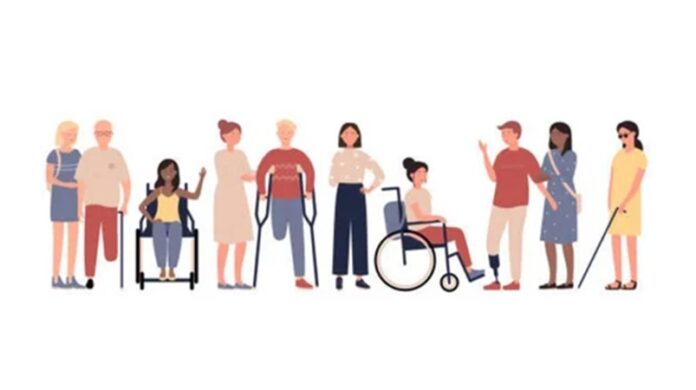
December 08, (THEWILL) — A few days ago, December 3, 2025 to be precise, the 2025 International Day of Persons With Disabilities was celebrated worldwide. Here in Nigeria, the Wife of the President and National Chairman of Renewed Hope Initiative (RHI), Senator Oluremi Tinubu doled out a total of N1.9bn as grants to Persons With Disabilities to mark the global event.
A total of 9,500 people living with disabilities across the 36 states and the Federal Capital Territory benefitted from the largesse under Senator Tinubu’s Renewed Hope Initiative.
In Ekiti State, for example, about 250 Persons With Disabilities (PWDs) were empowered with N50 million grant to boost their economic independence and improve their livelihoods. Each of the PWDs was presented N200,000 cash at the event which held at the Lady Jibowu Hall, Government House, Ado-Ekiti.

Speaking at the event, Senator Tinubu, represented by the Wife of Ekiti State Governor and RHI State Coordinator, Dr Olayemi Oyebanji, highlighted the importance of inclusion and equal opportunity, stressing that the initiative was part of a broader national vision to ensure that no one is left behind in the social and economic development of the country.
Senator Tinubu said the business recapitalisation grants of N200,000 given to 250 PWDs in each state and the Federal Capital Territory was intended to help strengthen their existing businesses, enhance their livelihoods and achieve greater self-reliance.
While giving the assurance that the economic empowerment programe would henceforth become part of the annual celebration of the International Day of Persons With Disabilities, she said, “Our nation grows stronger when every individual is empowered to contribute meaningfully. As Helen Keller, the renowned American disability rights advocate, once said, ‘Alone we can do so little; together we can do so much.’ These words remind us that a truly inclusive society is built when we stand together, creating opportunities that empower everyone to contribute their unique gifts to our collective progress.”
Beyond Senator Tinubu’s well-intended gesture and the Renewed Hope Initiative, we believe Nigeria needs a disability inclusion strategy with measurable targets in accessibility, education, employment, political participation and technology. But, first, there is a need to deal with a fundamental issue: The problem of discrimination against PWDs.
Discrimination against persons with disabilities in Nigeria is widespread, often manifesting as social stigma, physical barriers and exclusion from education, employment, and healthcare, despite the landmark Discrimination against Persons with Disabilities (Prohibition) Act 2018 which criminalises such acts and mandates accessibility, though implementation and enforcement remain significant challenges, with many states lagging in enacting or enforcing their own laws and PWDs facing daily obstacles like inaccessible transport, poor infrastructure and discriminatory attitudes rooted in cultural beliefs.
Existing forms of discrimination and barriers to inclusion of PWDs, particularly in this part of the world, include negative attitudes to PWDs, name-calling and misconceptions linking disabilities to curses or punishment, lack of ramps, lifts and accessible public transport, difficulty securing jobs, lack of promotion, harassment and inaccessible workplace, as well as poor access to inclusive services with government support often lacking.
It is important to note that children with disabilities are often at high risks of abuse, neglect and the lack of functional protection systems in their case further deepens vulnerability.
We observed that despite existing legislation, some of the challenges facing PWDs, such as inaccessible public buildings, transport systems, schools and health facilities, as well as limited employment opportunities, remain widespread and deeply concerning.
Nevertheless, discrimination or not, there is evidence that disability is not entirely insurmountable. No stigma or barrier poses a hindrance severe enough to stop a determined person with disability from achieving his goal in life. Take the case of the war-time President of the United States of America, Franklin Roosevelt, for example.
President Roosevelt had a disability. At the age of 35, he contracted polio, a viral cerebral disease that left him paralysed from the waist downward and confined on a wheelchair for the rest of his life. What this means is that throughout his tenure at the helm of a powerful country like the US, supervising its war effort and eventually guiding it to victory, he sat on a wheelchair. Only a man of cast -iron will and determination can achieve this.
This is not to say that Roosevelt did not encounter challenges in his time nor suffer discrimination from his countrymen, even as a president. The conditions were always the same as they are today. But he was made of a sterner stuff and could not allow his disability to stand in his way. Today he is proof that even persons with disabilities could make remarkable leaders.
On this note, we urge the Federal Government and other relevant stakeholders to seriously consider inclusion in governance for persons with disabilities. Indeed, as noted by Senator Oluremi Tinubu, a truly inclusive society is one in which the people are united and “creating opportunities that empower everyone to contribute their unique gifts” to the collective progress.
We call for stronger enforcement of the rights of persons with disabilities and the elimination of all barriers that continue to hinder their inclusion and full participation across the country. As a matter of urgency, the Federal Government should ensure that PWDs are not excluded from education, employment, healthcare, governance, infrastructure, and community life.

