
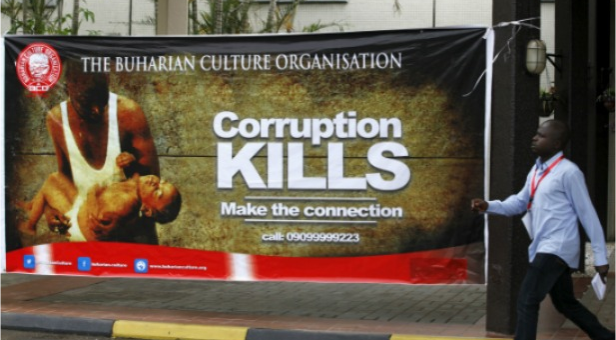
BEVERLY HILLS, January 22, (THEWILL) – The anti-corruption fight in Nigeria has assumed a groundswell, with each day unveiling fresh discoveries in the monumental looting of the nation’s treasury. Of particular reference is the trending $2.1 billion arms scandal, otherwise called the Dasukigate. So far, the battle, which started like smoke in a chimney, has become a raging inferno, consuming hitherto presumed untouchable persons in the society.
Tackling the hydra-headed corruption monster has become more critical now than ever before, against the backdrop of its huge tolls on the citizens. Minister of Information, Lai Mohammed, disclosed recently that a total of N1.34 trillion has been stolen by 55 people between 2006 and 2013. The amount, he explained, is more than a quarter of 2015 national budget, reinforcing the common saying that if corruption is not killed in Nigeria, most certainly, corruption would kill Nigeria.
Among suspects in the on-going arms scandal are former governors, ministers, public servants, businessmen and bank officials. Curiously, trivial reasons are adduced for the looting, such as claims that N4.5 billion was used for spiritual purpose. Looting of public treasury has become characteristic with public service and governance; while the people wallow in penury. This is very saddening.

THEWILL supports the on-going anti-corruption efforts of the Muhammadu Buhari administration and urge all Nigerians to join hands with the Federal Government to curtail this evil. If the fight must be successful, Nigerians in all walks of life should rise against this nuisance, and shun the celebration of corrupt leaders in both private and public service. This is topical because in every corruption case, it is the citizens that bear the brunt.
In a country where basic amenities are lacking, corruption is having unpalatable tales on the people. Out of every one naira stolen, the life of a Nigerian is shortchanged. Using the World Bank rates, one third of the alleged N1.34 trillion could have constructed 635.18 kilometres of roads, built 36 ultra-modern hospitals and 183 schools. They could also have been enough to provide education for 3,974 children from primary to tertiary level, as well as building 20,062 units of 2-bedroom houses.
The decay in infrastructure, which Nigerians and residents suffer today, are direct offshoots of decades of corruption in governance. For instance, most roads remain impassable despite the huge monies budgeted and expended annually for construction and maintenance. The same is true of the health, education, agriculture, power sectors, etc. Over the years, the multiplier effects of corruption has incapacitated and killed thousands of people.
According to the United States Center for Foreign Relations, Boko Haram alone killed 10,000 persons in 2014, including the over 2, 000 wasted from 2015 till date. This is outside the thousands that die every day due to ill-equipped hospitals and road accidents. Sharing monies meant to fight terrorism amongst politicians and their cronies considering the lack of adequate military hardware to prosecute the war is not only wicked but also disgraceful.
Corruption accounts for the thousands of Internally Displaced Persons (IDPs) scattered in camps across the north. Reports say the IDPs still suffer deprivations in camps, despite the monies meant for their welfare. This evil has created room for the easy recruitment of youths into terrorism and other social vices.
THEWILL calls on the judiciary to speed up on-going corruption trials, with a view to recovering all looted funds, including collaboration with foreign government and organisations to ensure repatriation of all monies laundered abroad. We decry the usual practice where corruption cases in courts run for decades, while the suspects enjoy their loots. Civil society groups and the media must collaborate to provide enabling environment for anti-corruption war, just as government should consider introducing anti-corruption teachings as part of schools curriculum.
The nation’s image has been battered before the international community, and our economic growth has been stifled. Corruption has also lowered the nation’s life expectancy and impacted negatively on livelihood of the citizens. As professed giant of Africa, this is unacceptable in the face of our vast human and material resources.
Nigerians must arise, unite and muster the will to crush corruption because we shall all remain casualties if we do nothing.

