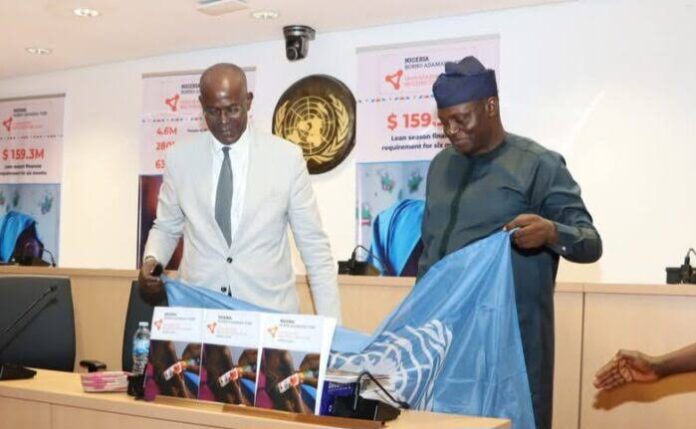
May 07, (THEWILL) – The Federal Government of Nigeria, in partnership with the United Nations, has launched a $159 million emergency response plan to combat rising food insecurity and malnutrition in Borno, Adamawa, and Yobe (BAY) states.
The 2025 Lean Season Response Plan was unveiled on Monday in Abuja by the Minister of Humanitarian Affairs and Poverty Reduction, Prof. Nentawe Goshwe Yilwatda, and the UN Resident and Humanitarian Coordinator in Nigeria, Mohamed Malick Fall.
The plan targets two million of the most vulnerable people across the BAY states over the next six months, providing urgent interventions in nutrition, food, health, water, sanitation, and other critical life-saving support.

According to the latest Government-led Cadre Harmonisé food security analysis released in March, an estimated 4.6 million people in the BAY states are projected to face acute food insecurity during the upcoming lean season beginning in June—marking the sixth consecutive year of severe food shortages in the region.
Worse still, nearly one million children are at risk of severe acute malnutrition (SAM) in 2025—double the number recorded in 2024. Of this figure, over 600,000 children face the threat of SAM within the next six months and may die without access to urgent nutrition services.
“This plan is not just about structures and strategies. It is a promise that no child in Borno, Adamawa, or Yobe should go to bed hungry when the world has enough food,” said Prof. Yilwatda at the launch.
He added, “No mother should lose a child to a preventable condition, and dignity must never be a casualty of conflict or poverty.”
He reiterated the Federal Government’s commitment to leading the response in line with national policies and strategies.
The humanitarian crisis in the BAY states—now in its 15th year—has been worsened by prolonged conflict, economic instability, climate shocks, and shrinking humanitarian funding. In 2025, deep cuts in donor support have further restricted access to health and nutrition services, with up to 70 per cent of healthcare and 50 per cent of nutrition services reportedly affected.
“Humanitarianism is under threat. Solidarity is in short supply. The lack of resources is putting millions—especially children—at grave risk,” said Fall, urging greater collaboration between government, private sector actors, and emerging donors.
The plan prioritises early action to prevent the worst outcomes of the lean season, particularly among children under five and pregnant or breastfeeding women. It also calls for sustained investment in locally driven responses aimed at long-term resilience.

Anthony Awunor, is a business correspondent who holds a Bachelor of Arts Degree in Linguistics (UNILAG). He is also an alumnus of the Nigerian College of Aviation Technology (NCAT), Zaria Kaduna State. He lives in Lagos.