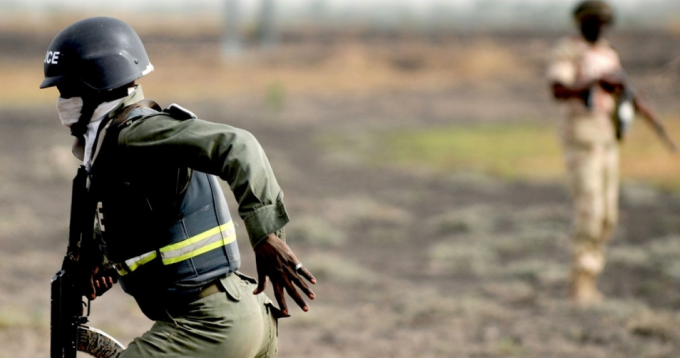
BEVERLY HILLS, April 15, (THEWILL) – The United States, U.S, has accused the Nigerian Armed Forces, Nigeria Police and the Department of State Services, DSS, of human rights abuses in their operations in different parts of Nigeria, even as it alleged that officials of the Nigeria Prisons Service, NPS, routinely extort money from inmates as fees for food, prison maintenance, and sometimes to secure their release from prison.
In a damming report on human rights abuses by security agencies in Nigeria tagged: ‘Country Reports on Human Rights Practices for 2015’ authored by the United States Department of States, Bureau of Democracy, Human Rights and Labour, Nigerian prison officials were also accused of raping female prisoners under their custody.
The report was contained in a document released on Thursday which focused essentially on human rights abuses by governments and agencies of governments across the world.

It claimed that only prisoners with money or support from their families had sufficient food as the officials routinely stole money provided for prisoners’ food, while poor inmates often relied on handouts from others to survive. Amidst that, it added that officials, police, and other security personnel often denied inmates food and medical treatment to punish them or extort money from them.
Revealing that the condition of prisons and detention centres across Nigeria were harsh and life threatening, the U.S report alleged that prisoners and detainees, mostly awaiting trial, were reportedly subjected to extrajudicial execution, torture, gross overcrowding, food and water shortages, inadequate medical treatment, deliberate and incidental exposure to heat and sun, and infrastructure deficiencies that led to wholly inadequate sanitary conditions that could result in death.
“Authorities sometimes held female and male prisoners together, especially in rural areas. Prisons had no facilities to care for pregnant women or nursing mothers. Infants born to inmate mothers usually remained with the mother until weaned. Prison authorities often held juvenile suspects with adults. The government often detained suspected militants outside the formal prison system. It also revealed that Nigeria operated some unofficial military prisons including the Giwa Barracks in Maiduguri, Borno State, the Sector Alpha (aka “Guantanamo”) and Presidential Lodge (aka “the Guardroom”) facilities in Damaturu, Yobe State, among others,” the report noted.
While acknowledging that the insurgency in the North-east has rendered many homeless, the U.S Bureau of Democracy, Human Rights and Labour blamed the terror Islamist sect, Boko Haram, for committing a pogrom in which more than 20,000 people have been killed and maimed with permanent injuries.
“The most serious human rights abuses included those committed by Boko Haram, which conducted numerous attacks on government and civilian targets that resulted in thousands of deaths and injuries, widespread destruction, the internal displacement of an estimated 1.8 million persons, and the external displacement of 220,000 Nigerian refugees to neighbouring countries,” it said.
The report pointed out that in response to Boko Haram’s violent attacks, and at times to crime and insecurity in general, “security services perpetrated extra-judicial killings, and engaged in torture, rape, arbitrary detention, mistreatment of detainees, and destruction of property”.
“The country also suffered from widespread societal unrest, including ethnic, regional, and religious violence. Other serious human rights problems included vigilante killings; prolonged pre-trial detention, often in facilities with poor conditions; denial of fair public trial; executive influence on the judiciary; infringement on citizens’ privacy rights; and restrictions on freedoms of speech, press, assembly, and movement.
“There were reports during the year of official corruption; violence against women and children, including female genital mutilation/cutting; infanticide; sexual exploitation of children; trafficking in persons; early and forced marriages; discrimination based on sexual orientation and gender identity; discrimination based on ethnicity, regional origin, religion, and disability; forced and bonded labour; and child labour,” the report added.
The report pointed out that impunity remained widespread at all levels of government, saying: “Although President Buhari’s administration began initial steps to curb corruption, authorities did not investigate or punish the majority of cases of police or military abuse.
“Boko Haram perpetrated numerous attacks, often directly targeting civilians. The group, which recruited and forcefully conscripted child soldiers, carried out bombings–including suicide bombings–and attacks on population centres in Adamawa, Bauchi, Borno, Gombe, Kano, Plateau, and Yobe States.
“In some cases, the group employed women and children as suicide bombers. The government investigated these attacks but prosecuted only a few members of Boko Haram.”
It said between November 2014 and February 2015, Boko Haram abducted more than 500 women and 1,000 children from one local government area in Borno State alone; subjecting many abducted women and girls to sexual and gender-based violence, including forced marriages and rape.
“Organised criminal forces in the southern and middle parts of the country committed abuses, such as kidnappings. Violence between farmers and herders in the North-central states claimed hundreds of lives,” it said.
As regards arbitrary and unlawful deprivation of life, the U.S accused the government and its agents of committing numerous arbitrary and unlawful killings, pointing out that the nation’s security “used lethal and excessive force to apprehend criminals and suspects as well as to disperse protesters”.
“Authorities generally did not hold police, military, or other security force personnel accountable for the use of excessive or deadly force or for the deaths of persons in custody. State and federal panels of inquiry investigating suspicious deaths did not make their findings public.
“Security forces’ use of excessive force, including live ammunition, to disperse demonstrators resulted in numerous killings,” it added.
The report gave the December 12 Army, Shiite clash as example, stating: “The army troops killed an undetermined number–possibly hundreds according to some credible reports–of members of the Islamic Movement of Nigeria, IMN, in Zaria, Kaduna State, following an altercation at a roadblock that disrupted the convoy of the Chief of Army Staff.”
It added that in May 2015, following the killing and mutilation of six soldiers by cattle rustlers, “army troops killed dozens of civilians and razed scores of houses in Wase District, Plateau State. Community leaders accused the military of storming several villages at night and firing indiscriminately”. “They also alleged government forces had previously killed more than 80 persons in similar attacks. While acknowledging it had carried out an operation against militants,” the report noted.
It stated that despite evidences, the military denied killing any civilians and promised to investigate, saying there were no reports of any investigations as of December 2015.
“Local NGOs, international human rights groups, and political and traditional leaders from affected states continued to accuse the security services of illegal detention, inhuman treatment of detainees, and torture.
“In May, Amnesty International (AI) released a report documenting mass arbitrary arrests, unlawful detention, and torture by security forces in the North-east. After the report’s release, President Buhari vowed to investigate.
“This report followed a 2014 AI report alleging the routine and systematic practice of torture and other mistreatment by security services. AI reported that police sections in various states, including the Special Anti-robbery Squad and the Criminal Investigation Division, had ‘torture chambers’, special rooms where suspects were tortured while being interrogated.
“The military and police reportedly used a wide range of torture methods, including beatings, shootings, nail and tooth extractions, rape, and other forms of sexual violence,” the US report added.
The report accused the police of “commonly using a technique called ‘parading’ of arrestees. Parading involved walking arrestees through public spaces and subjecting them to public ridicule and abuse”.