
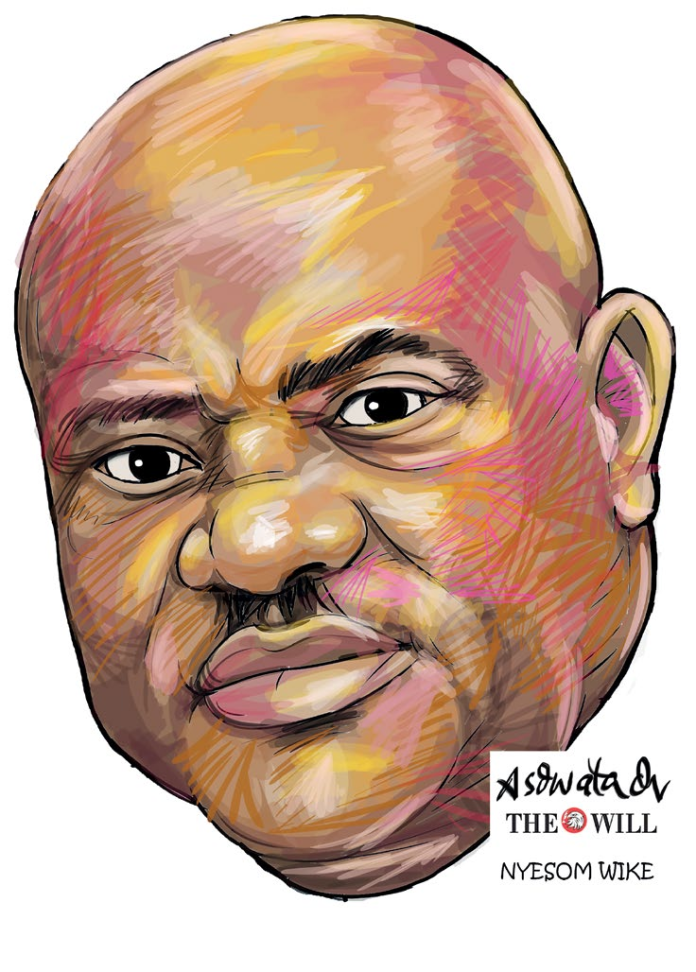
The time has come, perhaps, to put development and politics side by side – and appropriately so – appraise them as critical and vital in the evolution of a nation.
In the last one week, the prospect of former Governor Nyesom Wike being nominated as a minister to serve in President Bola Tinubu’s government has been most dominant among the issues trending in national discourse.
Most of the commentaries and analyses – excluding debates curiously – have been more concerned about Wike’s moral unction, making himself available and accepting to serve in an APC-led government with all the records of his venom and vituperations against the body chemistry of the All Progressives Congress Party which he uniquely and popularly dismissed as a ‘patient of lethal and terminal cancer’ and, on the other hand, as a dogged member of the opposition Peoples Democratic Party, PDP, the same party literally holding him responsible as being part of the metastasis of its woes in the February 2023 presidential poll.

The dominant digest of the talks and analyses is that Wike has not only betrayed his much cherished PDP but also veritably cracked its chassis and rocked its template and the entire boat put together,by accepting the offer and nomination by President Tinubu.
Those who favour the foregoing are also of the conclusion that there is no greater and more grandiloquent evidence of anti-party conduct and disposition than his nomination, which they discern as the ‘dividend’ and payback for Wike’s support to Tinubu , which may have caused the PDP to lose River State to the APC in the presidential election.
With Wike’s appearance and eventual screening by the Senate last Monday where and when he was honoured with a chorused approval symbolic in taking a bow, his critics (or adversaries?) have concluded that the die is cast and their fears are more than confirmed that he has jumped ship and gone beyond the threshold into the bosom of the APC.
This group, without tarrying or hesitating to recall that all the former Rivers governor has not as much as made an insinuation of joining the APC as the aftermath of President Tinubu’s ‘gratitude’ and ‘faithfulness’, feel, quite tempestuously and erroneously, that the leadership of the PDP itself is tardy, sluggish and delaying in slamming some sanctions on their ‘spoiler and showman’. The truth is that Wike has neither erred nor abandoned the party.
Nigerians and other global watchers of Nigeria’s politics sympathetic to the Nyesom Wike circumstance feel he is being unduly persecuted, misunderstood and maligned. This divide argue that, for one, as a bona fide Nigerian, he has a duty to respond to the call to serve the country.
Secondly, pedigree and trajectory in public service, they argue, are more the reason why the Bola Tinubu Administration has reached out to Wike to help it deliver on its electoral promises and dividends of democracy.
Citing a special recognition and honour bestowed on the former governor by the immediate past APC administration of Muhammadu Buhari as ‘Best Infrastructure Development Governor’ of that era, which was well received by the entire PDP elite and followership, pro-Wike commentators argue that this recognition and call by the Bola Tinubu Administration is simply leveraging that record, noting that it should thus not be misconstrued by the same PDP or some political analysts unwittingly on a course to hold back the wheel of progress of the national political economy.
It is verifiable, this group contends further, that as Governor of Rivers State, Wike did not only transform the state’s socio-economic appeal, he renewed the its infrastructural outlay and positioned it as a contemporary and competing investment and industrial destination, thereby bringing to the state uncommon development that has freed the entire space there from colonial, outlived relics that characterised its urban outlook.
This, rather than political undertones and overtones, surmises that the Bola Tinubu Administration has simply invited Wike to the national platform to add and boost its value as a distinguished public servant, development exemplar and a servant faithful to his electoral promises.
All the same, not even Nigeria’s political history is devoid of inter-party collaboration, cooperation and fraternisation.
A quick excursion to down memory lane will provide sufficient and instructive ebvidence in the circumstances. To fetch from the development and progressive politics of the First Republic, Nigeria will appear like a long road to a home so near.
Nevertheless, inter-party executive fraternity and collaboration has its amiable and enviable history and place in the history of progressive politics in Nigeria. In 1979, late former President Alhaji Aliyu Shehu Shagari, of the defunct National Party of Nigeria, NPN, reached out to the defunct Nigeria Peoples Party, NPP, led by the late political sage, Dr. Nnamdi Azikiwe, and one of its members, Paul Unongo emerged as Shagari’s Minister for Power Steel Development.
Former President Olusegun Obasanjo, following the restoration and return of democracy as a political culture and paradigm of economic administration in Nigeria in 1999, eschewed the politics of winner-takes-all after he was inaugurated as Executive President on May 29, 1999.
Although the PDP formed the central government and most of the states of the federation and the National Assembly, Obasanjo demonstrated dynamism and magnanimity, in line with the universal understanding and trend of progressive and developmental politics, by reaching out to invite a member of the opposition alliance of All Peoples Party, APP and the Alliance for Democracy, AD, then, to be part of his cabinet. The late Bola Ige emerged. He was validly nominated, screened and eventually sworn in as a Minister of Power and Steel of the Federal Republic in a PDP-controlled Government.
The same spirit of sportsmanship and political camaraderie was continued and sustained by late President Umaru Musa Yar’Adua in 2007 and Ibrahim Dasuki Nakande, of the All Nigeria Peoples Party, ANPP, remains a living beneficiary and witness to this inter-party executive fraternization.
To a large extent thus, the analyses and commentaries on the nomination and eventual screening of Wike is at best a good feature for democratic evolution, but certainly mistaken and misbegotten to the extent that what is continuing is inter-party collaboration, not personal development or aggrandisement or betrayal of one’s Party. Let Nyesom Wike be, as Nigeria’s democracy and political process continue to relish and relive cherished values. National development, unity and security should go ahead of party, partisanship and political differences.

