
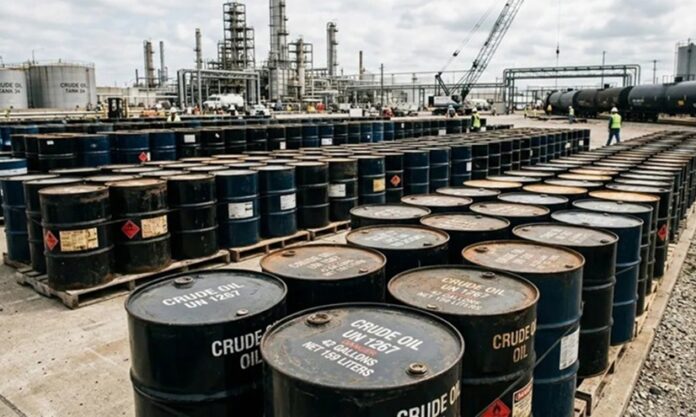
March 09, (THEWILL) — Nigerians are to embrace a fresh spate of cost-of-living crisis as crude oil soared past $110 per barrel in the international market on Sunday, March 8, 2026, amid ongoing war in the Persian Gulf. The U.S. and Israel launched joint, major military strikes against Iran on February 28, 2026, targeting missile infrastructure, military sites, and leadership.
The ensuing conflict triggered a surge in crude oil prices occasioned by spreading geopolitical tension in the Middle East – the world’s bastion of crude oil supply, as many countries and producers suspended production and shipment of the commodity.
Brent, the benchmark of Nigeria’s crude, jumped sharply on Monday, after the preceding Saturday’s attack on Iran by the combined forces of the US and Israel. Brent crude for April delivery rose as much as 8.7 percent to $79.28 per barrel by 6 p.m. Nigerian time, while Textile Intermediate climbed 7.8 percent to $72.16 per barrel.

Prices which had hovered around $80 per barrel surged above $100 per barrel on Sunday, after major Middle East producers cut output because the critical Strait of Hormuz remains closed due to the Iran war. (The Strait of Hormuz is a strait between the Persian Gulf and the Gulf of Oman which provides the only sea passage from the Persian Gulf to the open ocean and is one of the world’s most strategically important choke points.)
Reacting to the over-$100-per-barrel surge at the open of trading Sunday evening, President Donald Trump posted on Truth Social that a gain in “short term oil prices” was a “very small price to pay” for destroying Iran’s nuclear threat.
“Only fools would think differently!” Trump added.
Following the development in the region, the fifth-biggest producer in OPEC, Kuwait, announced precautionary cuts on Saturday to its oil production and refinery output citing “Iranian threats against safe passage of ships through the Strait of Hormuz.” On the part of Iraq, the second-biggest OPEC producer, output has effectively collapsed according to trading reports seen by THEWILL.
The United Arab Emirates, the third-biggest producer in OPEC, said on Saturday that it is “carefully managing offshore production levels to address storage requirements.” Effects of the Middle East crisis is beginning to cascade through Nigeria’s domestic economy, raising concerns that it would upset the “cooling effects” of the macroeconomic measures adopted to hedge the local currency, rein in inflation and maintain the surge in foreign reserves as cost of transport and energy escalate.
In the space of about 48 hours as of last week Tuesday, March 3, petrol prices at the filling stations jumped about 13 percent as Africa’s largest refinery, Dangote Refinery & Petrochemical Limited, rushed to reprice the product in response to crude oil’s sharpest rise in years.
The action was swift and decisive. Dangote Refinery suspended loading at midnight of March 2 after international crude prices surged past $80 per barrel overnight.
By Tuesday morning, it had raised its ex-depot price of petrol to N874 per litre from N774 per liter prior, a N110 increase as the company sources cited “changes in global crude fundamentals and replacement costs”.
The price adjustment by Dangote, the cornerstone of Nigeria’s downstream energy market cascaded downwards almost immediately as most petrol stations suspended sales, only to resume after they had effected upward adjustment of their pumps prices.
Market checks across major cities showed petrol selling for about N1,040 per litre in Lagos and around N1,080 per litre in Abuja for the most of last week, following fresh adjustments by marketers after the latest price increase by the Dangote Petroleum Refinery.
Checks revealed that Dangote Refinery had separately raised its ex-depo price of Automated Gas Oil (AGO), popularly called Diesel, by N170, from N880 to N1,050 per litre. This will trigger a rise in inflation and, by extension, lead to a fresh cost-of-living crisis as businesses that rely on diesel for their operations would experience additional costs which would be passed to the final consumers.
There are palpable fears that this could rekindle the inflation fury which had cooled down to 15.10 percent in January, 2026, the lowest level since 2024. Manufacturing companies, hospitals, cold store operators, transporters are major casualties of the surge in diesel price and would lead to trimmed expansion, lower profitability and increase in cost of products and services.
“With deregulated pricing, higher international crude cost translates directly into rising petrol, diesel and aviation fuel prices,” said Muda Yusuf, chief executive officer, Centre for the Promotion of Private Enterprise (CPPE). “This feeds into transportation, food distribution and manufacturing costs, intensifying inflationary pressures.”
In a policy brief released by CPPE on March 1, 2026, the Centre described the Middle East crisis as a “double-edge shock”, warning that the structural mechanics of the Nigerian economy leaves households with virtually no buffer.
“No one starts a business to reap losses. There must be adequate response to the impending energy crisis across the sectors. Transport fare will increase, cost of goods and services will increase, and the people will have no option but to cope with it,” said William Edoki, a Lagos-based transporter.
Findings showed that transportation and food account for a dominant share of the consumer price basket. When petrol and diesel prices move, almost every other thing moves – from the cost of running a generator to power basic business activities, to the cost of transporting food items from the North to the Southern cities.
For millions of Nigerian households already grappling with record inflation, the new petrol price threatens to further erode purchasing power. Transportation costs, which constitute a major driver of food inflation, are expected to rise sharply as commercial transport operators adjust fares to reflect higher fuel costs.
Economists warn that a sustained petrol price above N1,000 per litre could trigger a fresh round of price increases across food, manufacturing, logistics and retail sectors.
For low-income households, the impact could be particularly severe. Rising transport fares, electricity tariffs and food prices are already squeezing disposable incomes, raising fears that more Nigerians may slip into extreme poverty.
Businesses are also bracing for higher operational expenses as petrol remains a critical energy source for generators powering offices, factories and small enterprises.
Manufacturers and logistics operators say the rising cost of energy and transportation could force companies to either raise product prices or cut production a development that could further weaken consumer demand and economic growth.
Small businesses, especially in retail and hospitality, are expected to bear the brunt of the surge as they struggle to absorb higher energy costs.
The petrol price shock also complicates Nigeria’s fiscal outlook. While higher crude oil prices could boost government revenue, the inflationary impact may offset the gains by increasing pressure for wage adjustments, social interventions and fiscal spending.
The timing of the petrol surge may also carry political implications ahead of the 2027 general elections. Fuel prices have historically been a politically sensitive issue in Nigeria, often shaping public perception of economic management and governance.
Notice: Function wpdb::prepare was called incorrectly. Unsupported value type (object). Please see Debugging in WordPress for more information. (This message was added in version 4.8.2.) in /home/thewilln/public_html/staging.thewillnews.com/wp-includes/functions.php on line 6170
Notice: Function wpdb::prepare was called incorrectly. Unsupported value type (object). Please see Debugging in WordPress for more information. (This message was added in version 4.8.2.) in /home/thewilln/public_html/staging.thewillnews.com/wp-includes/functions.php on line 6170
Warning: Undefined variable $show_related in /home/thewilln/public_html/staging.thewillnews.com/wp-content/plugins/molongui-authorship/views/author-box/parts/html-tabs.php on line 30

Sam Diala is a Bloomberg Certified Financial Journalist with over a decade of experience in reporting Business and Economy. He is Business Editor at THEWILL Newspaper, and believes that work, not wishes, creates wealth.

Ogochukwu Onwaeze is a writer specializing in business and economic journalism. At THEWILL News Media, she translates market trends, financial developments, and policy shifts into clear and engaging stories.
