Sixteen (16) first-term governors will be confronted with a total debt of N2.9 trillion, bequeathed to them by their predecessors, as they assume office on May 29, 2023.
The amount comprises total domestic debt of N2.2 trillion and $1.6 billion external debt as of December 31, 2022, according to data by the Debt Management Office (DMO).
The external portion was converted to naira using an exchange rate of N465/US$1 to arrive at N753 billion.

With the exception of the South-West, all the geo-political zones were represented in the humongous debt accumulation by the states where first-term governors are assuming office under a new political dispensation.
Three states in the South-East where new governors are coming on board include Abia with a domestic debt of N103.8 billion and external debt of $94.3 million. The new governor is Alex Otti of the Labour Party.
Ebonyi, where Nwifuru Francis Ogbonnau of the All Progressives Congress (APC) will assume office on May 29, has a total domestic debt of N76.5 billion and external debt of $58.6 million.
Its sister state, Enugu, where Peter Mba of the Peoples Democratic Party (PDP) will become the new occupant of Government House, is saddled with a domestic debt of N91.9 billion and $120.9 million foreign debt.
The South-South has four states in the league – Akwa Ibom, Cross River, Delta and Rivers.
Akwa Ibom, with Eno Umo Bassey of the PDP as the new governor, has a domestic debt of N219.3 billion and $44.9 million external debt; while Cross River has $209.6 million external debt – the second highest among the 16 states, and N197.3 billion domestic debt. Its new governor is Otu Bassey Edet of the APC.
Delta, where Oborevwori Orohwedor of the PDP is succeeding Ifeanyi Okowa as governor, has accumulated domestic debt of N304.3 billion – the highest among the 16 affected states and an external debt of $59.9 million.
Data by the DMO showed that the incoming Rivers governor, Siminalayi Fubara (PDP), will be confronted with a domestic debt of N225.6 billion and the external component of $87.2 million to battle with as he assumes office on May 29.
Three North-West states in the league of first-term governors include Jigawa which has a domestic debt of N44 billion and external debt of $27 million, with Namadi Umar Alhaji of the APC, as its new governor, while Katsina is carrying a domestic debt of N62.4 billion and $573.8 million external debt – the highest among the 16 states. The new governor is Umaru Dikko Radda of the APC.
Kano new governor, Yusuf Abba Kabir also of the APC will be confronted with N122.4 billion and $100 million domestic and external debts respectively as he assumes office on May 29.
In North-Central zone, the new governor of Niger state, Mohammed Umaru Bago of APC will be inheriting a domestic debt of N95.6 billion and external debt of $69.3 million, while Mutfwang Caleb Manasseh of the PDP will take over the reins of power in Plateau where he will be welcomed with N149 billion and $32.4 million domestic and external debts respectively.
Alia Hyacinth Iormem, who will be succeeding Samuel Ortom in Benue, will battle with N141.3 billion domestic debt and $30 million external debt.
The new governor of the North-East state of Taraba, Kefas Agbu of the PDP, has N88 billion domestic debt and $46.5 million external debt to battle with on assumption of office.
The others are Sokoto and Zamfara in the North-West. Aliyu Ahmed Sokoto of APC will be confronted with a domestic debt of N90.6 billion and $$36.6 million external debt in Sokoto, while his Zamfara counterpart, Dauda Lawal of the PDP, will embrace N112.2 billion domestic and $28.9 million external debts.
The new governors will join their old counterparts to battle with the slide in economic fortune as the country’s GDP declined to 2.3 percent in the first quarter of 2013.
The bane of Nigeria’s economy is largely low productivity. The economy lacks adequate production base characterised by negative investment and export, which makes the country hugely import dependent, with Nigeria wearing the toga of the world’s headquarter of poverty.
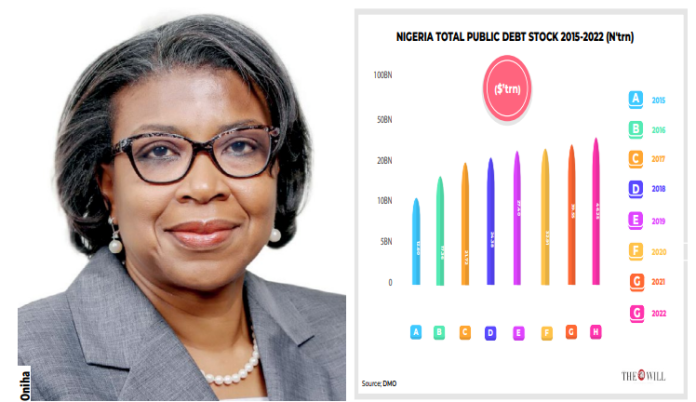
The DMO disclosed in March 2023 that Nigeria’s debt profile as of December 31, 2022 was N46.25 trillion or $103.1 billion. The amount comprises the debt of the Federal Government of Nigeria (FGN) and the sub-national governments.
“Total Public Debt Stock consisting of the Domestic and External Debt Stocks of the Federal Government of Nigeria (FGN) and the sub- national governments (the 36 State Governments and the Federal Capital Territory) was N46.25 trillion or $103.1 billion. The comparative figure for December 31, 2021, is N39.5 trillion or $95.77 billion.
“In terms of composition, Total Domestic Debt Stock was N27.55 trillion ($61.42 billion) while total external debt stock was N18.7 trillion ($41.6 billion),” the DMO said in a statement on March 31, 2023.”
It further stated that the reasons for the increase in the total public debt stock were new borrowings by the Federal Government and sub-national governments, primarily, to fund budget deficits and execute projects. With a weak economic base, servicing the debts becomes burdensome to the governments which have to sacrifice critical infrastructure to service loans.
The World Bank disclosed last April that Nigeria spent 96.3 percent of its 2022 revenue on servicing its debts.
The bank further stated that Nigeria’s fiscal position deteriorated in 2022, leaving the cost of the petrol subsidy to increase from 0.7 percent to 2.3 percent of GDP.
This is affecting the finance of the states which largely depend on the proceeds from the Federal Accounts Allocation Committee (FAAC) to pay salaries amid meagre internally generated revenue (IGR) to survive.
With inflation rate at 22.2 percent as of April 2023, driven largely by high cost of food, and GDP slowing down to 3.1 percent in the first quarter of 2023, as published by NBS, the economy of the states is not likely to wear a healthy outlook.
The states must restructure their public finance ecosystem to eliminate waste, ensure prudent management of resources, create an enabling environment for the private sector to thrive and generate employment, boost tax revenue and curb insecurity.
Sam Diala is a Bloomberg Certified Financial Journalist with over a decade of experience in reporting Business and Economy. He is Business Editor at THEWILL Newspaper, and believes that work, not wishes, creates wealth.