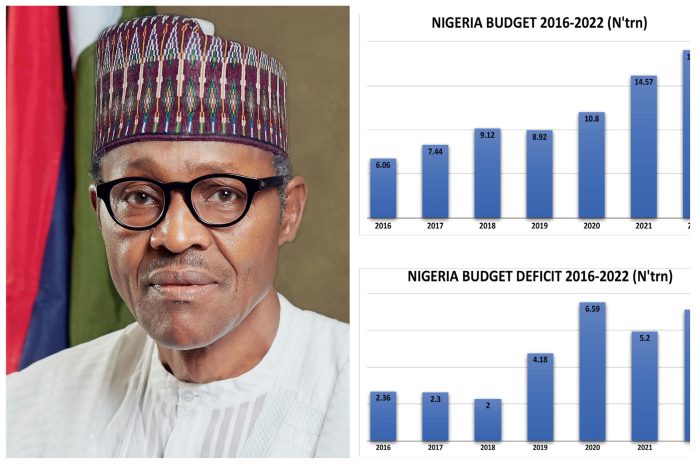
January 09, (THEWILL) – President Muhammadu Buhari on December 31, 2021 signed into law the 2022 budget of N17.12 trillion passed by the National Assembly. The lawmakers had jerked up the budget by N731 billion from the N16.39 trillion originally presented by the executive. The budget is not only huge but the largest in Nigeria’s history. It is also 182.5 percent over the 2016 budget of N6.06 trillion – the first under the Buhari-led administration, and 17.58 percent over the 2021 figure of N14.5 trillion.
Christened ‘Budget of Economic Growth and Sustainability’, it is doubtful if the budget will tread that path. The reasons are obvious. First, Nigeria’s budgets play a little role in stimulating the economy as they are rarely private sector-oriented. The agencies that play critical roles in boosting the economy have little linkage with the private sector. Thus, small and medium enterprises (SME), the engine of the economy, are rarely impacted by the budget.
Secondly, the budgets place priority on personnel cost, which constitutes the bulk of the recurrent expenditure – the largest part of the budget. For 2022, non-debt recurrent expenditure of N6.83 trillion is the largest expense item, with 60 percent relating to personnel costs at N4.11 trillion. This is 18.50 percent higher than the non-debt recurrent expenditure of N5.76 trillion in 2021.

This implies that a small fraction of the population consumes 60 percent of the nation’s budget, thereby elevating inefficiency, waste and corruption to national priority. Data from the Budget Office shows that non-debt recurrent expenditure, incorporating personnel cost, is usually executed 100 percent as against capital and other expense items. This is tied to Nigeria having one of the world’s highest costs of governance.
Thirdly, corruption, mismanagement and abuse of process reign supreme in our government business. While the federal lawmakers were considering the 2022 budget, the Auditor-General of the Federation (AuGF), Adolphus Aghughu, was issuing queries to various organs of the government over irregularities in public financial management.
The Office of the AuGF last December issued queries to the management of the National Assembly and the National Assembly Service Commission for carrying out unexplained expenditures totalling N9.424 billion in the 2019 financial year.
The AuGF’s office also queried the Federal Ministry of Agriculture for spending a total sum of N3.809bn on the suspended Rural Grazing Area scheme without a presidential approval or National Assembly appropriation.
“The squandering of public funds appropriated in the budget is one reason the economy is in a bad shape. When you are not investing but consuming the little resources at your disposal, you cannot achieve growth or sustainability,” said Dr Leonard Ikeagwu, an economist.
A London-based lawyer and political economist, Dr Olu Fasan, said it would be futile to expect any meaningful development in 2022 as the years of lost opportunity were gone. “First of all, it is futile to expect any significant improvements from President Buhari’s administration this year. This is the president’s final full year in office and it is also the pre-election year. The truth is politicking will trump everything else, including the economy.”
“Think about it. Foreign investors will not suddenly rush to Nigeria this year. Nigeria’s abysmally low non-oil exports will not suddenly grow this year. And local industry, particularly the manufacturing sector, which has, for years, been plummeted by bad policies, such as distortions in the forex market, will not miraculously be transformed this year,” he said.
Nigeria is immersed in debt of a frightening dimension. Our debt stock, which was about N12 trillion in 2015 is now about N32 trillion, with over 70 percent of revenue spent on debt servicing.
“You can see the contradiction in the government’s claim that Nigeria’s challenge is not debt but revenue. You are not producing. You are not exporting. You are borrowing massively and paying heaving to service your debts. Yet, you are not frugal. This is why the economy is on life support with a huge budget deficit every year,” said Ikeagwu in a telephone chat with THEWILL.
The 2022 budget has a deficit of about N6.26 trillion, approximately 3.39 percent of the Gross Domestic Product (GDP). This is slightly above the three percent ceiling set by the Fiscal responsibility Act 2007 (FRA). The President alluded that the expenditure level was necessary to assist with overcoming current security challenges and accelerate post-recession growth, insisting that Nigeria only has a revenue challenge and not a debt sustainability problem.
Interestingly, the Federal Government has realised the need to adopt the private-partnership model in infrastructure development which it has failed to embrace over the years. “In 2022, the Government will further strengthen the frameworks for concessions and public private partnerships (PPPs). Capital projects that are good candidates for PPP by their nature will be developed for private sector participation”, Buhari said in his budget speech.
In line with the government plan to accompany annual budgets with Finance Bills, partly to support the realisation of fiscal projections, current tax and fiscal laws are being reviewed to produce a draft Finance Bill 2022. The implication is that Nigerians should be prepared to pay more tax.
“Now, the government’s plans to increase taxes, tariffs and levies are as the result of low revenue intake. All over the world, tax increases are a product of economic growth. When the economy is growing and jobs are being created, governments generate more revenue through corporation and income taxes. But when the economy has collapsed and millions of people are jobless or are in low-paid jobs, tax revenues will naturally fall.
“Trying to increase taxes in those circumstances would make businesses uncompetitive, resulting in higher unemployment. Furthermore, such tax hikes would penalise households by depleting their disposable incomes, a situation that becomes even worse when the cost of living is too high because of rising inflation.
“So, the planned tax increases are a product of the Buhari administration’s failure to grow the economy and broaden the tax base. It is better to broaden a country’s tax base and spread taxes thinly across many payers than to have a narrow tax base and put unbearable tax burdens on a relatively small number of businesses and citizens. All over the world, low taxes are associated with economic growth and better living standards,” Fasan, a Visiting Fellow at the London School of Economics told THEWILL in a note.
Data from various reports showed that investment inflow has sharply dwindled since the beginning of 2021. The first wailing voice was raised by the Nigerian Investment Promotion Commission (NIPC). The agency in a report published in July 2021, revealed that investment announcements in Nigeria declined by a whopping 80 percent in the second quarter. According to NIPC, investment inflow fell to $1.69 billion in the second quarter from $8.41bn in the first quarter.
In another report, the National Bureau of Statistics (NBS) said that investment into Nigeria slumped to the lowest level in four years as of the first six months of 2021. The statistics bureau in its report entitled ‘Nigerian Capital Importation (Q1 & Q2 2021)’ released in July 2021, showed that the total amount of foreign investment in the nation’s economy was $2.78 billion in the review period. This was against $7.15 billion recorded in the corresponding period (second half) of 2020, a shortfall of 62 percent.
While the first quarter of 2021 recorded total investment inflow of $1.905 billion, the figure dropped to mere $875 million in the second quarter representing a decrease of 54.06 percent when compared with the first quarter of 2021. It also represents 32.38 percent decrease as against the second quarter of 2020 when $1.29 billion investment came to the economy.
It will be difficult for the budget to deliver on target without two critical actions: revenue diversification and engagement of the private sector in infrastructure development; these should be considered as a priority.
According to Fasan, “The way forward is to reduce the cost of governance significantly, by about 50 per cent. To do this, the government must merge the Ministries, Departments and Agencies (MDAs). It must reduce the cost of running the Presidency. The cost of running the two arms of the National Assembly must also be reduced drastically. State governments should also streamline their bureaucracies!
“For me, if President Buhari really wants to leave a legacy in the remaining one-and-a-half years that he has left in office, he must focus on just two things: security and restructuring. Even if he cannot achieve full restructuring before he leaves office, he must lay solid foundations that his successor would find difficult to reverse. This includes significantly reducing the size of the Federal Government.
“Let’s face it, 2022 will be challenging because politics and politicking will dominate everything else.”
Sam Diala is a Bloomberg Certified Financial Journalist with over a decade of experience in reporting Business and Economy. He is Business Editor at THEWILL Newspaper, and believes that work, not wishes, creates wealth.