
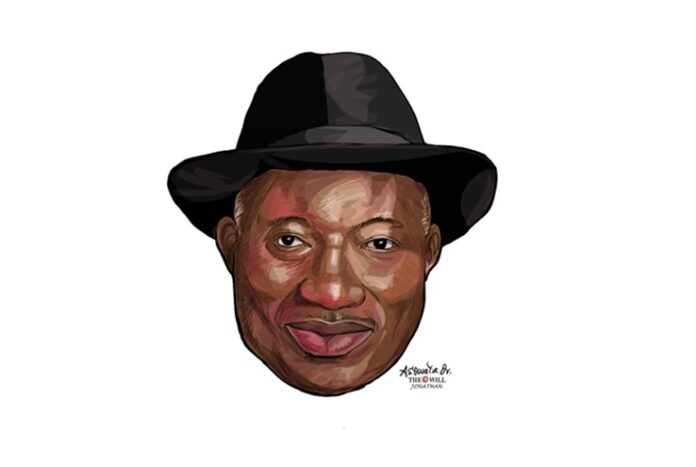
May 10, (THEWILL) — Tomorrow, Monday, May 10, 2023, the legal tussle over the eligibility of ex-President Goodluck Jonathan for the 2027 general election may be laid to rest. A Federal High Court in Abuja had on Friday adjourned the suit seeking to disqualify him from contesting the 2027 presidential election.
The adjournment by Justice Peter Lifu followed an application by the plaintiff’s counsel, Ndubuisi Ukpai, that he needed time to respond to a preliminary objection filed by the defence. The suit wants the court to determine whether Jonathan can lawfully present himself for another presidential contest under the 1999 Constitution.
According to an amendment, generally referred to as ‘two-term limit,’ which was signed into law by President Muhammadu Buhari in 2018, a person shall not be qualified for election to the office of President or Governor if they have been elected to such office at any two previous elections. A person who was sworn in as President or Governor to complete the term for which another person was elected, and later wins an election, is restricted to only one more elected term.

According to Sections 137(3) and 182(3) of the Constitution, (introduced by the Fourth Alteration No. 16 Act, 2018), a person who completes another’s tenure (by succession) can only be elected for a maximum of one subsequent
However, during proceedings on Friday counsel to Jonathan, Chris Uche, a Senior Advocate of Nigeria, SAN, informed the court that both the Federal High Court and the Court of Appeal had determined the matter, questioning why the controversy around Jonathan’s eligibility was resurfacing. That was in 2015 and 2022 respectively.
In Cyriacus Njoku vs Dr. Goodluck Ebele Jonathan the Court of Appeal in 2015 cleared Jonathan to contest, ruling that he become President through constitutional succession, not by being elected twice. Again in. In Andy Solomon & Idibiye Abraham vs Dr. Goodluck Ebele Jonathan, following the 2018 amendment to the 1999 Constitution, Justice Isa Dashen of the Federal High Court ruled in 2022 that the amendment did not retroactively apply to Jonathan’s case because he assumed office before the amendment.
The Independent National Electoral Commission (INEC) and the Attorney-General of the Federation, listed as second and third respondents, were not represented in court. After listening to submissions from parties, Justice Lifu adjourned the case and ordered that hearing notices be properly served on all respondents before the next date.
Johnmary Jideobi, who filed the suit, wants the court to declare that Jonathan is constitutionally ineligible to contest the presidency again under the Constitution as amended in Sections 137(3) and 182(3). Moreover, the plaintiff is seeking an order restraining the former president from presenting himself to any political party as a candidate in the 2027 general election. He is also seeking a directive barring INEC from accepting or publishing the former President’s name as a presidential candidate.
At the heart of the case is a constitutional interpretation question posed by the plaintiff: “Whether in view of the combined provisions of sections 1(1), (2) and (3) and 137(3) of the 1999 Constitution, the 1st defendant is eligible, under any circumstances whatsoever, to contest for the office of the President of the Federal Republic of Nigeria.”
According to Jideobi, Jonathan had already complied with the constitutional provisions, having completed the tenure of the late President Umaru Musa Yar’Adua after his death in 2010, and later serving a full four-year term after winning the 2011 presidential election. Jonathan’s defence is that the law took effect after he left office and thus should not affect him retroactively.
Meanwhile, Jonathan, on the previous day told supporters urging him to contest the 2027 presidential election that the race for Nigeria’s highest office was “not a computer game”, adding that he would undertake wide consultations before taking any decision on a possible return to active presidential politics.
Jonathan made the remarks in Abuja while addressing a large crowd of supporters and youth groups, who marched to his office to appeal to him to join the 2027 presidential contest amid growing political discussions over the country’s future leadership.
The supporters, who described themselves as a nationwide movement cutting across ethnic, political and social divides, said they mobilised out of concern over Nigeria’s current situation and the need for experienced leadership.
Addressing the former president, the group said: “Because of our genuine fear of Nigeria’s possible collapse, we decided to march on your office today again, hoping that you will step out to receive us and make a statement that will gladden our hearts and the entire nation.” They further urged Jonathan to formally declare his intention to contest the 2027 presidential election.
“We are asking you to hear our cries and contest the 2027 presidential election. The mammoth crowd that came with us here today is a fragment of our supporters nationwide”, the group stated. They also claimed to command over 10 million supporters across the country and insisted that their movement reflected Nigeria’s diverse population.
“Your Excellency, we have over 10 million supporters nationwide. And then, we represent every tribe, every political party and tongue. Young, old, girls and boys, men and women are all here crying for your voice to say ‘Yes’ to our request”, they added. The supporters further appealed to Jonathan to immediately obtain a presidential nomination form under any political platform of his choice ahead of the next general election.
“We’re asking you, sir, to kindly make a commitment for the 2027 presidential election. Secondly, we want you to immediately pick a presidential nomination form of any party of your choice to contest the election”, the group begged.
Responding, Jonathan stressed that patriotism, peace and credible elections remained critical to national development and democratic stability.
“It’s only patriotic citizens that build their nations. Unpatriotic citizens will destroy their nation, take the money to anywhere to enjoy their life. So you must be patriotic. And things are very, very clear”, he said.
The former president noted that peaceful coexistence remained the most important requirement for Nigeria’s progress, particularly for younger generations who would inherit the country’s future.
“The key thing we need in this country is peace. So as young people, for most of you here, more than 80 percent of you are very young people. I don’t even know how old some of you were when I was a President. But the key thing is peace in this country, and you will continue to advocate for that”, Jonathan stated. He also charged Nigerian youths to continue promoting peaceful and credible elections, warning that flawed electoral processes discourage competent and responsible citizens from participating in politics.
“And you continue to advocate for peaceful and credible elections in the country, because if we don’t have peaceful and credible elections, most good citizens will not want to bother getting involved in politics. It’s very dear to us – peaceful election. And, indeed, you as young people must continue to be fully involved in the electoral processes, especially your right to vote”, he stressed.
Jonathan further highlighted his post-presidency involvement in election observation missions across Africa, saying his international engagements had exposed him to democratic experiences in several countries on the continent.
“I’ve observed elections in about 14 or more African countries, some I have been there two times”, he said. Speaking directly on the growing calls for his return to active politics, Jonathan reiterated that contesting for the presidency required serious consultations and national considerations.
“Presidential race is not a computer game. But I heard you. And I will consult widely”, he declared. The former president also stressed the need for leaders and citizens to focus on building a future that would benefit younger Nigerians and generations yet unborn.
“But the most important thing is in Nigeria, the young people will have a Nigeria that will plan for our grandchildren.”
Jonathan served as Nigeria’s president from 2010 to 2015, having won the 2011 election after succeeding late President Umaru Musa Yar’Adua but lost his re-election bid in 2015 to former President Muhammadu Buhari in a historic poll that produced Nigeria’s first democratic transfer of power from an incumbent president to an opposition candidate.
Felix Ifijeh is a journalist with years of professional reporting experience. Known for his keen news sense, compelling storytelling and commitment to accurate, impactful reporting, he has built a reputation for turning leads into clear, engaging, and well-structured reports that resonate with readers. His work reflects deep newsroom experience and a commitment to accurate, impactful journalism.
