
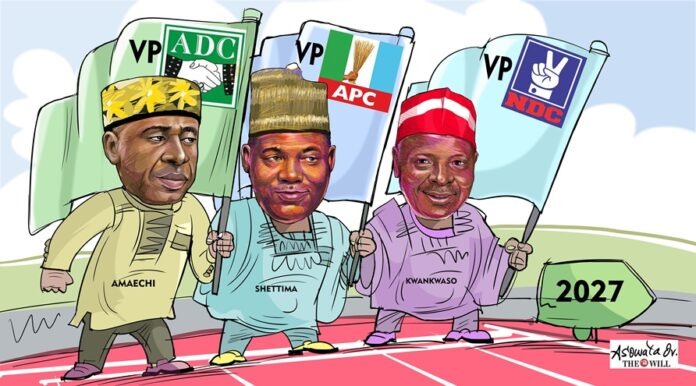
July 5 (THEWILL) — The Vice Presidential candidate of the African Democratic Congress, ADC, Rotimi Amaechi, and his Nigeria Democratic Congress, NDC, counterpart, Dr. Rabiu Kwankwaso, will join incumbent Vice President Kashim Shettima as the three prominent VPs in the 2027 presidential race. The prominence of the deputies is enhanced by the strength of the de facto presidential candidates and their political parties.
President Bola Tinubu, presidential candidate of the governing All Progressives Congress, APC; Atiku Abubakar, presidential candidate of the ADC, and their NDC counterpart, Peter Obi, would be staging a rematch in 2027, having slugged it out in 2023, though under different parties for Abubakar and Obi. Both men ran on the platform of the Peoples Democratic Party, PDP, and the Labour Party, LP, respectively. A highly likely second competition among them has leveraged their political capital for 2027.
The three of them command considerable followership. During their first meeting, the major public focus was on their strengths and weaknesses as well as their geopolitical and strategic relevance. However, the political landscape has changed drastically in the past three years.

The parties have successfully uploaded the names of their respective VPs, Shettima, Amaechi, and Kwankwaso, on the website of the Independent National Electoral Commission, INEC.
Analysts say that unlike in the past when VP candidates mostly tagged along with presidential candidates, Shettima, Ameachi and Kwankwaso stand out in their potential to make significant contributions to the overall performances of their principals in the upcoming poll. Political realignment, geopolitical balance and brinksmanship have been identified as the main sources of their strength.
APC, ADC, NDC – TINUBU, ABUBAKAR and OBI
Pundits say that politically, the governing APC is enjoying a larger- than- life public image: They have the incumbent President; 31 out of 36 state governors; 88 out of 108 senators and 269 out of 360 members in the House of Representatives. On the surface, these are numbers and political actors make up a formidable political machine for the governing APC to win elections.
The recent by-elections held across six states and a governorship in Ekiti state proved it.
APC won resoundingly with the seeming exception in Rivers State, where even though the PDP won a senatorial seat, politically discerning Nigerians know the winner is an ally of the Minister of the Federal Capital Territory, Nyesom Wike, who has vowed to work for President Bola Tinubu’s re-election.
Besides, the fallouts from the recent primary election have unsettled the party, with aggrieved members threatening all kinds of sabotage in revenge. The internal crisis that followed the alleged controversial substitution of candidates during the primary election has been triggered afresh by the party’s endorsement of six senatorial and 19 House of Representatives candidates said to have won the primaries in constituencies across ten states of Abia, Benue, Ondo, and Niger, Kwara, Ebonyi, Kaduna, Kogi, Nasarawa and Taraba.
Following established party tradition, the aggrieved members can always be granted concessions by the party to retain their loyalty.
But as presidential elections have gone in Nigeria in the past 26 years, the presidential election always attracts more voters than other elections. Voters tend to vote across party lines. Current research confirms this view.
In its May 23, 2026 edition, for example, the Review of African Political Economy states that, “Nigerians vote in higher numbers during presidential elections primarily because the citizens generally believe that the micro-management of the country’s economy originates from Aso Rock, making the presidential choice feel far more consequential to their daily survival than local leaders… Nigeria operates a powerful federal centre where the president controls the nation’s primary revenue source and budget allocations; the presidency holds ultimate power over the country’s highly centralised resources, security and governance.”
That is why concerns over the security of lives and property, inclusive governance, employment, economic hardship, perceived geopolitical marginalisation and ethnic mistrust generally prove attractive in pulling a majority of voters during presidential polls. This tendency of voters to consider presidential elections higher than others has enabled rivals and competitors to perform well outside their geopolitical zones.
THE 2023 POLL
Abubakar, the presidential candidate of the PDP, was able to sweep the polls in four out of seven states in the Northwest in 2023, namely Kaduna, Katsina, Kebbi, and Sokoto because of this factor. Of the four states, only Sokoto was under the control of the PDP in 2023. The rest were APC ruled. Kano was a notable exception, the home state of the presidential candidate of the New Nigeria Peoples Party, NNPP, Dr. Rabiu Kwankwaso, who swept the poll in the state. Abubakar also maintained the lead in the other Northwest state of Kebbi with 61 per cent of the votes cast and over 40 per cent in Jigawa, both APC-controlled.
The same scenario played out in the five Southeast states where Obi swept the polls and got the required 25 per cent of popular votes in neighbouring states of Delta, Rivers and Cross Rivers with high Igbo populations, even when none of the states had a governor, senator or House of Representatives member on the platform of the Labour Party on which Obi ran.
Demographically, many of the youths who make up 65 per cent of voters were said to have been attracted to the former Anambra governor because of their perception of him as a man of his word, which accounted for his victory in some North Central states of Plateau, Nasarawa and Benue, besides his victory in Bayelsa, Edo, Delta and Lagos State. He won 25 per cent in 16 states despite a pre-election prediction that he would lose because he had no structure.
Having survived difficult political litigations that almost harassed them out of the race, Abubakar and Obi are back in another three-horse race with incumbent President Tinubu. Even though NDC and ADC have boosted their ranks with defections, their parties do not match the strength of the governing APC.
APC’s current political dominance is therefore not a guarantee that the party is on its way to an easy victory in 2027. The ongoing social and economic challenges in the country will play a significant role. In the race to make the difference, the major parties in a likely three-horse race will have to count on the strategic importance of their VPs, THEWILL has gathered.
In his VP pick Kaduna State in 2023, Obi could only poll 21 per cent, 4 per cent short of the required 25 per cent margin. In Borno State, VP Shettima’s home state, Tinubu triumphed with 54.22 per cent of the votes cast; Abubakar scored 41 per cent of the votes in 2023. Both states were and are still APC-controlled, though Borno falls into Abubakar’s Northeast geopolitical zone.
SHETTIMA, KWANKWASO, AMAECHI
Ahead of the upcoming poll, Shettima, Kwankwaso and Amaechi look poised to contribute to the success of their principals in 2027, to ensure that at the minimum they secure 25 per cent of the votes cast in their home state and geopolitical zone to boost the electoral performances of the presidential candidates.
For Shettima, the Northeast geopolitical zone looks more predictable for the APC than in 2023, when three of the six states in the zone were under the control of the PDP, Adamawa, Taraba, and Bauchi, which provided the required votes for Abubakar. Now Adamawa and Taraba states are under the APC. Shettima is said to have worked day and night, to convince the governors to join his party ensuring its dominance in the zone.
Apart from Bauch State, the other five states of Adamawa, Borno, Gombe, Taraba and Yobe are all governed by the APC. Although that is no guarantee that all the states will vote in a landslide for APC, the possibility of securing the popular vote for the party’s presidential candidate remains high.
In a restive North following the worsening insecurity, the political dominance of APC in the Northeast counts for much, leaving the party to concentrate more on the Northwest where aggrieved members of former President Muhammadi Buhari’s Congress for Progressive Change, CPC, are said to have since fallen out with their APC allies for sidelining them, leaving them to seek relevance in the ADC for which they are currently rallying massive support.
This Northwest is Kwankwaso’s political zone, with his Kano home base as one of the largest vote-catching states. As the presidential candidate of the NNPP in the 2023 polls, he swept the polls here, winning 997,279 votes out of the 1.746, 410 votes cast. Tinubu came second, securing 517, 341 votes, leaving Abubakar, a distant third with 131,716 votes and Obi with 28,513 votes. Characteristically, a politically volatile state, the Kano political landscape has changed recently. The defection of Governor Abba Yusuf from the NNPP to the APC has reduced the political capital of the Kano godfather and increased the leverage of the APC there. But Kwankwaso has been able to maintain a grip on his political foot soldiers in the Kwankwasiyya movement, who continue to maintain their followership with fanatical zeal.
Analysts say Kwanwanso may find it hard to replicate the 2023 feat in the state, amid the preceding crisis in his former party, NNPP, followed by the parting of ways with his godson governor, leaving APC to consolidate in the state. Yet, pundits say his position as VP on the platform of the NDC will not only assist him to remain relevant in the state but also help to secure more than the required 25 per cent vote margin for Obi. That would be a valuable inroad for Obi into the Northeast geopolitical zone, the only zone where he failed to secure the required 25 per cent margin in 2023.
Rivers State was a voters’ nightmare for Abubakar in 2023 because he conflicted with the then-Governor Nyesom Wike-led PDP G-5 aggrieved governors who worked against his candidacy in 2023. Rivers is one of the states in the South-South with high voting strength. A Rotimi Amaechi as VP of the ADC may not mean much on face value, but given the shifting alliances forged by the uncertainty surrounding the Wike-Governor Siminalayi Fubara peace accord, the former Transportation Minister is likely to cause a disruptive effect as VP, considering Wike’s brinksmanship in cobbling a “rainbow coalition” of parties in the state. Analysts say that the recent by-election that produced victory for the senatorial candidates of PDP and APC was Wike’s design no doubt, but the result looked like the outcome of the performance of a trapeze artist rather that apolitical strategist. Besides, Amaechi hails from Ikwerre, one of the most populous nationalities in the riverine state, with almost 800, 000 persons out of the 5.3 million population, according to the 2006 census figure.
In the heightened political conflict in the state, voters, who are said to have lamented the bruising conflict between Wike and Fubara, have a choice among the NDC of Obi, who secured more than 25 per cent of the votes in the state in 2023, the PDP-APC led by Wike, and the ADC led by former governor of the state, Amaechi. The popular vote would more likely go to Wike-led parties, but the ADC looks poised to exploit and harvest the outrage of those who felt cheated by a lack of purposeful governance during the prolonged supremacy battle between Wike and Fubara.

Amos Esele is the Editor of THEWILL Newspaper. He has over two decades of experience on the job.
