
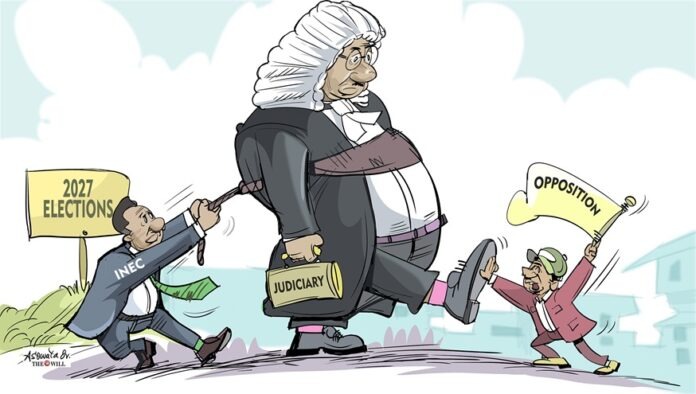
June 28 (THEWILL) — Three recent ambiguous judgements by Federal High Court judges have sparked public concern about the interference of judges in the electoral process in Nigeria. At a time when the Independent National Electoral Commission, INEC, has released an election timetable and conducting by-elections and off circle polls ahead of the 2027 general election, when politicians had criss-crossed parties and many Nigerians have registered as party members according to the Electoral Act, the public and even INEC are worried about the likely judicial threat to the smooth conduct of the upcoming poll six months away.
The looming threat heightened on Friday, June 26, 2026 when the Federal High Court in Lokoja, Kogi State, appealed its earlier judgement delivered in November 2025 directing INEC to register the Nigeria Democratic Congress, NDC as a political party.
THE THREE JUDGEMENTS
Justice Isah Dashen, who delivered the ruling, held that the earlier judgment was constitutionally defective because the Peace Movement Party (PMP), whose rights were allegedly affected by the registration of the NDC, was not joined in the proceedings before the court made its decision.

The judge upheld an application filed by the PMP seeking to be joined in the suit, declaring that the party was a necessary party whose absence rendered previous proceedings fundamentally flawed.
Prior to Friday’s judgement, a panel of the Abuja Division of the Court of Appeal had on March 12, 2026 ordered factions of the African Democratic Congress, ADC, to maintain the status quo ante bellum. INEC responded immediately. It deleted the names of the party’s National Working Committee from INEC website, raising a storm. The ruling heated up the polity until the Supreme Court on April 30, 2026 nullified the status quo order, describing it as legally “unnecessary, unwarranted and improper.”
The dust was yet to settle on that judgement when Justice Peter Lifu of the Federal High Court of Appeal Abuja struck: Despite a subsisting order of the Court of Appeal issued on May 22, 2026, directing a stay of proceedings on the matter and INEC’s position that the political parties under litigation had violated no law, Justice Lifu granted the prayers of the plaintiff and directed INEC to deregister five political parties, namely ADC, Action Peoples Party, AP, Action Alliance, AA, Accord Party, AP and Zenith Labour Party, ZLP, over failure to meet constitutional electoral performance requirements.
Coming at a tense period when parties had submitted digital membership list to INEC and were mending fences with aggrieved members in the aftermath of primaries, the Appeal Court had to step and knock down the judgement.
A three-man panel led by Justice Abubakar Mohammed described Justice Lifu’s judgement as “the highest form of judicial impertinence,” stressing that the Supreme Court previously held that a judge who acted in such manner “is unfit for the bench as it amounts to judicial rascality.”
Earlier, Justice Uche Agomo of the Federal High Court, Ibadan, had come under the searching gaze of the Appeal Court on June 6, 2026.
Delivering judgement on a suit filed by the rival Peoples Democratic Party, PDP, faction, Justice Uchechukwu Onyemenam of the appellate court held that the trial judge, Agomoh, went beyond the reliefs before her when she recognised a factional caretaker committee in the PDP leadership crisis, thus adding fuel to an already combustible crisis that had festered and reduced the party that ruled the country for 16 years to a mere shadow of its former glorious self.
“In the instant case, there is clearly a live issue where the trial court went outside the reliefs sought to recognise and uphold a factional caretaker committee,” Justice Onyemenam said, adding that, “Once the Convention itself has been pronounced null, void and of no effect by the Supreme Court, any superstructure erected upon it is necessarily without legal foundation.”
Reacting to the sequence of these rulings at the eve of an upcoming general election, politically discerning Nigerians are wondering whether pacifications should not be political rather than legal, allowing political parties more room to operate with less judicial interference.
A LEGAL OPINION
A former senior lawmaker and a Senior Advocate of Nigeria, SAN, Ehiogie West-Idahosa, is measured in his response. He spoke with THEWILL in Saturday.
“For every action, there is a reaction. It is not good to pound the judiciary alone. The confusion you see in the judiciary today take its root in the insincerity of the political elite. None of these cases you have mentioned originated from the judiciary. Have you seen anywhere in the world where political parties are as litigious as Nigerian political parties? None. In Nigeria, we are still struggling with electoral democracy and not public relations democracy as you have in African countries like Ghana, Senegal and Rwanda, countries less developed than Nigeria. Which of them have you seen daily dragging the judiciary into their domestic and ephemeral affairs? Yes, some judges have acted below par but we must not just blame them without seeing the source of their collective challenges. What is going on in the judiciary is a reflection of the complete collapse of moral issues in Nigeria, many institutions today have collapsed.”
He however submitted that the governing elite should also be blamed for going out of their way to compromise the judiciary.
“If we fund the judiciary to build houses for themselves, buy their vehicles and furnish their offices, do you think we will find judges genuflecting before elected political leaders. That is why I said it is about a systemic decay. One part goes bad and affects the whole. I recall as a member of the House of Representatives when a politician who did not stand for election was made the governor of the party through a Supreme Court ruling. To correct this matter, we, the lawmakers had to amend the Electoral Act to include a provision that anyone who did not participate in the electoral process cannot be declared winner in an election. Since then we have not had such a case again. In the absence of that, what the judge says becomes the law. ”
On the Kogi court ruling, he disclosed that the view in some quarters that a court cannot reverse its earlier judgement was incorrect though the reversal must be done under certain conditions, namely the presence of an established case of fraud and the concealment of a material fact in cases before a judge.
“If a judgement is found to be a fraud, the victim who must have suffered a loss arising from the judgement may approach the court to seek redress. In the case of material concealment, if a stolen identity is finally exposed, the court can set aside its previous judgement if the judgement was done timeously.” Even so, he contended that the PMP is yet to fully establish its case against the NDC.
“My worry in this case is the status of the party. It is clear that INEC and NDC were the parties in the case involving the use of logo. If they are now insisting that NDC used their logo, the question to ask is did they register the logo officially with a certificate to show for it and establish their right to violation by NDC? I say this because two -fingers is a sign of victory all over the world and nobody’s property. Chief Obafemi Awolowo used the sign during his days as presidential candidates of Unity Party of Nigeria. The sign is not a product you can register as a patent. If you say NDC used two fingers, you may have to prove that it violated your certificate of registration or patent. Still, I am not too sure one can go to a court to set aside a judgement that it has concluded.”
OTHER REACTIONS
For the INEC, these conflicting court judgments and orders are becoming a major headache for its operations, according to the National Commissioner in charge of Voter Education and Publicity, Malam Mohammed Haruna.
Speaking at an event last week, Haruna explained the dilemma with the Commission’s experience during the recently held Ekiti governorship election INEC, he said, received last-minute court orders between 24 and 48 hours before the election, upsetting administrative workflows and the making of election result sheets.
He said, “When a court gives a last-minute injunction to include parties like the NDC and the ADC, we are forced to reconfigure the software and update physical materials instantly. This leaves very little room to test the systems extensively, though we still manage to achieve substantial compliance with the rules.”
He promised that the commission would take the necessary steps to engage relevant judicial authorities to resolve the issue. Like INEC, the public outrage that trailed the court judgement on NDC was across board, some excusable, some indicting, but all expressing worry about a potential risk for the polity.
“The point is that the potpourri of rulings is not healthy for the polity. It undermines our democracy.” Professor Sylvester Odion-Akaine of political science department in the University of Lagos, told THEWILL on Saturday, that, “historically conflicting court judgements were used as a rationale for the annulment of June 12 in 1993. The somersault can be read as the hand of Esau and the voice of Jacob. This is not good for the image of the incumbent.”
Expectedly, political parties and leaders in the opposition have pointedly accused the government of using the courts to exclude them from the ongoing electoral process towards the 2027 election. The presidential candidate of the NDC, Peter Obi said the party’s recent challenge is part of the government’s game plan to stop him from contesting.
“If you know what they are doing to ensure that I’m not on the ballot in 2027, you will be surprised. The Nigerian government is doing everything to ensure that I do not contest in this election, but I’m not looking at the obstacles but at the destination. I am rather focused at the fruitfulness of the destination and that is what keeps me going. They cannot stop me. They will fail.” he said, hours after his support group, Peter Obi Media Reach, POMR, had denounced the ruling. National Chairman of the NDC, Senator Moses Cleopas Zuwoghe, National Leader, Senator Seriake Dickson, and the party’s caucus in the National Assembly.
Cleopas claimed that the judiciary was allowing itself to be used to derail the electoral process and damage the democratisation process in Nigeria.
“It is too late for anyone to attempt to use the judiciary to derail or narrow Nigeria’s multi-party democratic space. If the said association (Peace Movement Party) were a party affected by the judgment on our initial suit, the only option open to it was to appeal the verdict, an option which it did not take. Even at that, the window open for such appeal has since closed and any such appeal by now has become statute-barred.
“To now try to upturn that verdict through the back door, via a motion, is not only unheard-of, but also illegal and an outright abuse of court process,” the NDC leader said. However, the National Chairman said the party would appeal the judgement, expressing confidence that justice would be done.
Senator Dickson who disclosed that PMP did not apply for registration in 2025 and was not among the 171 associations that sought registration from INEC or the 21 shortlisted for registration, alleged that the legal challenge was intended to slow the party’s progress, but insisted that the party “will use appropriate judicial channels to correct the judicial anomaly that occurred under the watch of Honourable Justice Dashen.” The PMP reportedly applied for registration in 2015.
For the African Democratic Congress, ADC, which is still faced with a similar legal challenge as the NDC, the Kogi ruling is “a dangerous development capable of shrinking Nigeria’s democratic space.”
According to the party’s National Publicity Secretary, Bolaji Abdullahi, the ruling should serve as a wake-up call for opposition parties, alleging that attempts to deregister political parties on the eve of elections reflected a growing threat to Nigeria’s democracy. Abdullahi maintained that the development was unprecedented and bore the hallmarks of authoritarianism, insisting that opposition parties must unite to defend the country’s democratic order.
“The Lokoja Federal High Court’s decision to set aside its initial judgment that recognised the NDC is another reminder that no opposition party is immune when there is a concerted attempt to shrink the democratic space by the ruling party. What we are witnessing is certainly unprecedented. This is precisely why the opposition must stand together. Divided, we are easy targets, but united, we can confront the growing monster of dictatorship and defend the constitutional right of Nigerians to freely choose their leaders. Democracy survives only when the opposition survives,” he said. Mr Paul Ibe, Media Adviser to the presidential candidate of the ADC, Atiku Abubakar told THEWILL that by now the opposition parties must realise that they are being targeted.
“They should harmonise their strength otherwise as PDP, NDP, PRP and ADC, nobody is safe. They will be picked one by one if they fail to work together.”
Speaking to journalists after the Kogi court ruling, counsel to the applicant, Chikezie Ekeocha, explained that the PMP approached the court after discovering that the NDC’s registration was based on a logo the party had previously submitted to INEC before the commencement of the original suit.
According to Ekeocha, the court agreed that the applicant’s legal rights had been affected by the earlier judgment and consequently vacated it. Ekeocha stated that Friday’s ruling implies that every action taken by INEC pursuant to the now-vacated judgment stands reversed.
“The recognition of the NDC, the issuance of its certificate of registration, its inclusion in INEC’s records, and any appearance on ballot papers arising from that judgment must be withdrawn pending the final determination of the substantive suit,” he said. He, however, clarified that the substantive case remains pending before the court and has not been decided on its merits.
“The matter has not been concluded. The court merely set aside its previous judgment and directed that the party whose interests were affected be joined so that all sides can be heard before a fresh decision is reached,” Ekeocha added. He also dismissed suggestions that the court merely ordered parties to maintain the status quo, insisting that the ruling specifically restored the legal position that existed before the December 10, 2025 judgment.
The promoter of All Democratic Alliance, ADA, Dr, Umar Ardo, who had earlier challenged the registration of the NDC, expressed satisfaction with the Kogi court ruling.
He said he knew all the legal requirements and procedures involved and in the registration of political parties and knew that NDC was not among the associations that were involved in the exercise.
”So, when I saw NDC as having being registered by a court order I was perplexed. I knew something was fishy about it. I then raised the alarm. And I did that on a national television a day after INEC made the announcement of the registration. I’m glad that the same judge who ordered for its registration is so honourable to see cause to technicality reverse his earlier judgment,” he said.

Amos Esele is the Editor of THEWILL Newspaper. He has over two decades of experience on the job.
