
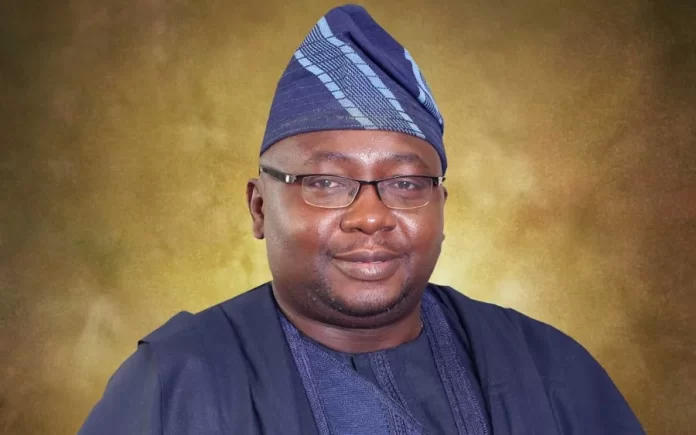
April 22, (THEWILL) — Nigeria’s Minister of Power, Adebayo Adelabu, has formally tendered his resignation from the Federal Executive Council, with effect from April 30, 2026, to pursue his governorship ambition in Oyo State, marking a significant but orderly transition in the leadership of the nation’s power sector.
In a resignation letter dated April 22 and addressed to President Bola Tinubu, Adelabu stated that his decision complied with the provisions of the Amended Electoral Act 2026, which bars serving political office holders from contesting elections while in office.
He described the move as necessary to uphold democratic principles and ensure a level playing field..

“I write with a deep sense of honour and profound gratitude to formally tender my resignation as the Honourable Minister of Power of the Federal Republic of Nigeria. This resignation is to take effect on 30th April 2026, to allow sufficient time for a smooth and orderly handover of responsibilities.
“Your Excellency, I remain sincerely grateful for the privilege and confidence you reposed in me by appointing me to serve our great nation in this capacity.
“It has been a rare honour to contribute to national development under your leadership and to play a role in advancing reforms in the power sector—one of the most critical foundations of Nigeria’s industrial growth and economic transformation,” the letter read in part.
Confirming the development, his Special Adviser on Strategic Communications and Media Relations, Bolaji Tunji, said the minister expressed deep appreciation to the President for the opportunity to serve, noting that his tenure offered him the privilege to contribute meaningfully to Nigeria’s economic growth and infrastructure development.
Adelabu, who previously served as Deputy Governor of the Central Bank of Nigeria, disclosed that his governorship ambition dates back to 2016, adding that his resignation reflects both personal conviction and adherence to the rule of law.
The outgoing minister used the opportunity of his resignation to highlight key milestones achieved under his leadership, particularly the implementation of the Electricity Act 2023, which decentralised the electricity market and expanded opportunities for state governments and private sector participation.
He noted that peak power generation rose to over 6,000 megawatts during his tenure, supported by the integration of the Zungeru Hydropower Plant and the rehabilitation of several thermal power plants.
Transmission capacity was also strengthened through ongoing grid expansion and modernisation efforts under the Presidential Power Initiative.
In the distribution segment, Adelabu reported improvements in operational efficiency, including enhanced regulatory oversight, better revenue collection, and gradual reductions in Aggregate Technical, Commercial, and Collection (ATC&C) losses.
He added that efforts to close the country’s metering gap gained momentum through the Presidential Metering Initiative and the World Bank-supported Distribution Sector Recovery Programme (DISREP).
Financially, the sector witnessed a notable turnaround, with tariff reforms and a N4 trillion debt restructuring programme increasing market revenues from N1 trillion in 2023 to N2.3 trillion in 2025.
According to him, these measures restored investor confidence and positioned the power sector for long-term sustainability.
Beyond his resignation, Adelabu proposed the establishment of a Coordinating Ministry for Energy to consolidate reforms and drive integrated policy execution across Nigeria’s power, gas, and related sectors.
He emphasised that sustaining recent gains requires stronger coordination at the highest level of government, particularly to address persistent challenges such as gas supply constraints, infrastructure vandalism, and the need for full commercialisation of the electricity value chain.
The proposed coordinating structure, he explained, would ensure synergy between power generation, gas supply, hydro resources, and renewable energy development, thereby improving overall sector efficiency and energy security.
Adelabu reaffirmed his commitment to a smooth and seamless handover process ahead of his exit date, underscoring the importance of continuity in policy implementation and sector stability.

Felix Ifijeh is a journalist with years of professional reporting experience. Known for his keen news sense, compelling storytelling and commitment to accurate, impactful reporting, he has built a reputation for turning leads into clear, engaging, and well-structured reports that resonate with readers. His work reflects deep newsroom experience and a commitment to accurate, impactful journalism.
