July 28, (THEWILL) – For a country grappling with an energy crisis that spans over two decades, the coming of Dangote Refinery offers the much-desired hope. In that regard, when Aliko Dangote, President/CEO of Dangote Group, operators of Dangote Petroleum Refinery and Petrochemical Limited in Lagos, expressed ‘regrets’ for investing in the behemoth project without really knowing what it entailed and against the advice of trusted associates, there are reasons for concern.
In an interview broadcast on CNN last June, Dangote said he would not have delved into the gigantic project if he had known what it entailed. He also revealed at another forum that a close friend advised him against building the facility in Nigeria. But he went ahead to construct the largest single train refinery in the world, which is now being threatened by calculated sabotage and undermining activities from the regulatory authorities and other industry players.
EARLY SIGNS OF TROUBLE

Early signs of trouble emerged when a rumour began to make the rounds that the host community planned to demand adequate compensation for their land acquired by Dangote as part of the government incentives to invest in the Export Processing Zone. But Dangote has dismissed the rumour frontally, explaining that the refinery does not sit on any land acquired freely.
Addressing journalists at his refinery recently, Dangote maintained that the facility was not built on free land nor did the Federal Government extend any ‘incentive’ to the group. He said, “In building the refinery, we did not collect one single incentive from the Federal Government of Nigeria. Although the Lagos State Government gave us a good deal, we paid $100 million for land. It was not free land; we paid for it.”
A prominent figure had hinted at a public forum that the community would ask questions about their land acquired by Dangote in due course. This heightened speculation that the facility was headed for troubled days ahead. Then came the interventions of the regulator.
UNSEEN HANDS OF FATE
Initially, Dangote Refinery suffered many years of missed completion dates. Although plans for the project were unveiled in 2013, the history of Dangote Refinery began with actual construction on the site in 2017 when the refinery cost was put at $9 billion. Earlier in 2013, there were assurances that production would start in 2016, but the date was later moved to 2018.
During this period, the cost of building the refinery ($10 billion), together with the fertiliser plant ($2.5 billion) and pipeline components ($2.5 billion) had jumped up to $15 billion. By 2024, the refinery was said to have cost $20 billion to build, up from $19 billion as of December 2023.
At each stage of waiting and working, Nigerians were assured that Dangote Refinery would terminate the country’s shameful, endless reliance on imported refined petroleum products. This has been the gold mine for the notorious cabal that have held Nigeria hostage by ensuring that the local refineries remained unproductive.
This, perhaps, explained why Nigeria’s four refineries have remained dormant for over two decades despite – consuming over N11 trillion in 10 years, according to the Senate during plenary about a year ago.
The upper legislative chamber on October 24, 2023 constituted an ad-hoc committee to investigate all contracts estimated at over N11.35 trillion awarded for the rehabilitation of the four moribund refineries in the country. This followed a motion on the unending repairs of the nation’s refineries despite the huge resources invested in fixing them proposed by Senator Sunday Karimu.
Karimu had said, “We are concerned that the Federal Government of Nigeria has carried out rehabilitation projects in Port Harcourt Refinery Company (PHRC) over a period of seven (7) years from 2013-2019 at an estimated cost of N12,161,237,811.61.
“In addition, on the 18th March 2021, a rehabilitation contract was executed between NNPC/PHRC and Tenenimont SPA at a lump sum of $1,397,000,000.00… amidst global public criticism, no result has been achieved.”
It is on record that one of the NNPC subsidiaries, Port Harcourt Refining and Petrochemical Company (PHRC), employed 487 new staff four years ago and paid N23 billion in salaries without producing one litre of petrol.
Nothing has come out of the Senate probe as at date. This is part of the ugly narrative Dangote Refinery aims to terminate.
DANGOTE’s ANGST
Speaking at the Africa CEO Forum Annual Summit held in Kigali, Rwanda, on May 17, 2024 Aliko Dangote said Nigeria, and indeed West Africa, could get all of their needs for diesel, aviation fuel and gasoline from his refinery as early as June 2024, with a daily capacity of 650,000 barrels.
This revelation, which drew a loud ovation from the audience, must have been received with a pinch of salt at home when he argued that African governments had not built a single refining facility in the last 35 years because of the people benefitting from massive fuel imports into the continent.
In a clip from an interview conducted by CNN’s Eleni Giokos, Dangote stated that although he had gained plenty of experience from building the $19 billion refinery, he would have a rethink if he knew beforehand the huge challenge with building such a facility on the continent.
“There are so many issues. I can’t count them, but there are so many. It’s not only money, a lack of political will and the people who are benefiting from this whole stuff of importing petroleum products into Africa are actually discouraging those governments from building a refinery,” he said.
He argued that foreign aid and investments will not build Africa, explaining that Africans will have to develop the continent on their own. He explained that he had to dredge a lot of sand, over 65 million tonnes, before work could start on the project, part of which was responsible for the prolonged start-off date.
REGULATOR-INDUCED CHALLENGES
A cloud of uncertainty began to emerge when on July 19, 2024, news emerged that the Federal Government had said the country would continue to import refined petroleum products to ensure that Dangote Refinery did not have a monopoly that could affect the country in the long run.
The Chief Executive of the Nigerian Midstream and Downstream Petroleum Authority (NMDPRA), Farouk Ahmed, had said that Nigeria could not depend on one refinery to feed the nation, adding that Dangote Refinery’s quest that all oil marketers should buy products from the plant does not support competition.
In a dramatic twist, Ahmed told journalists in Port Harcourt that Dangote Refinery’s diesel, much as the diesel from modular refineries like Waltersmith and Aradel, has high sulphur levels, which could cause harm to vehicle engines and damage the human biosphere – the interdependent atmospheric conditions that support all life.
This unproven declaration by the agency of government contradicts the results of tests of diesel products imported into the country by the regulator, which were done in the presence of the leadership of the house of representatives at the sophisticated lab of the Dangote refinery recently. The tests proved the imported diesel products were of very poor quality and that diesel from the Dangote refinery are superior and better for engines.
Industry watchers considered the statement a curious counter to the views of Aliko Dangote, who had assured that Nigeria, and indeed West Africa, could get all of their need for diesel, aviation fuel and gasoline from his refinery.
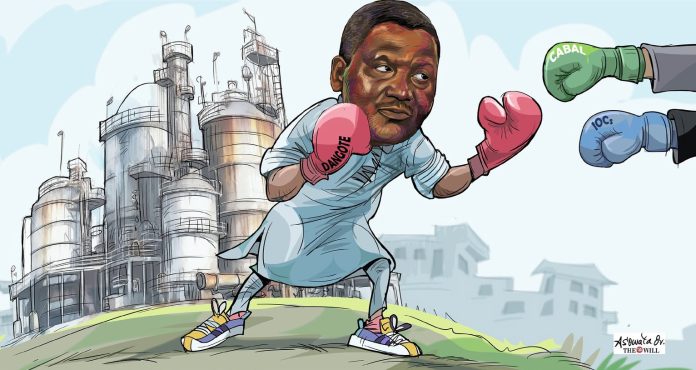
Nigerians also took exception to the attitude of the government regulator which aimed at de-marketing the new refinery, validating Dangote’s claim that there are powerful cabals who are bent on ensuring that Nigeria’s thirst for imported petroleum products is not quenched by building local capacity.
STUNNING DROP IN FG STAKE
Perhaps, of greatest concern to Nigerians was the revelation by Aliko Dangote that Nigerian National Petroleum Company (NNPC) Limited now owns a 7.2 per cent stake in the Dangote Petroleum Refinery, and not a 20 per cent stake as initially announced before the inauguration of the facility at the Lekki Free Trade Zone.
Dangote, who made this known at a press briefing said NNPC’s stake dropped to 7.2 per cent over the company’s failure to pay the balance of their share, which was due in June. The NNPC had acquired a 20 per cent interest in the $20bn Dangote Refinery for $2.76 billion.
“NNPC no longer owns a 20 per cent stake in the Dangote Refinery. They were meant to pay their balance in June, but have yet to fulfil the obligations. Now, they only own a 7.2 per cent stake in the refinery,” Dangote said.
The NNPC confirmed the development in a statement. “NNPC Limited periodically assesses its investment portfolio to ensure alignment with the company’s strategic goals. The decision to cap its equity participation at the paid-up sum was made and communicated to Dangote Refinery several months ago,” said Olufemi Soneye, spokesman for the company.
THEWILL could not confirm NNPCL’s claim that it notified Dangote “several months ago” of its decision to scale down its stake in the refinery from 20 per cent to 7.2 per cent as Dangote Refinery did not respond to an enquiry to this effect.
In August 2023, NNPC disclosed that it had borrowed $1.036 billion to acquire 20 per cent stake in Dangote Refinery for $2.76 billion through a $1.036 billion funding from Lekki Refinery Funding Limited of which $1 billion was paid to Dangote Refinery and $36 million was for transaction costs.
Data from NNPC Ltd’s audited financial report for 2022 showed the state-owned company pledged 35,000 barrels of crude oil per day (bpd) as repayment for the loan. Aside from these 35,000 forward sales, the NNPC also has a 90,000-bpd oil-for-debt financing deal of $3.3 billion with Afreximbank
SERIAL BACKLASH
Industry watchers believe that the series of revelations from Dangote must have upset the government and NNPC, prompting the rift that has now gone viral on social media. Moreover, the attempt by the NMDPRA boss to de-market Dangote sparked public outrage, forcing Mr. Dangote himself, a man not known for many words, to react.
Dangote tongue-lashed NMDPRA, describing it as a regulator without a laboratory to test the “inferior” quality petroleum products that they strategically import from a blending facility in Malta in which some Nigerians are involved.
Addressing a delegation of the House of Representatives, led by the Speaker, Tajudeen Abbas, on July 20, who were on a familiarisation visit to the Dangote refinery and Petrochemicals Company, in Lagos, a very livid Mr. Dangote condemned the campaign of calumny against his company by those he accused of not telling Nigerians the truth about the situation.
He said, “Another complaint I heard, which I think the Rt. Hon Deputy Speaker also raised was, ‘why did we drop the price of diesel, is it because of the bad quality we produce?, I said no.”
Insisting that Dangote Refinery was producing a better and top quality fuel than what was being imported, he said to Rt. Hon Abbas, “I am sure, your excellency, sir, that most of you have problems with your vehicles, It is either you had or you are still having the problems. It is because of the bad fuel that they are importing into the country.
“I still stand by what I said. Go to the petrol filling stations. You can pick up, or you can check the quality. That is the only way. Someone will bring in a ship and present a fake certificate. When we go ahead, we will say more. We know where they blend these things.
“Some NNPC people and some traders have opened a blending plant somewhere off Malta. We know all these areas; we know what they are doing. It is not that I do not know. I have been fighting all my life I am a very fearless person.
“I believe so much in God and I do not fear anybody. They can do whatever they want. I am not scared, I will fight head-on.”
REACTIONS
Reacting to the development, the President of the African Development Bank (AfDB) Akinwunmi Adesina faulted the claims of “monopoly” against the chairman of the Dangote Group Aliko Dangote.
He said: “Monopoly often exists where there are high barriers to entry or high capital costs. How many individuals or companies can do railways? How many can do refineries of the scale of Dangote Refinery?” he wrote in a post on his X handle on Tuesday.
“In a nation that has been importing refined petroleum products for several decades, the abnormal simply became very normal. No smart investor would make a $19.5 billion investment and want it to be undermined by importers.
“To manufacture is extremely expensive and risky. This is even more so in Nigeria, given the very challenging business and economic environment, fraught with policy uncertainties and policy reversals, and where the self-defeating default mode of “simply import it” is always so easily rationalized and chorused to solve any problem.
“Competition is good for everyone. But is Dangote Refinery anti-competitive? What is the evidence? Has Dangote Refinery prevented any other company from setting up refineries? Why have others not done so? How come they have not done so for several decades? Was it Dangote that held them back?
“But Dangote Refinery surely cannot be asked to ‘compete’ with importers of petroleum products. That is not competition. Let the importers set up local refineries and compete by refining in Nigeria. That is fair and justified competition.”
Oil and Gas expert, Engr Bala Zaka, said the attacks on Dangote will have a negative impact on his determination to contribute to the growth of the economy.
“Dangote is thoroughly shocked and shaken, right now. He must be feeling that his romance and enjoyment days with the likes of Buhari and Emefiele, are over. He must definitely be feeling or suspecting that a new gang or cartel is out to deal with him and bring his business empire down, nocturnally, under PBAT,” Bala said in a note to THEWILL.
“It is obvious to me that certain interests have been adversely affected thus these external communication that the public is now privy to.
“I will wait and see how the financiers resolve this matter as they stand to lose too much if the Refinery production is delayed any further”, said Engr. Ibilola Amao, a finance expert.
The Northern Elders Forum (NEF) has warned government officials and other Nigerians against attacking the Dangote Refinery and its Chairman, Aliko Dangote, to desist from such actions.
The northern elders issued the warning in a statement signed by Convener Professor Ango Abdullahi.
The forum condemned the attempts to demarket the refinery, which NEF said is capable of saving the country from continued importation of refined petroleum products.
The statement said, “The Northern Elders Forum (NEF) is watching with sustained interest the unfolding drama being orchestrated by some powerful vested interests to frustrate the good example set by the nation’s leading investor and foremost African entrepreneur, Alh. Aliko Dangote, who has defied all formidable odds to build a privately-owned world-class, ultramodern petroleum refinery in Nigeria.
“Dangote refinery, which is reputed to be the biggest single-train refinery in the world, is a technological marvel that showcases the most advanced innovation in the trade field and is also a symbol of our national pride.
“This remarkable business feat, which ordinarily should instantly earns him national encomiums and accolades, has paradoxically ignited the malicious fury of enemies of our dear country, who are strategically located in the oil and gas sector of the economy.
“Nigeria became the object of global ridicule, as we are the only OPEC member nation without refining capability and heavily dependent on mass importation of oil and other derivatives,” the statement said.
The forum noted that Nigerians, who bear the brunt of escalating fuel prices and shortages, will no longer allow a few individuals to hold the economy hostage. It commended the Minister of State for Petroleum Resources, Mr. Heineken Lokpobri, for his timely action to address the situation.
The forum stated its determination to stand with Aliko Dangote in defence of the refinery.

Sam Diala is a Bloomberg Certified Financial Journalist with over a decade of experience in reporting Business and Economy. He is Business Editor at THEWILL Newspaper, and believes that work, not wishes, creates wealth.