
June 07 (THEWILL) — On Thursday, June 4, Thailand donated 12 metric tonnes of rice worth $22,000 to aid vulnerable communities in Nigeria, as humanitarian agencies caution that up to 34.7 million Nigerians may experience severe food insecurity this year.
The donation, which was presented to the World Food Programme (WFP) in Abuja by Thailand’s Ambassador to Nigeria, Mr. Thirapath Mongkolnavin, for distribution to vulnerable populations, particularly in the conflict-affected North-East states of Borno, Adamawa, and Yobe, reveals the ugly dimension of the damage that persistent terror-related attacks are inflicting on the citizenry.
According to the ambassador, the intervention will support communities grappling with hunger driven by the worsening insecurity, economic pressures, and climate-related shocks.

“In response to this crisis, Thailand is pleased to contribute 12 metric tonnes of Thai rice valued at $22,000 through the WFP to support communities affected by food insecurity,” Mongkolnavin said.
He noted that the Royal Thai Government had previously provided $10,000 through the Nigeria Humanitarian Fund, managed by the United Nations Office for the Coordination of Humanitarian Affairs (UNOCHA), to support humanitarian efforts in the North-East.
The Permanent Secretary of the Federal Ministry of Humanitarian Affairs and Poverty Reduction, Mr. Olubunmi Olusanya, described the donation as a demonstration of international solidarity in addressing hunger and poverty.
Behind the niceties of the occasion, however, stands a looming danger that foreign partners and the Federal Government have admitted through shared data.
HUMANITARIAN DIMENSION
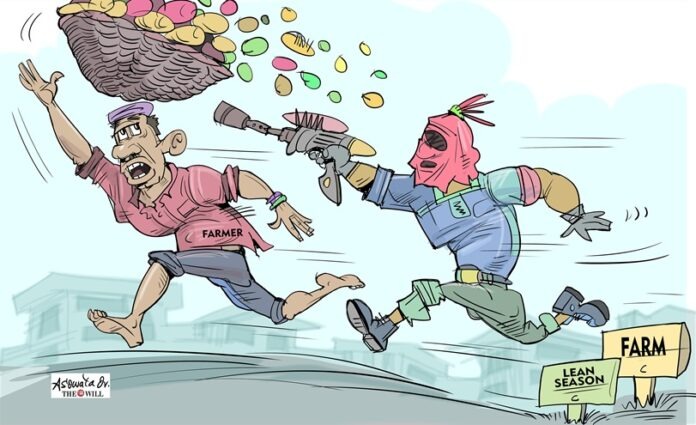
The escalating insecurity situation in the country indicates a shift towards a severe food crisis, which is expected to drive more than 30 million Nigerians into imminent acute food insecurity, and that will spell doom for the citizens. As farmlands are deserted due to banditry and terrorism, Nigeria faces an unprecedented food crisis and acute hunger.
According to projections by the United Nations Food and Agriculture Organisation (FAO), about 34.7 million Nigerians could experience severe food insecurity during the June-August 2026 lean season due to high inflation and deepening insecurity.
This indicates that Nigeria is moving towards a daunting crisis of food insecurity, which will significantly affect the developmental progress already achieved by the government through its various reform initiatives.
This ugly situation is leading to food assistance from other nations and several humanitarian organisations, like what occurred with Thailand recently.
Worried citizens are voicing their concerns that the deteriorating security situation has transformed Nigeria into a nation of beggars, grappling with severe food shortages. The ongoing insecurity in agricultural areas, coupled with conflicts between farmers and herders, banditry, flooding, droughts, and wider economic difficulties, has severely impacted agricultural output and disrupted food supply chains.
For instance, Nigeria, one of Africa’s largest rice-consuming nations, is estimated to consume about 7.6 million metric tonnes of rice annually but continues to face a production deficit of between two million and three million metric tonnes each year.
The rice donation by Thailand will be implemented by the WFP in partnership with the Federal Government and targeted at newly arrived residents of Internally Displaced Persons (IDP) camps in North-East Nigeria.
GOVERNMENT WORRIES
On its part, the Federal Government has disclosed that over 31.8 million Nigerians are currently experiencing severe food shortages because of persistent security issues and the recent elimination of fuel subsidies. Research carried out by various international development partners indicates that this situation has led to extensive malnutrition among women and children.
The U.N. Food and Agriculture Organization, the Global Alliance for Improved Nutrition, and the German development agency GIZ conducted the research. It relied on statistics from the Cadre Harmonise, a regional food security framework, to analyze nutrition data.
It states, “The surge in food commodity prices, which is a result of the removal of fuel subsidy in addition to security challenges, has placed millions of Nigerians in a precarious situation.”
Nigeria’s National Convener of Food Systems and Director of Social Development in the Ministry of Budget and Economic Planning, Sanjo Faniran, stated that the study provided valuable insights by identifying gaps, successes, and challenges, and offering key recommendations.
He recalled that earlier this year, the World Bank’s food security report for Nigeria projected that seven Northern states would face severe food security challenges due to escalating food inflation and insecurity in key food-producing areas.
The Boko Haram insurgency in the Northeast has severely disrupted food production, leading to widespread destruction of farmlands.
The report from the federal government, therefore, aligns with similar reports from international development organisations such as the World Bank, the International Rescue Committee (IRC), the World Food Programme (WFP), and others.
Additionally, it observed that the herders’ attack on farmers and ongoing banditry have significantly impacted agricultural output in the Northwest and North Central regions.
These security issues, compounded by disruptions in global food supply chains, have driven Nigeria’s food inflation by over 40 percent, according to the National Bureau of Statistics. The Bureau recently stated that food inflation remained above 20 per cent in 11 states in April 2026.
Its latest Consumer Price Index report showed that food inflation rose to 16.06 per cent in April 2026, slightly higher than the 15.69 per cent inflation rate recorded in the same month.
Confirming the gloomy picture ahead, the Famine Early Warning Systems Network has projected that 16.99 million Nigerians could require urgent humanitarian food assistance by November 2026. Nigeria, it said, faces the same dire situation as countries like Sudan, the Democratic Republic of Congo, and Yemen.
ESCALATING SECURITY CRISIS
Amnesty International Nigeria and other civil society groups, such as Global Rights Nigeria, have said that over 2,300 Nigerians were killed and up to 2,000 were abducted nationwide due to terrorism, banditry, and insurgent attacks from January to mid-2026.
Also, security experts and geopolitical risk organisations have tracked at least 2,063 to 2,350 conflict-related deaths in the opening months of 2026, driven largely by banditry and localised terror attacks.
The escalating crisis has forced many families out of their communities to become occupants of internally displaced persons (IDP) camps where they now become ‘refugees’ in their own lands. The communities, which are predominantly farmers, have also abandoned their ancestral homes to terrorists and bandits who either prevent them from accessing their farmlands or impose huge levies to plant and harvest their crops.
IMPACT ON BUSINESSES
The escalating insecurity compels financial institutions to restrict credit for SMEs, as high interest rates make expansion or inventory financing prohibitively expensive. The inability to sustain operations through periods of hyper-inflated costs and reduced demand forces many micro-enterprises and SMEs to shut down entirely.
Consequently, SMEs serving highly localised or rural markets suffer as their customers completely exhaust their funds on basic staples due to the high cost of living, as micro-manufacturers and food vendors face difficulty sourcing local agricultural products at profitable prices, limiting production volume.
As a result, SMEs are forced to divert limited capital toward private security and insurance to protect assets, personnel, and supply routes in high-risk zones. Capital that could have been used to upgrade technology, expand market reach, or innovate is redirected toward daily survival and basic business sustenance.
Commenting on the impact of insecurity in the food supply chain, Oluwatosin Oluwafemi, a public health professional, noted that the high cost of food is a major concern among industry stakeholders.
In her article titled, ‘Food Crisis: When Policy Gaps and Insecurity Break Supply Chains,’ Oluwafemi said: “When fuel costs rise, transportation becomes more expensive, and so does food. When insecurity spreads, farming slows or stops; when supply chains break, prices climb, and households absorb the shock.
“Many Nigerian households now spend more than half of their income on food. When food takes up this much of household spending, everything else takes a back seat. Healthcare is delayed, school fees are stretched, and productivity falls. Food insecurity quietly becomes both an economic and public health problem.”
She continued, “Insecurity compounds these pressures. In several farming regions, conflict, banditry, and displacement have pushed farmers off their land. Some have scaled back production; others have abandoned farming entirely. Each empty field narrows the national food supply.”
WAY OUT
According to Oluwafemi, rural security must be strengthened so farmers can return to their fields.
“Food security is not charity. It is infrastructure. When supply chains break, households pay first, then the economy. Fixing Nigeria’s food crisis requires closing policy gaps, restoring safety, and rebuilding the systems that move food from farm to table.
“The longer food remains unstable, the harder recovery becomes. Markets lose confidence, farmers exit production, and households adopt coping strategies that weaken long-term well-being.
“Rebuilding trust in the food system takes time, coordination, and deliberate investment. But the cost of inaction is higher. A country that cannot reliably feed its population compromises its health, labour force, and economic future, one market stall at a time,” she said.
Without such measures, stakeholders fear that the country could experience severe food shortages in 2026, further worsening inflation and deepening poverty levels.

Sam Diala is a Bloomberg Certified Financial Journalist with over a decade of experience in reporting Business and Economy. He is Business Editor at THEWILL Newspaper, and believes that work, not wishes, creates wealth.
