
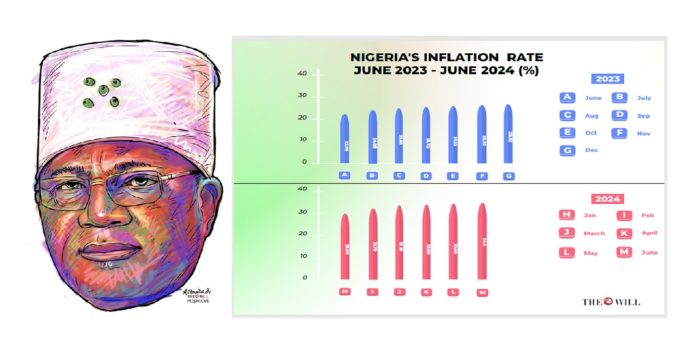
November 18, (THEWILL) – There are strong indications that the continued rise in Nigeria’s inflation rate is a threat to agribusiness — key anchor of a struggling economy that is gasping for breath, and yearning for diversification. The country has witnessed a frightening upward trend in inflation movement in the past 18 months of the President Bola Tinubu-led government which was inaugurated on May 29, 2023.
The worst hit in business circle are the micro, small and medium enterprises which play active role in the agribusiness value chain, and also help to ameliorate the exasperating impact of high food inflation.
Data pieced from the National Bureau of Statistics (NBS) showed that inflation rate rose to an average of 38.7 percent, during the period: from 22.41 percent in May 2023 to 38.88 percent in October 2024 – the second highest after the 34.19 percent recorded in June 2024.
According to NBS, the upward trend in inflation rate was caused by food inflation which stemmed from the high cost of petrol and electricity – two derivatives of the Government’s reforms that witnessed the removal of petrol subsidy, devaluation of the naira and high electricity tariff.
During the period, the pump price of petrol rose from N200 per litre to N1,300 per litre, while the exchange rate of the naira jumped from N468 to a dollar mid-June 2023, to N1,700 to a dollar mid-November 2024 in the official forex market. Additionally, the government increased electricity tariff for Band ‘A’ customers from N68 per kilowatt-hour (kwh) to N225 per kwh.
These constituted a 550 percent, 263.24 percent and 230.8 percent jump respectively, and put pressure on food prices leading to an average food inflation of 60.84 percent during the 18-month period.
Investigation revealed that food inflation skyrocketed from 24.82 percent in May 2023, to the peak of 40.87 percent in July 2024 before decelerating to 39.16 percent in October 2024.
The United Nations Food and Agriculture Organization (FAO) and the World Food Programme (WPF) recently published the “Hunger Hotspots” report, which highlights the devastating impact of conflict, climate change, and economic instability on food security across the world, with Nigeria among the possibly worst hit in Africa.
The worrying rise in food inflation mirrors the impact on agriculture and, by extension agribusiness, which witnessed a receding trend during the period. The agriculture sector in Nigeria’s 2024 Q2 GDP dropped to 1.41 percent in real terms from 1.50 percent in the same quarter of 2023.
The trend has added to the woes of MSMEs which derive their continued operation from a viable agribusiness value chain across the sectors.
According to Abdulrasid Yarima, president/chairman of the governing council of the Nigerian Association of Small and Medium Enterprises (NASME), about 10 percent of the 40 million MSMEs in the country have shut down since the subsidy removal.
In a statement late last year, Yarima said, “It’s been very tough for our members as we are managing to survive. Some of them are closing shops while others are looking for new business opportunities.”
THEWILL findings revealed that many thriving MSMEs involved in the value chain of major manufacturing companies’ operations under the backward integration policy have either scaled down their operations or stopped doing business.
Backward integration is a practice where companies are encouraged to cultivate their own raw materials by purchasing from their suppliers or establishing their own farms, for instance, to grow produce for their factories.
The consumer goods firms, in particular, keyed into the scheme and have since taken giant strides in its implementation. This is to the benefit of the MSMEs, especially those engaged in the agriculture and transport value chain. But the receding fortune of the consumer goods firms suggest a strong negative impact on the agribusiness operators.
For instance, Nigerian Breweries Plc recorded a 159.7 percent increase in its pre-tax losses in the first nine months of 2024.
During the period, the company’s pre-tax losses increased from N78.16 billion between January and September 2023 to N202.99 billion.

Industry experts explained that Nigerian Breweries continued its woeful financial performance from 2023 owing to inflation pressures affecting raw materials cost and foreign exchange problems beginning since last year.
In the same period of last year, the company attributed its losses to lower sales volumes, rising input costs driven by high inflation, the naira’s devaluation, higher interest expenses, and a significant increase in foreign exchange losses stemming from the currency’s devaluation.
It is obvious that the company is still susceptible to the current macroeconomic malaise bedevilling Nigeria, especial high inflation, as its raw materials cost spiked by 129 percent from N177.4 billion in the first nine months of 2023 to N407.19 billion in the current period.
During the period under review, the company reacted to the high inflationary environment by increasing the prices of products twice as announced. Also, the seemingly harsh operating environment necessitated the company to suspend operations in two of its nine production plants.
Nigerian Breweries Plc to restore its balance sheet to a healthy position carried out a capital raise by way of Right Issue to the tune of N600 billion which closed on October 11, 2024.
Similarly, Bournvita maker, Cadbury Nigeria Plc in the first nine months of 2024 recorded a 65 increase increase in pre-tax losses from N10.24 billion in the same period of 2023 to N16.93 billion in the period under review.
In the period under review, the company’s finance costs increased significantly, preventing profitability during the period.
During the period, the company saw declines in its gross profit and also in its operating profit when compared to the third quarter of 2023. Gross profit in the period between July and September 2023 stood at N5.17 billion, from N6.07 billion in 2023.
Cadbury reported a pre-tax loss of N28.2 billion for the 2023 fiscal year, reflecting a steep 2269% decline from the N1.3 billion pre-tax profit recorded in 2022.
These are among the large firms that patronize agribusiness operators for the supply of raw materials and other services to promote backward integration. The high interest rate at about 30 percent and the general unfavourable macro-economic climate exert pressure on the agribusiness value chain which is largely populated by the MSMEs.
Yarima predicts that the continued inflationary trend will definitely impact on the agribusiness sub-sector — creating job losses, business failures and huge tax revenue loss for the government.

Sam Diala is a Bloomberg Certified Financial Journalist with over a decade of experience in reporting Business and Economy. He is Business Editor at THEWILL Newspaper, and believes that work, not wishes, creates wealth.
