The increased volume of agricultural goods helped to achieve a relatively high value of non-oil exports in the first quarter (Q1) of 2023, compared to the corresponding period of 2022, data by the National Bureau of Statistics (NBS) have shown.
Although total non-oil exports dropped by 8.9 percent to N652.29 billion during the period, from N715.19 billion in Q1 2022, the positive performance by Agriculture helped to buoy the non-oil export numbers.
The NBS in its ‘Foreign Trade in Goods Statistics’ report for Q1 2023, showed that non-oil exports in various segments – agriculture, raw materials, solid minerals and part of manufactured goods – recorded mixed performance. However, the contribution of agricultural goods was significant in achieving the level recorded.

The report said the value of agricultural goods exported during the period stood at N279.64 billion (in Q1, 2023). This shows an increase of 63.92 per cent and 38.72 per cent when compared to the value recorded in Q4, 2022 (N170.59 billion) and Q1, 2022 (N201.59 billion) respectively.
The NBS report showed that most of the agricultural products were exported to Asia amounting to N172.90 billion during the quarter, followed by Europe with N85.00 billion.
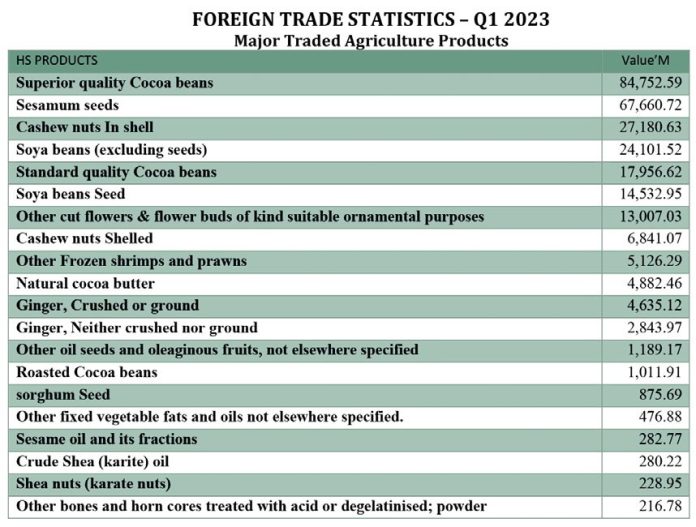
The exported agricultural products were dominated by ‘Superior quality cocoa beans’ valued at N84.75 billion followed by ‘Sesamum seeds,’ with N67.66 billion and ‘Cashew nuts in shell’ with N27.18 billion.
By direction of trade, ‘Superior quality cocoa beans’ worth N28.51 billion and N25.25 billion were exported to The Netherlands and Malaysia, respectively. Furthermore, ‘Sesamum seeds’ worth N21.88 billion and N20.28 billion were exported to China and Japan respectively. Export of ‘Cashew nuts in a shell’ worth N15.13 billion and N10.20 billion was made to the Socialist Republic of Vietnam and to India, respectively.
The agricultural sector has been severely challenged over insecurity, poor infrastructure, multiple taxes, inflation and post-harvest waste — knocking off the gains in the value chain. This has reflected in the quarterly GDP reports by the NBS for some time now, which shows the dwindling fortunes of the two key areas of the real sector – agriculture and manufacturing.
The statistics bureau in its Q1 2023 GDP report also showed that the agricultural sector grew by -0.90 percent (year-on-year) in real terms, representing a decrease of 4.06 percent points from the corresponding period of 2022. It recorded a decrease of 2.95 percent points from the preceding quarter which showed a growth rate of 2.05 percent.
The sector grew on a quarter-on-quarter basis at -30.95 percent.
In terms of total impact, the sector contributed 21.66 percent to overall GDP in real terms in Q1 2023, lower than the contribution in the first quarter of 2022 and lower than the fourth quarter of 2022 which stood at 22.36 percent and 26.46 percent respectively.
To boost non-oil exports and expand the contribution of agriculture to GDP, the Central Bank of Nigeria (CBN) created several intervention schemes to achieve the objective. The latest is the RT 200 introduced in February 2022 to revolutionise non-oil export, stimulate domestic production and expand the frontier of diversification.
The RT 200 which stands for ‘Race to US$200 billion in Forex Repatriation’ constitutes a blueprint that will enable Nigeria to attain the sky-high goal of US$200 billion repatriation, exclusively from non-oil exports over the next 3 to 5 years.
Assessing the performance of the scheme at the 3rd edition of the Biannual RT200 Non-Oil Export Summit, in Lagos on May 9, 2023, the Governor, CBN, Mr Godwin Emefiele, disclosed that proceeds of non-oil exports repatriated under the RT200 programme increased by 40 percent to $5.6 billion in 2022 as against $3.0 billion in 2021.
He added that indications had proved that the trend in the first quarter of 2023, was also encouraging as a total of $1.7 billion repatriation was recorded during the period.
“The momentum for 2023 is equally showing strong numbers and impressive prospects.
“In the first quarter of 2023, a total of US$1.7 billion was repatriated to the economy while about $790 million was sold at the I&E window year-to-date,” Emefiele said.
The intervention funds include the Agricultural Credit Guarantee Scheme (ACGS); Nigeria Incentive-Based Risk Sharing System for Agricultural Lending (NIRSAL) and the Commercial Agriculture Credit Scheme (CACS).
Others are the N220 billion Micro, Small and Medium Enterprises (MSME) Fund; the Anchor Borrowers’ Programme, and the Small Medium Enterprise Credit Guarantee Scheme (SMECGS), among others.
In a bid to ensure that businesses across all sectors of the economy sustained their operations after the COVID-19 pandemic, CBN introduced several loan opportunities under its intervention arrangement in favour of agriculture.
These include the AGSMEIS Loan for SMEs And Agricultural Businesses Without Collateral; Anchor Borrowers Programme (ABP) Intervention For Agriculture; Accelerated Agricultural Development Scheme (AADS) Loan; MSMEDF Loan – Micro, Small and Medium Enterprises Development Fund.
The famed Anchor Borrowers’ Programme (ABP) brought unusual reform to Nigeria’s agricultural sector.
Under the scheme, the bank granted N756.51 billion to 3,734,938 small holder farmers cultivating 4.6 million hectares of land, of which N120.24 billion was extended for the 2021 Wet Season to 627,051 farmers for 847,484 hectares of land.
The result was a boost in productivity beyond expectation.
The ABP saw the farmers, the millers, the off-takers and others actively involved in the value chain advancement. The scheme created over 3.5 million jobs.
The CBN also created the Agribusiness/Small and Medium Enterprise Investment Scheme (AGSMEIS), and the Targeted Credit Facility (TCF) through which the sum of N121.57 billion was disbursed to 32,617 beneficiaries; while N318.17 billion was released to 679,422 beneficiaries, comprising 572,189 households and 107,233 Small and Medium Enterprises (SMEs), respectively.

Sam Diala is a Bloomberg Certified Financial Journalist with over a decade of experience in reporting Business and Economy. He is Business Editor at THEWILL Newspaper, and believes that work, not wishes, creates wealth.