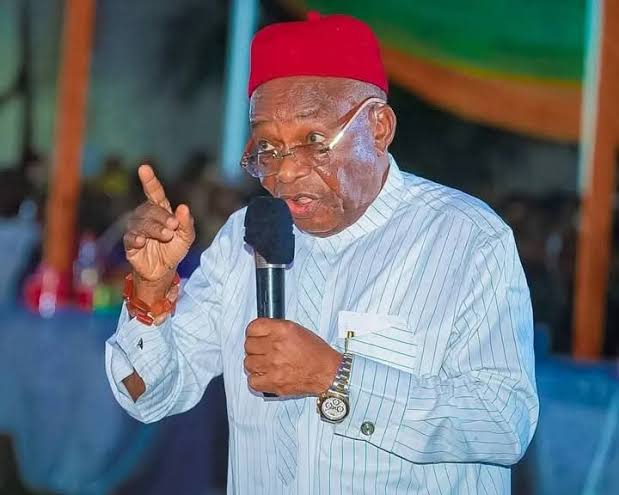
August 02, (THEWILL) — Former Minister of Lands and Urban Development, Chief Nduese Essien, condemned in strong terms, the renewed agitations for a separate Obolo State, describing the move as a veiled attempt to annex Ibibio ancestral lands.
Chief Essien, a two-term member of the House of Representatives, described the agitation as “land grabbing in disguise”, warning that no inch of Ibibio land would be ceded under any pretext.
Speaking in Uyo as Chairman of the occasion during the installation of His Eminence, Ntenyin (Dr) Solomon Daniel Etuk, CFR, as the 4th Grand Patron of Mboho Mkparawa Ibibio, the elder statesman recalled a century-long history of efforts to seize control of the Ibibio coastline, particularly the Stubbs Creek Forest.

According to him, the Ibibio people have consistently defended their territorial rights, even up to the Privy Council in London. “Today, the same people, with new allies from neighbouring states, are attempting the same agenda, this time under the guise of creating Obolo State”, he declared.
“Let me emphasise unambiguously: any attempt to appropriate Ibibio land must be vehemently resisted. This ill-fated expedition has been exposed and must end. No part of Ibibio land will be annexed”, Essien stated.
He recalled previous attempts to encroach on Ibibio territory, notably the violent episode in 1993, which was curtailed by the Justice Ephraim Akpata Commission of Inquiry, and another in 2014 during the National Conference, where a proposal was made to merge the region with parts of neighbouring Rivers State into a so-called “Oil Rivers State.”
Essien’s remarks were met with resounding applause from a distinguished audience that included traditional rulers, government officials, youth leaders, professionals, and members of the press.
While the installation of the Oku Ibom Ibibio as Grand Patron was the main event, the Attah of Eket seized the moment to charge Mboho Mkparawa Ibibio and other socio-cultural organisations to transcend ceremonial roles and take up more active responsibilities in protecting Ibibio heritage, promoting justice, and contributing to national discourse.
He commended Mboho Mkparawa for its strides since its founding in 1987—highlighting its contributions in education, agriculture, tourism, and cultural revival—but warned against it being used as a vehicle for personal political ambitions.
“Mboho must develop the courage to speak truth to power. Its loyalty must be to the people, not to any political establishment.”
In a direct appeal to the youth, Chief Essien urged them to preserve their culture and history by speaking the Ibibio language, respecting traditions, and shunning cultism and other social vices.
The installation of the Oku Ibom Ibibio as Grand Patron was widely hailed as a significant endorsement of unity between traditional authority and the collective aspirations of the Ibibio people.
Describing the symbolic alignment, Chief Essien noted, “The Oku Ibom now serves as a link between our glorious past, our vibrant present, and the promise of a bright future.”
He concluded with a renewed call for unity among all Akwa Ibom people, urging socio-cultural groups to champion a common identity and focus their energies on national relevance and developmental initiatives.