
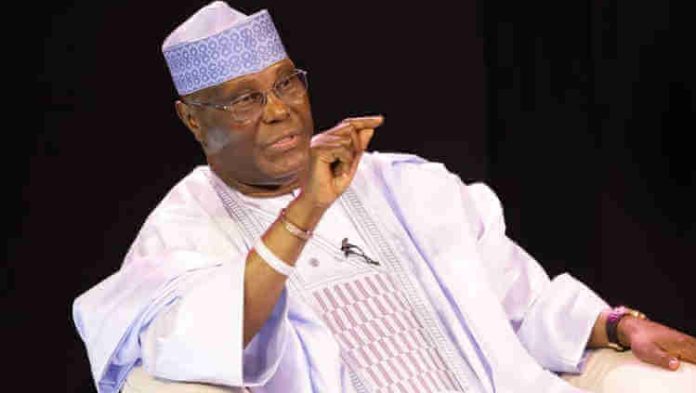
July 4 (THEWILL) — Former Vice President and the presidential candidate of the African Democratic Congress (ADC), Atiku Abubakar, has raised fresh concerns over the management of Nigeria’s public finances, accusing the administration of President Bola Tinubu of operating what he described as a “shadow treasury” after citing findings from the International Monetary Fund (IMF), which he claimed, revealed that public expenditures equivalent to about two percent of Nigeria’s Gross Domestic Product (GDP) were executed outside the country’s official budget framework.
In a statement issued on Saturday, Atiku described the alleged development as “the most consequential act of fiscal impunity in Nigeria’s recent democratic history”, alleging that approximately ₦8.8 trillion in public expenditure was neither captured in official budget documents nor subjected to constitutional oversight.
The former Vice President said his concerns were prompted by the IMF’s latest Article IV consultation on Nigeria, published by Reuters on July 1, 2026, which, according to him, disclosed that government expenditures amounting to roughly two percent of GDP had not been recorded in recent official budgets. Using Nigeria’s estimated GDP of about ₦441.5 trillion, Atiku said the figure translates to approximately ₦8.8 trillion.

“My attention has been drawn to a deeply troubling report by the International Monetary Fund… which reveals that the Tinubu-led APC administration failed to record public expenditures amounting to approximately two percent of Nigeria’s Gross Domestic Product in recent official budgets”, he stated.
He said the revelation should concern every Nigerian, urging the media, civil society organisations, the National Assembly and democratic institutions to treat the issue as a constitutional emergency rather than a routine fiscal matter.
According to Atiku, the IMF attributed the discrepancy to large-scale government projects allegedly executed outside the country’s statutory budget process. He argued that if the report was accurate, it suggested that multi-trillion-naira contracts and capital projects were being implemented without the scrutiny of the National Assembly, outside the oversight of the Auditor-General of the Federation and beyond the reach of Nigeria’s procurement laws.
He described the alleged arrangement as “a parallel fiscal universe governed by executive whim”, insisting that it represented a direct assault on constitutional accountability and transparent governance.
The former Vice President further alleged that the development followed what he described as a familiar pattern established during Tinubu’s tenure as Governor of Lagos State through the controversial Alpha Beta revenue collection arrangement.
According to Atiku, revenues collected under that arrangement allegedly escaped full legislative appropriation before entering government coffers. He argued that what the IMF allegedly documented at the federal level reflected the same governance model, only on a much larger national scale.
“What the IMF has now documented at the federal level is that same Lagos playbook replicated at the national scale and with national consequences”, he alleged.
Beyond the alleged off-budget expenditures, Atiku also accused the Federal Government of unlawfully withholding approximately ₦800 billion from statutory allocations due to state governments.
He claimed the deductions were carried out without the authorisation of the National Assembly, judicial approval or any constitutional basis, alleging that the funds had been diverted to projects and purposes yet to be disclosed to Nigerians.
According to him, the alleged ₦800 billion deductions, when combined with the reported ₦8.8 trillion in unrecorded public expenditure, suggested the creation of what he described as a massive political “war chest” ahead of the 2027 general elections.
“When a government operates a secret treasury of this scale at precisely the moment it needs to purchase electoral outcomes, the conclusion is not difficult to reach. The Tinubu administration is not reforming Nigeria’s economy. It is financing its own political survival with money that belongs to the Nigerian people”, Atiku alleged.
The former Vice President also linked his allegations to the recent controversy surrounding the insertion of ₦1.3 billion in the 2026 Appropriation Act for the Presidential Foreign Intervention Promotion Council, an agency whose existence was subsequently questioned by the Federal Government.
According to him, the controversy over what he described as a “ghost agency” reflected the same governance culture that allegedly permitted trillions of naira to be spent outside official budget records.
“The ghost agency and the shadow budget are not separate scandals. They are two expressions of the same governing philosophy”, he said.
Atiku further accused the Tinubu administration of imposing painful economic reforms on Nigerians while allegedly operating undisclosed public spending outside constitutional accountability mechanisms.
He argued that the removal of fuel subsidy without adequate social protection, repeated devaluation of the naira, high interest rates, rising inflation and increased public borrowing had inflicted unprecedented hardship on citizens.
According to him, successive policy decisions had eroded the purchasing power of workers, traders, pensioners and small businesses while making access to credit increasingly difficult for manufacturers and entrepreneurs.
He claimed that Nigerians had consistently been told that the treasury was under severe pressure and that difficult reforms were unavoidable, only for the IMF report, in his view, to suggest the existence of substantial public expenditure outside official records.
Atiku argued that if the alleged ₦8.8 trillion had been transparently appropriated and deployed through constitutional processes, it could have supported productive sectors of the economy, strengthened the naira, reduced borrowing costs, stimulated manufacturing, expanded agricultural production and created employment opportunities.
He also alleged that the reported off-budget spending partly explained why contractors were allegedly owed outstanding payments and why some public sector obligations remained unsettled.
Drawing comparisons with his economic proposals during the 2023 presidential election campaign, Atiku recalled that he had proposed a $10 billion economic stimulus package to stabilise the exchange rate, support businesses and create jobs.
According to him, critics had questioned the feasibility of mobilising such resources, but he argued that the alleged ₦8.8 trillion identified by the IMF demonstrated that significant fiscal resources existed but were, in his view, deployed without transparency or accountability.
“The poverty of Nigerian citizens today is not fate. It is policy, or more precisely, it is the consequence of the absence of transparent, accountable, productive economic policy”, he stated.
The former Vice President consequently demanded immediate action from relevant institutions, beginning with what he described as emergency investigative hearings by the National Assembly into the IMF’s findings.
He also called for the Auditor-General of the Federation to conduct a comprehensive and independent audit of all alleged off-budget expenditures referenced in the IMF’s Article IV consultation and publish the findings without redaction.
Atiku further demanded that the Federal Government provide a detailed public account of every naira allegedly spent outside the official budget, identifying the projects executed, contractors engaged, procurement procedures followed and officials who authorised the expenditures.
He equally urged the Federal Government to refund the alleged ₦800 billion deducted from state allocations and account for how the funds were utilised.
The former Vice President further called on the Economic and Financial Crimes Commission, the Independent Corrupt Practices and Other Related Offences Commission and other law enforcement agencies to commence independent investigations into both the alleged off-budget expenditures and the disputed deductions from state allocations.
He also urged civil society organisations, professional associations, the organised private sector and the international community, particularly international financial institutions, to insist on accountability and transparency in the management of Nigeria’s public finances.
“A government that governs in secret spends in secret. A government that spends in secret does not govern—it plunders”, Atiku declared, insisting that the allegations were based on observations attributed to the IMF rather than partisan political criticism.
The former Vice President maintained that the issues raised transcended party politics and challenged every democratic institution to ensure that public resources were managed in accordance with constitutional provisions.
Felix Ifijeh is a journalist with years of professional reporting experience. Known for his keen news sense, compelling storytelling and commitment to accurate, impactful reporting, he has built a reputation for turning leads into clear, engaging, and well-structured reports that resonate with readers. His work reflects deep newsroom experience and a commitment to accurate, impactful journalism.
