
-
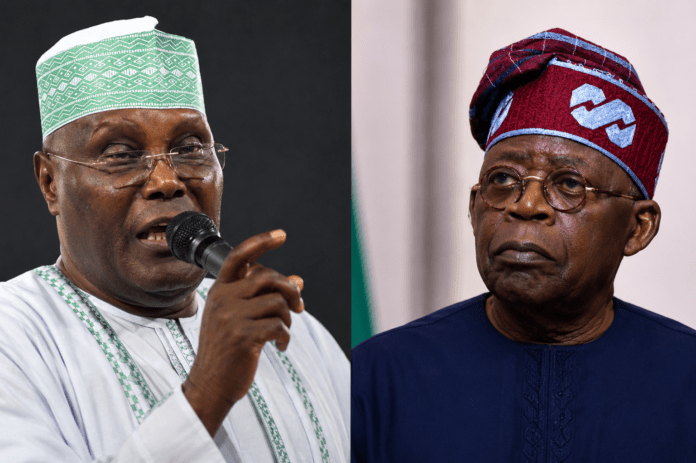
Atiku accuses the Tinubu administration of using macroeconomic statistics and official narratives to mask worsening poverty, hunger, and declining living standards across Nigeria.
-
The former vice president questions the gains from fuel subsidy removal, rising public debt, and crude-backed financing deals, insisting Nigerians deserve greater transparency and accountability.
-
Citing Manufacturers Association of Nigeria (MAN) figures, he says 767 factories have shut down, 335 are distressed and trillions of naira in unsold goods reflect a worsening business climate.
-
The latest broadside signals an escalation of opposition attacks ahead of the 2027 presidential election, with Atiku positioning the economy as a central campaign issue.
Aug 03, (THEWILL) — The African Democratic Congress (ADC) presidential candidate, Atiku Abubakar, has launched a fresh attack on President Bola Tinubu’s economic policies.
He accused the administration of relying on favourable economic statistics and official narratives to conceal what he described as deepening hardship across the country as political activities gradually build towards the 2027 general election.
The former Vice President in a statement issued on Monday by his Senior Special Assistant on Public Communication, Phrank Shaibu, dismissed the Presidency’s defence of Tinubu’s economic record.

He argued that no amount of statistical analysis or government messaging could erase the daily struggles of millions of Nigerians battling inflation, hunger, unemployment, and declining purchasing power.
Atiku said the Tinubu administration had devoted considerable energy to defending its economic policies while failing to answer what he described as the most important question confronting Nigerians: why living conditions continue to deteriorate despite repeated assurances that the economy is improving.
“If the economy is doing so well, why are Nigerians getting poorer?” Atiku asked, insisting that governments are elected to improve the lives of citizens rather than produce impressive economic data.
He added, “Governments are not elected to improve spreadsheets. They are elected to improve the lives of their people. Nigerians cannot eat GDP.
“They cannot cook with debt-to-GDP ratios. They cannot pay school fees with statistical projections. The true measure of economic management is whether families are living better today than they were yesterday.”
Questions Tinubu’s Economic Narrative
Atiku argued that the Presidency’s emphasis on GDP growth, exchange-rate reforms, and improved debt ratios reflected a disconnect between official economic indicators and the realities experienced by ordinary Nigerians.
According to him, market women, artisans, transport operators, manufacturers, civil servants, and small business owners continue to struggle with soaring prices, high operating costs, and shrinking purchasing power despite the government’s optimistic assessment of the economy.
He cited the latest International Monetary Fund (IMF) Article IV Consultation, noting that while the Fund acknowledged progress in some reform areas, it also estimated that about 63 per cent of Nigerians now live below the national poverty line, while approximately 27 million people experienced food insecurity in late 2025.
According to Atiku, those findings reinforced his argument that macroeconomic stability has yet to translate into meaningful improvements in the welfare of ordinary citizens.
The former vice president also challenged the administration’s defence of its borrowing profile, arguing that the real issue was not the size of Nigeria’s debt but whether borrowed funds were delivering measurable improvements in infrastructure, job creation, electricity supply, and public services.
He questioned why the Federal Government continued to accumulate fresh debt despite repeatedly celebrating increased revenues from fuel subsidy removal and improved tax collections.
“If revenue has improved so dramatically, why does this administration continue to borrow at record levels?” he asked.
On fuel subsidy removal, Atiku maintained that Nigerians never opposed difficult economic reforms but expected the promised savings to translate into better healthcare, education, transportation, infrastructure, and social protection.
Instead, he argued, citizens had been left with record fuel prices, rising transport fares, worsening food inflation, and a severe cost-of-living crisis.
He further called for full disclosure of crude-backed financing arrangements, saying Nigerians deserved to know how much of the country’s future oil production had been committed, under what terms, and for which projects.
Atiku devoted a significant part of his statement to what he described as the deteriorating condition of Nigeria’s manufacturing sector, insisting that the industry’s performance offered a more accurate assessment of the economy than government statistics.
Citing figures released by the Manufacturers Association of Nigeria (MAN), he said 767 manufacturing companies had shut down, while another 335 were currently operating under severe financial distress.
He added that manufacturers were holding approximately ₦2.14 trillion worth of unsold finished goods because many Nigerians could no longer afford to buy basic products.
According to him, multinational companies including Procter & Gamble, GlaxoSmithKline, Sanofi, and Kimberly-Clark had either exited or suspended local manufacturing operations, while indigenous firms were also struggling under rising production costs.
He further noted that manufacturers spent about ₦1.11 trillion on diesel to power their factories following rising electricity tariffs and persistent power supply challenges.
“Factories do not shut down because the opposition writes press statements. Manufacturers do not accumulate trillions of naira in unsold goods because critics hold press conferences.
“They leave because the economic environment has become increasingly hostile to production, investment, and enterprise,” he said.
Beyond economic management, Atiku also faulted the administration’s claims of significant achievements in healthcare, education, and infrastructure.
He argued that healthcare should be assessed by citizens’ ability to obtain affordable treatment without financial hardship, noting that Nigeria still records one of the highest maternal mortality rates globally and continues to lose medical professionals to migration.
On education, he said student loan programmes alone could not be presented as evidence of meaningful reform while millions of children remained out of school and educational infrastructure continued to deteriorate in many parts of the country.
He also maintained that infrastructure projects should be judged by their impact on electricity supply, transportation, productivity, and the cost of doing business rather than by the number of projects announced.
Political Battle Ahead of 2027
The latest statement represents one of Atiku’s most extensive critiques of the Tinubu administration since the 2023 presidential election and is expected to further intensify political debate as preparations for the 2027 general election gather pace.
With the economy emerging as one of the dominant issues likely to shape the next electoral cycle, the former vice president appears determined to frame the contest around the impact of the administration’s reforms on the everyday lives of Nigerians.
Atiku concluded that the ultimate verdict on the government’s performance would come from ordinary Nigerians rather than official statements issued from the Presidential Villa.
“The report card of this administration is not written in the corridors of Aso Rock. It is written every day in the markets, on the farms, in the factories, in hospitals, in classrooms, and in millions of Nigerian homes,” he said.

Felix Ifijeh is a journalist with years of professional reporting experience. Known for his keen news sense, compelling storytelling and commitment to accurate, impactful reporting, he has built a reputation for turning leads into clear, engaging, and well-structured reports that resonate with readers. His work reflects deep newsroom experience and a commitment to accurate, impactful journalism.
