SAM DIALA shows how the audacious stance of brave domestic investors lifted Nigeria’s equities market to a 15-year high after foreign investors fled in 2020.
Nigeria’s equities market recorded an outstanding performance in the first half of the year (H1-2023), which put the country on a global spotlight. This was the outcome of audacious domestic investors whose unmatched resolution lifted and repositioned the domestic bourse some years after the bellwether foreign-portfolio investors had fled.
Investors’ exit
Following the outbreak of COVID-19 in 2020, foreign bargain hunters exited Nigeria’s equities market in droves and this negatively affected the performance of the local bourse.

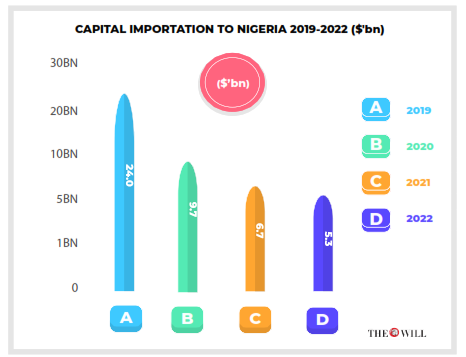
Checks showed that investment inflow (which reflects multiple foreign portfolio investments) to the economy declined by 78 percent between 2019 and 2022, as follows: $24 billion, $10 billion, $5.7 billion and $5.4 billion in 2019, 2020, 2021 and 2022 respectively, according to data from the Nigerian Exchange Group (NGX).
A report by NGX also showed that foreign portfolio investors (FPI) scaled down their investments in Nigeria’s stock market to N53.71 billion in the first quarter of 2023, following concerns around rising socio-political risks and other macroeconomic uncertainties.
This represents a 58.3 percent year-on-year (y-o-y) decline compared to N128.91 billion they staked in the corresponding period in 2022.
In a graphic detail, the NGX reported that in 2022, the foreign portfolio investors (FPI) staked N156.3 billion and took away N173.32 billion. This implies that these portfolio investors left just N6.83 billion in Nigeria equities.
The monthly breakdown showed that in January 2022, foreigners invested N18.10 billion in stocks but took out N23.21 billion from the market. They brought in N20.86 billion and took out N24.57 billion in February.
The trend continued in March when the foreigners invested N16.37 billion in Nigerian stocks but took out N25.80 billion. In April, foreign inflows into the market were N15.02 billion while N12.06 billion was taken out of the market by foreign portfolio investors.
The foreigners invested N25.53 billion in Nigerian stocks in May and took out N19.7 billion, while in June they invested N24.63 billion in stocks and moved out N17.56 billion from the market.
The foreign inflow into the Nigerian capital market was N15.78 billion while N12.43 billion was recorded as an outflow executed by foreign investors in August.
In September, foreigners invested N10.08 billion in the stock market but moved N9.59 billion out; while in October they invested N18.16 billion in stocks but went away with N10.39 billion.
The summary of stock transactions for November 30, 2022 showed that foreign inflows into the stock market were worth N13.68 billion while the foreign outflow was N16 billion. The scenario created a panic among domestic investors who lacked the war-chest their foreign counterparts had displayed in mustering the shares of firms with strong fundamentals.
“In that gloom, it was not expected that domestic investors, who had played a second fiddle in the foreign-dominated local bourse over the years, could take such a brave step that eventually culminated in lifting and repositioning the equities market,” said Sam Ndata, Doyen of Nigerian Stockbrokers and non-executive director at UIDC Securities Limited, in a note to THEWILL.
Ndata noted that the impressive performance of the equities market driven by the audacious move of domestic investors dazzled market watchers.
Audacious players
Despite the headwinds that characterised the operating environment when the economy slipped into a recession, the market rallied amid buying interest from domestic investors, especially in bellwether stocks. Domestic investors also stepped up their listings on the local bourse at a time no foreign investor looked towards Nigeria.
Investigation showed that, besides buying pressure, no less than N8 trillion was added to the capital market capitalisation through new listings by eight indigenous firms during the last two year period.
The companies include Access Corporation (N562 billion), BAPlc (N62.5 million), Bua Cement (N3.31 trillion) and Bua Foods (N3.44 trillion).
Others are Geregu (N750 billion), GTCO (N1.030 trillion), Ronchess Global (N223.6 billion) and Sterling Financial Holdings (N74.3 billion).
The impressive performance dazzled market watchers who wondered how domestic investors who had played a minority role in the market dominated by foreign investors, could lift and reposition the local bourse at a very challenging time.
Amazing outcome
Findings showed that the development contributed largely to the outstanding performance of the equities market during the first half of 2023, as reported by the NGX in its report.
In H1-2023, the NGX All-Share Index (ASI), an indicator which is used to measure the performance of listed firms on NGX, hit a 15-year high for the first time since March 12, 2008. It also crossed 60,000 index basis points (bsp) to close at 60,968.27 bsp as against an opening value of 51,251.06 bsp (January 3, 2023).
This implies an increase of 8,717.21 bsp or 18.96 percent rise. Similarly, the market capitalisation of listed companies, which had opened the year (on January 3, 2023) at N27.915 trillion, closed on Friday, June 30 at N33.197 trillion — a gain of N5.3 trillion in six months (H1: 2023).
This represents an overall year-to-date gain of 18.96 percent. It also confirmed investors’ gain of N5.3 trillion during the period.
The result was an outstanding performance given the circumstance the market operated in the past three years since the COVID-19-raven 2020, which triggered the mass exodus of foreign investors, compounded by severe macroeconomic headwinds.
Experts speak
Capital market sources said the battle of huge war chests in the form of Greenmail, which hinges on a hostile approach to take over a target company, could be part of the rally in the equities market.
“Greenmail or greenmailing is the action of purchasing enough shares in a firm to challenge a firm’s leadership with the threat of a hostile takeover to force the target company to buy the purchased shares back at a premium. This could lead to a temporary high in share price which is part of the boom we see in the equities market,” said Dr Paul Uzum, a stockbroker and Head of Securities Trading at Planet Capital.
Uzum’s example could be seen in the case of the battle for the soul of Transcorp Plc between Femi Otedola and Tony Elumelu in the first quarter of 2023 where the duo tried to out-smart one another (through amassing of the company’s stocks) in order to assume the control of the conglomerate.
However, Sam Ndata shared a different view. He said the bullish trend in the Nigerian equities market cannot be detached from political activities that heightened in 2022, culminating in the general elections in the first quarter of 2023.
According to Ndata, the flock to the equities market had been the trend during election seasons when there is a lot of cash in circulation. He noted that the Central Bank of Nigeria (CBN) tight monetary policy could not dampen the flood into the equities market because of the circumstances surrounding the source of the funds.
“The politicians are no longer interested in buying houses or dumping their money in their bank accounts. In order to run away from the prying eyes of the anti-graft agencies, they put their money in stocks where it is safe and covered,” Ndata said in a telephone chat. He however noted that credit must be given to the domestic investors who held the ace when the foreign investors took their exit.
The Chief Relationship Officer, Foresight Securities and Investments Limited, Charles Fakrogha, noted that the huge volumes of shares traded recently meant that foreign investors might be thinking about making a comeback into the equities market following the pro-market stance of the new government.
But domestic investors should be commended for their confidence in the equities market as shown in the massive risks they embraced which salvaged the local bourse at a very difficult time.
A significant point to note is that investors look forward to a harvest of more dividends this year as the earnings season approaches. Some analysts believe that the pro-market focus of Nigeria’s new government contributed to the boom in the local bourse.
However, look at the HY-2 performance of the NGX showed that the bullish trend had commenced much earlier before the inauguration of the new administration on May 29, 2023. This suggests that the domestic investors played a key role in repositioning Nigeria’s equities market when the foreign investors took to their heels.

Sam Diala is a Bloomberg Certified Financial Journalist with over a decade of experience in reporting Business and Economy. He is Business Editor at THEWILL Newspaper, and believes that work, not wishes, creates wealth.