
December 09, (THEWILL) – The ongoing recapitalisation of Nigerian banks must be executed in a manner that boosts investors’ confidence while guiding against short-changing them, industry experts and stakeholders have emphasized.
This view was expressed at the annual conference of the Capital Market Correspondents Association of Nigeria (CAMCAN) held in Lagos at the weekend with the theme, ‘Banks’ Recapitalization: Bridging the Gap Between Investors and Issuers in the Nigerian Capital Market’.
Participants at the event which included regulators, operators and other stakeholders were unanimous in their positions that the ongoing banks’ recapitalisation exercise must toe the lines that enhance investors’ confidence both during and after the exercise.
They also recalled previous recapitalisation programmes which suffered policy implementation shortcomings that created lasting negative effects on the industry, and urged the authorities to embrace technology and other transparency-enhancing tools for effective delivery.
The capital market regulator, the Securities and Exchange Commission (SEC) urged banks to strengthen their corporate governance principles and risk management framework to enhance investors’ confidence in the recapitalisation exercise.
The SEC Director-General, Dr Emomotimi Agama, emphasised the commission’s commitment towards ensuring transparency and efficiency in the recapitalisation process.
Agama, who was represented by the Divisional Head, Legal and Enforcement at SEC, Mr John Achile, noted that the framework on the banking sector recapitalisation (2024–2026) provided clear guidance for issuers while also safeguarding the interests of investors.
He noted that the key to bridging the gap between issuers and investors remained the harnessing of innovation for inclusive growth.
In view of this, he pointed out that SEC, through the aid of digital platform, is exploring the integration of blockchain technology for secure and transparent transaction processing, a step that will redefine trust in the market.
Agama noted that the oversubscription of most recapitalisation offers in 2024 reflects strong investor confidence.
To sustain this momentum, he said that SEC has intensified efforts to enhance disclosure standards and corporate governance practices.
On his part, an economist, Mr Johnson Chukwu, who was the guest speaker at the CAMCAN event, stressed the need for effective deployment of technology in nthe process.
According to Chukwu who is the CEO of Cowry Assets Limited, the Central Bank of Nigeria (CBN) must deploy available Infrastructure technology and Bank Verification Numbers (BVN) to tackle delay in the verification of banks’ offers and ensure speedy conclusion of the process.
Chukwu noted that the delay in the apex bank’s verification process has continued to raise concerns among investors, especially as it has not been able to conclude any almost four months after the closure of some offers.
According to the economist/banker, the deployment of high level of IT available at the CBN and the use of the BVN would fast-track the process of accepting or rejecting offers and enable investors get their allotment or deploy their funds in other profitable economic activities.
He argued that while the apex bank’s role in verifying the source of the capital invested is important, the longer period for completion of the verification process is dampening investors’ confidence.
He noted that this is particularly worrisome for investors whose funds may be returned where the offers may be oversubscribed given the missed reinvestment opportunities.
Chukwu also stated that the current CBN requirements for investors investing in banks shares are seen by many as overly stringent and creating barriers for both issuers and investors.
He cited the provision of three-year audited financial statements, board resolution authoring the investment and tax clearance certificates for the past three years for corporate investors, noting that these requirements are disincentive to investment in the capital market.
He added that while regulation is necessary for maintaining the stability and integrity of the financial system in ensuring that unqualified capital is not invested in the banks, there is need to leverage on existing customer information in the banking system to avoid imposing onerous conditions on investors.
Participants observed that the lingering and rising figure of unclaimed dividend poses a challenge towards achieving high investors’ confidence in the capital market.
However, SEC blamed the inability of investors to comply with regulatory requirements and information gap, noting that the capital market regulator has done everything within its powers to ensure that investors receive their dividend at the appropriate time despite the discouragement that the situation portends.
However, it assured that the commission would continue to strengthen its dual role of market regulation and investor protection to boost confidence in the market.
THEWILL recalls that on March 28, 2024, the CBN issued a directive to financially reshape the domestic money banks (DMBs), which spiked a theatre of competition among the operators.
In a direct memo, the CBN revised the capitalization requirements, setting new benchmarks for banks with international operations at N500 billion, national licences, N200 billion, and regional licences, N50 billion. This directive, a crucial step towards a stronger banking sector, initiates a time-sensitive two-year journey that will start on April 1, 2024, and end on March 31, 2026.
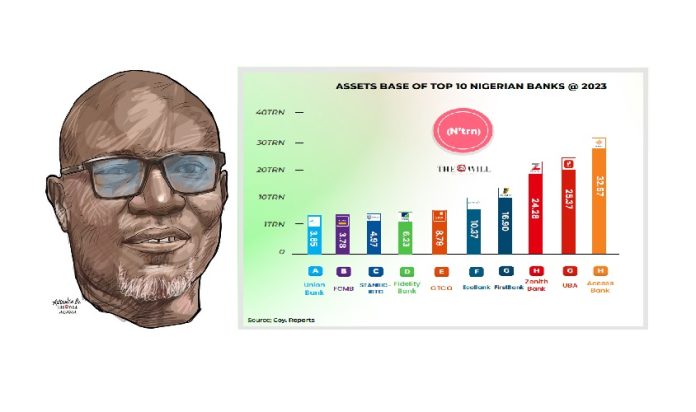
Going by the data available, commercial banks in the country would require a combined N3.894 trillion to meet the new baseline capital requirements.
This will necessitate capital raising efforts to the combined tune of N3.894 trillion to meet the new baseline capital requirements. The capital raising would be from both domestic and international markets which the banks have already keyed into.
According to available data, under commercial banks with international authorization of N500 billion, in meeting with the new capital base, Access Bank, Fidelity Bank, FCMB, First Bank, Guaranty Trust Bank, Union Bank, United Bank for Africa and Zenith will be raising capital of N248.19 billion, N370.30 billion, N374.71 billion, N248.66 billion, N361.81 billion, N351.91 billion, N384.19 billion, and N229.25 billion respectively.
Also, CitiBank Nigeria Limited, Polaris Bank, Stanbic IBTC Bank, Standard Chartered Bank Limited, Sterling Bank, Titan Trust Bank, Unity Bank, and Wema Bank will be adding a new capital of N185.56 billion, N149.57 billion, N90.74 billion, N154.58 billion, N142.85 billion, N90.74 billion, N154.58 billion, N142.85 billion, N170.80 billion, N183.67 billion, and N184.87 billion respectively.

Sam Diala is a Bloomberg Certified Financial Journalist with over a decade of experience in reporting Business and Economy. He is Business Editor at THEWILL Newspaper, and believes that work, not wishes, creates wealth.
