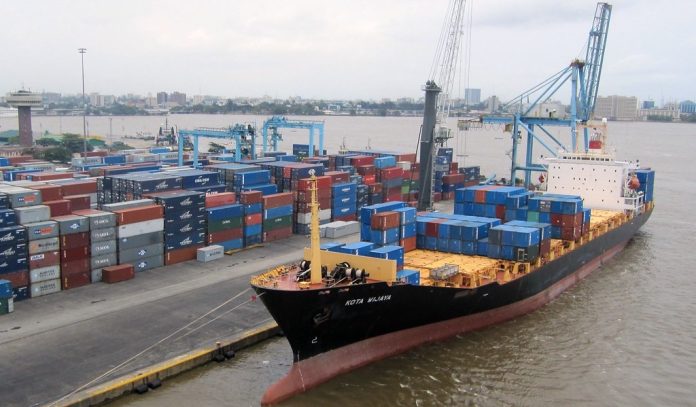
December 06, (THEWILL) – Where problems exist and persist, there are usually opportunities. This is the case in Lagos ports, where business opportunities abound alongside the perennial issue with vessel, truck, and cargo congestions. The ports, Apapa and Tin-Can, are the busiest in Nigeria, accounting for why the congestions exist and cargoes remain trapped. This situation makes cargo evacuation difficult and ultimately affects the ease of doing business in the ports and their environs.
These situations continue to hinder trade, free flow of traffic and ease of doing business in and around the Apapa area of Lagos. According to findings, the vessels calling at the Lagos ports suffer extraordinary delays. The waiting periods at the terminals exceed 20 days, which is bad for economic reasons.
The findings further showed that the congestions are largely due to inadequate and aging infrastructure, unautomated systems, bad and under-construction roads. In addition, the poor state of the rail system means 90 per cent of cargo cleared at the port have to be transported by road. These challenges are prevalent and, from information gathered, some shipping lines sometimes divert Nigeria-bound cargoes to ports in neighbouring countries.

With the perennial congestion and terminal operators running very low on yard space, there is a need for short- to medium-term solutions before the government comes up with a lasting resolution to the challenges.
In the meantime, opportunities exist in barge operations to ease cargo evacuation processes at the ports. From indications, barge operations have been initiated by maritime regulators to reduce the congestion at the ports, but it is high time more attention was paid to it and the benefits thereof.
For readers unaware of what a barge is, it is a wide and flat-shaped boat, like a raft, built mainly for river and canal transport of bulk goods. The main reason for this particular shape is to ensure that the cargo-carrying capacity is enhanced and more bulk can be hauled in and out conveniently. Therefore, efficient and regulated barge operations can effectively to resolve the congestion issue. This option can drastically reduce the pressure on the roads if adequately regulated and put to use. In my opinion, if harnessed with adequate technology, barge operation can improve the current situation at the ports, particularly the traffic gridlock in and around Apapa.
Without a doubt, barge operations can reduce the dwelling time of cargo and turnaround time on vessels calling at the Lagos ports. Further to this, using barges to evacuate cargo from the ports can become a sustainable way to reduce the burden on Nigerian roads. in the meantime. If the operation and setup are done effectively, it can help reduce the overall cargo clearing cost. In fact, if barge operations are encouraged on our waterways into the hinterland, the human and trailer traffic going into the ports will reduce significantly.
In addition, if barge operations are effectively adopted, the ports’ capacity to receive more imports would be enhanced and more shipping lines will be encouraged to call at the Lagos ports. Recall that Nigeria has the population, market, businesses and has an import-dependent economy. Therefore, barge operations can become an essential part of intermodal transportation in the country, a quick way to ensure seamless cargo evacuation from the ports.
Currently, cargoes from the ports are moved or evacuated mainly by trucks, while a very insignificant number is moved by rail. Barge operations can help improve the evacuation process at the ports. For example, a large number of the traffic entering the ports is to deliver empty containers. An alternative to these drop-offs of empty containers can be through barges to the ports, without the pressure on the roads and the long queues of articulated trucks at port entries. Recall, most of the time, a truck can only transport one container, irrespective of the size of the container. However, a barge can take at least twelve (12) 40-foot containers at once.
Therefore, container barging can form key succour to the current congestion at the ports and promote ease of moving cargo out of the ports. A good illustration of how barge operations can be effective can be seen in the arrangement to move 500 containers out of the Lagos ports in a day. The current situation will require 500 articulated trucks. However, only 42 flat container barges will be required to move the 500 containers to the hinterland, menaing there will 500 less cars on the road per day.
This will adequately decongest the port and the roads over time. In my opinion, barge operations can easily compliment the already established architecture at the ports and ease the high volume of traffic in and out of the ports. So, it is safe to say barge operations ought to be part of the architecture of the ports and consideration should be given to improve intermodal transportation around the country.
Considerably, for ease of cargo movement and to further promote ease of doing business at the ports, barge operations will assist. It will create jobs and help activate more new businesses in that ecosystem. Port terminal operators (companies that operate terminals) may need to align their operations with barge operations and ensure that barge loading points are created at their various terminals to grow and support this line of business.
When a more enabling environment exists, it expands opportunities and can be achieved at the ports with barge operations. In fact, it will drive job creation, promote more business creation and value-added services within the maritime sector. In reality, it will improve service delivery and business competitiveness at the ports. Truckers and haulage companies will eventually be challenged to innovate, reduce charges, and improve service delivery time.
In conclusion, there is a need to reduce cargo dwell time at the ports from twenty-one (21) days to the regional average of seven days and achieve efficient trade facilitation and ease of doing business at the ports. In the meantime, this can be achieved through the use of barge services.
Therefore, to support this cause, key stakeholders in the maritime sector, regulators, government agencies—National Inland Waterways Authority, NIWA; Nigerian Shippers Council, NSC; Nigeria Port Authority, NPA; Nigerian Maritime Administration and Safety Agency, NIMASA; Nigerian Navy, Nigeria Police, and Lagos State Waterways Authority, LASWA—need to work on barge operation regulations, licensing and registration, market entry and exit modalities, service minimum standards and standardization, security, safety, insurance, tariffs, pricing, and others to ensure stable operations of barges in the country. Good luck and God bless Nigeria!
•Dr Olubiyi is an entrepreneurship and business management expert.