
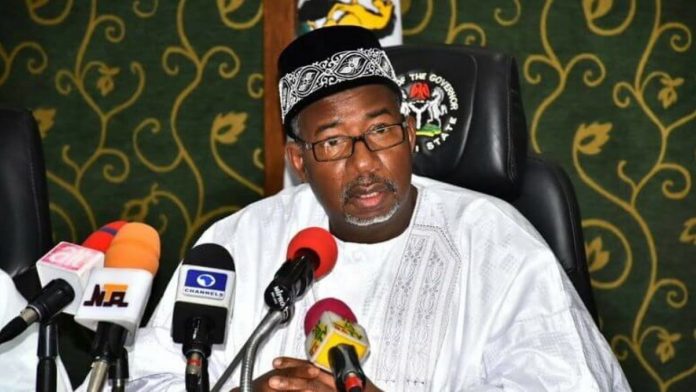
April 21, (THEWILL) — Bauchi State Governor, Bala Mohammed has announced what he described as a breakthrough in the fight against banditry, revealing that security forces have neutralised more than 20,000 bandits during coordinated operations across parts of the State.
The governor disclosed this while briefing journalists after a closed-door meeting with security agencies and critical stakeholders.
He said the operations, which combined ground assaults with aerial bombardments, targeted entrenched bandit camps in the Dajin Madam forest and adjoining areas extending toward Taraba State.

According to Mohammed, the offensive was driven by actionable intelligence and executed through joint efforts of the Nigerian Armed Forces and other security agencies.
He stated that troops successfully overran several camps, destroyed logistics bases, and disrupted the mobility of armed groups by targeting and eliminating motorcycles used for attacks and movement within forest corridors.
While the figure represents one of the most significant casualty claims in Nigeria’s ongoing security operations, it was not independently verified, raising questions about the scale and assessment of the reported losses.
Nonetheless, the governor maintained that the outcome has significantly weakened criminal networks that had long operated within the region.
Mohammed attributed the success of the operation to the intervention and support of President Bola Tinubu and the Office of the National Security Adviser, noting that federal authorities acted on concerns raised by residents over persistent insecurity.
He added that troops have established a sustained presence in recaptured areas to consolidate gains and prevent fleeing bandits from regrouping.
The use of air power, he said, played a decisive role in dislodging large settlements of armed groups hidden deep within forested terrain.
In a parallel strategy aimed at stabilising the security environment, the state government has introduced a “surrender window” for bandits willing to lay down their arms.
The governor clarified that the initiative is not an amnesty programme but a controlled reintegration process under strict government supervision.
“We are offering an opportunity for those who wish to abandon violence to return and reintegrate responsibly. This is not amnesty, but a structured pathway to peace,” he said.
He disclosed that the government is considering relocating those who surrender, including their families, particularly as many of the suspects are believed to be non-indigenes.
However, details on screening processes, accountability measures, and long-term reintegration frameworks were not fully outlined.
Beyond military operations, the state unveiled a comprehensive set of security reforms designed to prevent the re-emergence of criminal enclaves.
Central to this plan is the introduction of biometric profiling of residents in vulnerable communities, to be carried out in collaboration with the National Identity Management Commission and other relevant federal agencies.
The initiative, according to the governor, is aimed at tracking population movements, strengthening intelligence gathering, and eliminating ungoverned spaces that have historically served as safe havens for criminal elements.
Additional measures include intensified surveillance across public spaces such as markets and motor parks, as well as intelligence-led monitoring systems to detect suspicious activities.
Mohammed emphasised that these steps are necessary to ensure that no part of the state remains beyond the reach of governance or security oversight.
The government also plans to strengthen community-based security frameworks by recruiting and supporting local vigilante groups to complement formal security agencies.
While such arrangements have been widely adopted in parts of northern Nigeria, they continue to generate debate around regulation, training, and oversight.
Residents were urged to cooperate with security agencies and remain vigilant, even as communities continue to deal with the broader impact of years of banditry, including displacement, economic disruption, and social instability.
Governor Mohammed reiterated his administration’s commitment to sustained collaboration with federal authorities, traditional institutions, and security stakeholders to ensure that recent gains are not reversed.
He said the combination of military pressure, intelligence coordination, and administrative reforms would form the foundation for long-term peace and stability in Bauchi State, while acknowledging that continued vigilance and public cooperation remain critical to securing lasting results.

Felix Ifijeh is a journalist with years of professional reporting experience. Known for his keen news sense, compelling storytelling and commitment to accurate, impactful reporting, he has built a reputation for turning leads into clear, engaging, and well-structured reports that resonate with readers. His work reflects deep newsroom experience and a commitment to accurate, impactful journalism.
