December 22, (THEWILL) – The Bayelsa State Government has launched an ambitious dry season farming programme aimed at boosting agricultural output and ensuring food security across the state.
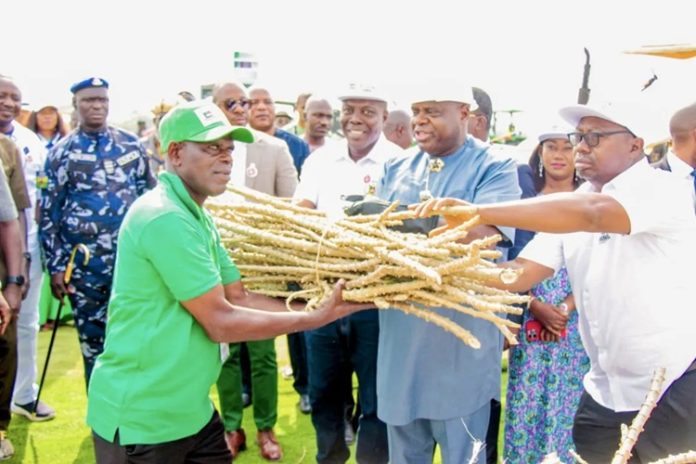
Speaking at the official flag-off of the 2024/2025 dry season farming initiative at the Ministry of Agriculture’s rice farm in Otuasega, Ogbia Local Government Area, Governor Douye Diri called on residents, including government officials, to embrace farming as part of efforts to transform Bayelsa into a productive economy.
The initiative focuses on providing farmers with essential inputs, technical assistance, and training in areas such as irrigation, soil preparation, and post-harvest management. The government plans to cultivate rice, cassava, plantain, and other crops where the state has comparative advantages.

Governor Diri reiterated his administration’s commitment to food security and challenged public officeholders to own and manage farms, no matter the scale.
“All of us should engage in farming, including appointees. This is a clarion call to support our farmers and ensure food security. The era of subsistence farming is over; farming is now big business,” the governor stated.
He added that road construction projects leading to hinterland areas are part of efforts to ensure seamless transportation of farm produce to markets.
Expressing dissatisfaction with the poor results from beneficiaries of previous agricultural training schemes, Governor Diri announced the suspension of cash incentives for trainees, noting that many had failed to deliver tangible outcomes despite receiving financial support.
“The records show that each of our CSS trainees received N300,000 after their training, yet we’ve seen little impact. Moving forward, there will be no more cash incentives. Instead, farmers and trainees will be encouraged to access agricultural loan schemes and repay whatever they borrow,” he said.
The governor also revealed that over 600 youths have been trained in advanced agricultural techniques at CSS Integrated Farms in Nasarawa State and Ogun State, with another 100 youths scheduled for training in January 2025.
In his remarks, the Commissioner for Agriculture and Natural Resources, Prof. Beke Sese, outlined the state’s extensive rice farming plans, which include cultivating 208 hectares across key locations, such as Amassoma, Otuasega, Yenagoa’s School-to-Land, and Niger Delta University.
“We estimate a yield of 16,640 bags of rice paddies, translating to 8,320 bags of 50kg milled rice after the next harvest. Additionally, larger projects in Isampou (4,500 hectares) and Peremabiri (2,500 hectares) are set to produce 560,000 bags of rice paddies, which will yield 280,000 bags of 50kg milled rice,” Sese said.
The commissioner affirmed the government’s goal to achieve one million tonnes of rice production annually and full-scale rice processing within the state.
The ministry has also secured partnerships with the Federal Ministry of Agriculture and Food Security, international organisations, and private investors, including France, South Korea, IFAD, and USAID, to bring global best practices into Bayelsa’s agricultural sector.
“These collaborations are already yielding positive results, and we are confident their impact will be transformative for Bayelsa’s agriculture,” Sese added.
Representatives of agricultural trainees and advocacy groups praised the government’s efforts. Rhoda Enabogha, a trainee at CSS Farms, commended the governor for the opportunity to undergo training in advanced farming techniques, while Ebimotimi Leghemo of Nigerian Women in Agriculture (NIWA) revealed plans to mobilise women for cluster farming across the state’s eight local government areas.
The state government remains optimistic that its initiatives will not only ensure food security but also position Bayelsa as a key player in Nigeria’s agricultural sector.

Amos Okioma is a Correspondent at THEWILL