
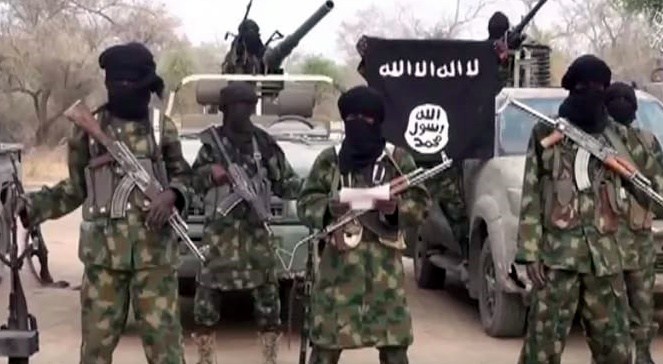
May 12, (THEWILL) —The United States has raised fresh concerns over the growing activities of extremist groups across Africa, warning that Boko Haram and the Islamic State West Africa Province (ISWAP) remain major drivers of the expansion of the Islamic State (ISIS) network on the continent.
In a newly released counterterrorism strategy document, the US said remnants of ISIS have regrouped in several African regions after the group’s territorial defeat in Iraq and Syria, exploiting weak governance structures, insecurity, and political instability to rebuild operational networks.
ISIS was declared defeated by the governments of Syria and Iraq in 2017 following years of coordinated military operations backed by the United States and allied forces.

However, Washington said the collapse of the group’s Middle East strongholds forced many jihadist elements to splinter and relocate to fragile regions across Africa and Central Asia.
According to the document, extremist cells affiliated with ISIS have since established footholds in West Africa, the Sahel region, the Lake Chad Basin, Mozambique, Sudan, and Somalia.
“As a result, today there are parts of Africa where a resurgent terror threat is the reality. These include in West Africa, the Sahel region, the Lake Chad Basin, Mozambique, Sudan, and of course Somalia, where parts of ISIS have re-established themselves and Al Shabaab maintains its tribal-based Islamist insurgency,” the US strategy document stated.
The document specifically identified Boko Haram and ISWAP as key ISIS-linked groups operating in the Lake Chad Basin and the Sahel region, where they continue to control territories and launch attacks on military formations and civilian communities.
Parts of northern Nigeria remain among the areas heavily impacted by the insurgency, despite years of military offensives and regional counterterrorism operations involving Nigeria, Chad, Niger, and Cameroon.
The US noted that its new African counterterrorism approach would differ from the interventionist and nation-building policies that characterised earlier American security engagements abroad.
“In Africa, we have two clear goals that depart from the nation-building and interventionist policies of the past.
“The first is to guarantee that none of the Jihadi groups can build a base of operations that allows them to plot and execute attacks against the United States and American interests around the world. The second is to protect Christians, who have been slaughtered at the hands of these Jihadi groups,” the document stated..
Despite plans to reduce its broader global military footprint, the United States said it would continue to target extremist organisations in Africa capable of planning or inspiring attacks against American interests.
Washington further pledged to strengthen bilateral counterterrorism cooperation with African governments threatened by ISIS and al-Qaeda-linked groups.
According to the strategy document, the US will continue providing intelligence support, operational cooperation, and counterterrorism partner-force development to affected countries until extremist threats are substantially degraded.
The document added that the United States intends to combine security cooperation with stronger trade and economic partnerships aimed at promoting regional stability and prosperity.
“Wherever possible, we will marry such CT cooperation with the stabilising effect of heightened trade and commercial relations,” the document stated, citing President Trump’s peace initiative between Rwanda and the Democratic Republic of Congo as an example of the relationship between security and economic development.
The US described Africa as a continent with “almost limitless potential,” but stressed that sustainable development would only be possible if governments exercise effective sovereign control over their territories and deny extremist groups operational safe havens.
Washington also indicated that African governments and regional partners would increasingly be expected to shoulder a greater share of the counterterrorism burden as the US recalibrates its global security priorities.

Felix Ifijeh is a journalist with years of professional reporting experience. Known for his keen news sense, compelling storytelling and commitment to accurate, impactful reporting, he has built a reputation for turning leads into clear, engaging, and well-structured reports that resonate with readers. His work reflects deep newsroom experience and a commitment to accurate, impactful journalism.
