
Author: Femi Otedola
Reviewer: Sam Diala
October 27, (THEWILL) — Femi Otedola’s memoir, Making It Big: Lessons From A Life in Business, effectively encapsulates the three essential components of achieving success – God, Self, and Others. He humbly credits his achievements to the divine influence of the Almighty. Simultaneously, he acknowledges that he recognised his aspirations early in life and pursued them with diligence.
Moreover, he recognises the significance of opportunities provided by others in enhancing what God has accomplished and the milestones reached. These individuals include parents, friends, associates, clients, employees, and those in positions of authority. Thus, the memoir serves as a collection of genuine life experiences woven together by passion, determination, and discipline.

The core message is that every endeavor is directed towards a specific goal, fueled by passion and principles. In line with this, Femi succinctly articulates the essence of the memoir in 48 words on page 105: “I believe that my inclination to study the wealthy and successful paid off handsomely. And today, I am humbly grateful that people say they count me among their role models. It is for them that I write this book in an attempt to help them with what I have learned.”
In essence, he shares what he did to achieve success and the methods he employed. To further validate the success narrative presented in the 186-page book, Otedola received endorsements from renowned successful Nigerians: Aliko Dangote, President/CE of Dangote Group; Arunma Oteh, Chair of the Royal African Society; Dr. Akinwunmi Adesina, former President of the African Development Bank Group; and Prince (Dr) Samuel Adedoyin, Chairman of Doyin Investment Nigeria Limited, who contributed the preface titled ‘Advance Praise’.
“At each stage of this journey, there are important and enriching lessons learned that are relevant not only to the Nigerian and African business landscape but also to the global context,” stated Dr. Ngozi Okonjo-Iweala, Director General of the World Trade Organisation (WTO), in the well-crafted foreword.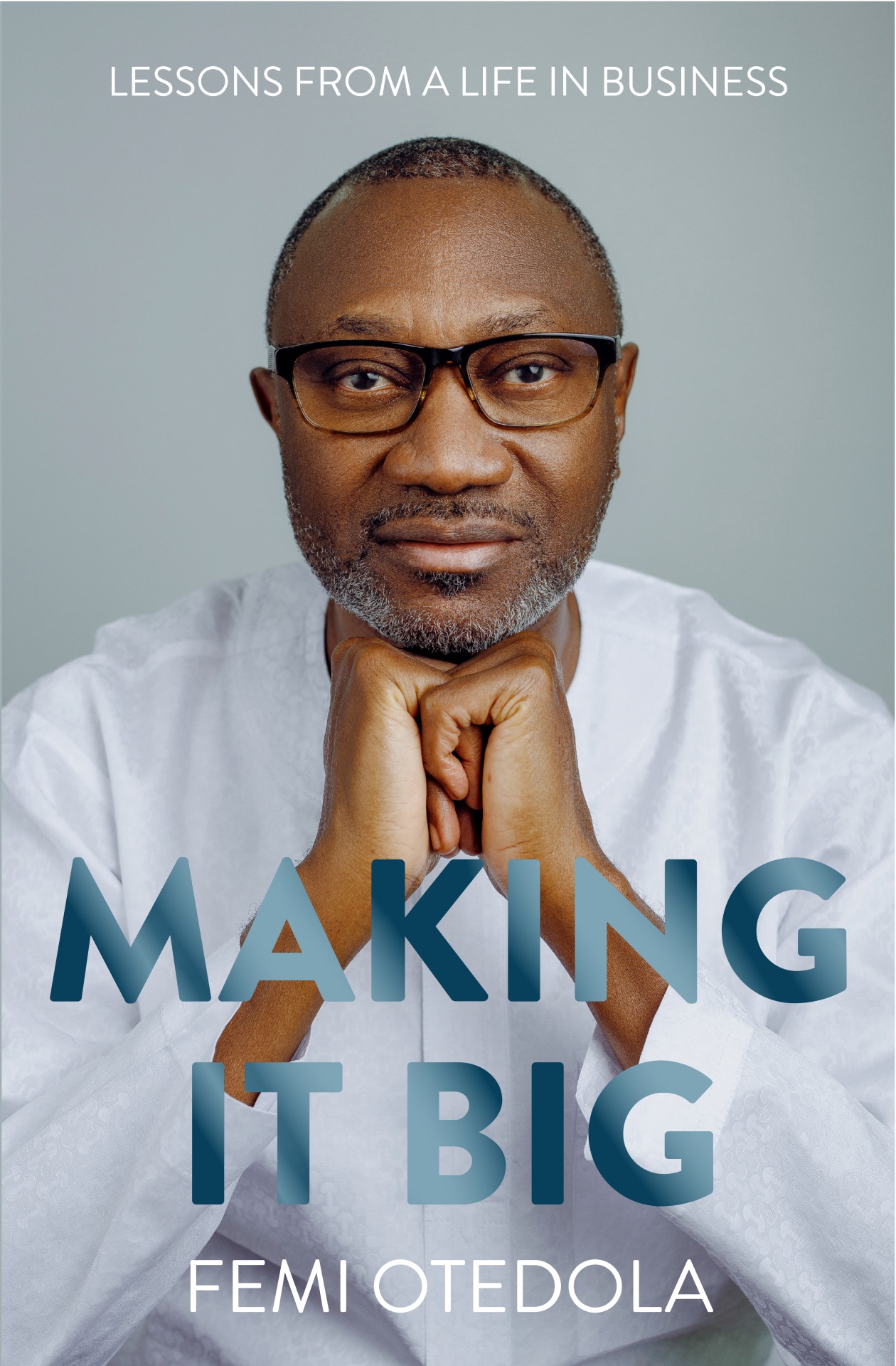
A significant aspect of the book is the influence of destiny on human endeavors. Although it serves as a philosophical addition to life, Femi successfully demonstrates its existence in reality. He methodically established that he recognised his calling for a career in business, a realisation that became evident from his childhood. Every aspect of his early life was centered around business.
While his participation in his father’s well-established printing press provided a pathway to further his ambitions, he remained steadfast in his behavioral patterns. This consistency was attributed to what he refers to as the God factor. This element adds to the book’s allure as readers progress from one lesson (chapter) to the next.
For instance, his acquisition of shorthand and typewriting skills, two essential subjects in commerce at the time, indicated his destined path towards a commercial career. Shorthand is an exceptional subject; it enhances vocabulary, equips one with phonetic precision, and boosts creative capabilities. Similar to Mathematics, Shorthand is governed by principles that must be adhered to systematically in order to attain proficiency in business communication.
Similarly, Typewriting is rich with examples of business correspondence that assist students in crafting persuasive letters and well-structured reports, among other skills. It reinforces the adage that words serve as messengers. When we communicate through writing or speaking, we are dispatching words on a mission.
All these experiences contributed to the opportunities for self-transformation that propelled Femi into an executive role within his father’s large printing press. For him, each phase of life presents a chance for acquiring knowledge.
What captivates the reader the most is Femi’s careful approach to business. His journey of discovering and nurturing his talent is encapsulated in Lesson One, ‘Start Small, Keep Dreaming.’ Like the other lessons (chapters), this section includes sub-lessons and actionable steps that guide the reader at every stage. It is no surprise that he opted for the term ‘lessons’ rather than ‘chapters’ in organising the book. This lesson comprises 22 actionable plans categorised under sub-lessons, detailing what actions to take and the lessons to learn.
Interestingly, Femi began his entrepreneurial journey through manicure – specifically, nail-cutting. As a teenager, he remarkably established a ‘business’ focused on nail-cutting. One can envision how the son of a senior executive at Mobil Oil would approach his father’s guests – who were predominantly distinguished individuals, including the expatriate Chief Executive.
Once the guests were welcomed into the sitting room, Femi would bring forth his tools to initiate the unsolicited nail-cutting service. This must have elicited a blend of admiration and surprise. He did not provide this service free of charge; the clients compensated him (according to their …). What is particularly extraordinary is that Femi had prepared invoices and receipts for the unsolicited manicure services he offered to his parents’ guests.
This Lesson includes actionable steps such as (1) Begin as early as possible, even if the payment is minimal. (2) Do not wait for the ‘perfect moment’ or until financial need arises; create value now. (3) Recognize, support, and cultivate business acumen wherever it appears. And many more. Through this, Femi aimed not only to inform and educate but also to instruct.
A sub-section titled ‘Tapping into huge opportunity’ outlines practical steps to achieve the chapter’s objectives. The arrangement of the content renders the book both engaging and captivating. Each chapter (lesson) raises anticipation for what the subsequent chapter will reveal. Notably, he has organised the chapters (lessons) in a systematic manner that maintains the reader’s interest and stimulates a desire to continue. He contends that every phase of business presents its own challenges.
In recounting his experiences of challenges and triumphs, he emphasises the significance of knowledge. He asserts that knowledge is the optimal starting point, providing a competitive advantage and enabling a clearer, long-term vision. He further states that knowledge conserves both resources and time. The insights he gained through experience, observation of others, and reading equipped him with the expertise necessary to manage Zenoil and Forte Oil effectively.
He openly acknowledged that this was influenced by his father, Sir Michael Otedola, who later served as the 9th governor of Lagos State. Femi refers to himself as a devoted student of the Sir Michael Otedola School of Life. “He instilled confidence and self-belief in my young and impressionable mind, granting me the wings to soar.”
A fascinating aspect is the philosophical influence of his grandfather. He claims that his father was the conduit through which his grandfather’s prophecy came to fruition in his life.
Femi, who was still in his twenties and working at his father’s printing press, received a visit from his grandfather, who made the following declarations: “You will become great. Cleanse your mind and body and wear white attire every day. It will define who you will become, my grandson. Let everything sparkle and shine, but be neat and simple.” This appears in Lesson Nine titled, ‘Make your life simple’.
One of the most crucial and challenging lessons in business is recognising when to cut your losses. Readers are encouraged to recognise that the most thrilling section of the book is Lesson Five, “Create a Warm Working Environment.” Here, Femi exemplifies the kindness that emanates from him. He elaborates on how to inspire his employees and encourage them to take ownership of their duties.
“I did not achieve perfection at Zenon, but one thing was undeniable: we functioned like a family.” He stressed that the loyalty and dedication of his staff were both evident and indisputable – at Zenon and at Forte Oil. He asserted that ensuring the happiness of the team should be a priority for any business owner.
Femi illustrated his concern for the well-being of his employees to the extent that working at Forte Oil was regarded as the best opportunity anyone could have. He emphasises the significance of incentives. The company provided houses and cars for high-performing management staff and established an educational support system that benefited even the lowest levels of employees.
He financed the educational expenses of the children of first-generation workers all the way through to university and Ph.D. levels. Two children of drivers successfully qualified and obtained doctorate degrees through the company’s scholarship program. Additionally, there was provision for free lunch. This account does not shy away from addressing the negative aspects: staff members with opposing characteristics.
He discovered that treating people well does not guarantee their honesty towards you. He provides instances where the company had to take decisive action against employees who displayed compromised integrity.
The book warns against self-promotion, indiscipline, lack of self-control, greed, imitating negative role models, and involving family in business matters. These issues are thoroughly illustrated with suggested action steps for the reader. He strongly advises engaging with political authorities as your business expands.
“In a developing country where democracy is struggling to gain a foothold, and the policy environment is heavily dependent on the whims of political actors, it is practically impossible to play big without engaging with the decision makers, Femi states in Lesson 19.
To emphasize this point, he adds, “Government is like the owl that’s watching you but you probably don’t know it”.
He contends that advantages from the corridors of power are not easily obtained. Furthermore, he encourages the reader to contribute to society through a well-structured and robust philanthropic programme.
Femi confidently informs the reader that his successful engagement in the banking, oil, power, and other sectors was propelled by divine intervention, the support of his parents, and opportunities provided by others and the external environment. He concludes with a note: “My main objective with the compilation of business lessons – and thoughts on life – is to save a new generation of entrepreneurs enormous time and resources by teaching them what I had to learn through experience.”
Indeed, the book successfully achieved its goal. One could argue that Femi’s upbringing as a member of a wealthy family provided him with an effortless path to success. However, it extends beyond that. Not everyone has been able to take advantage of such opportunities to ascend to greatness.
This is illustrated by the fact that he had the privilege of meeting and engaging with prominent individuals of wealth. He also mingled with those who wielded significant power and influence. “I learnt from them at close quarters one-on-one”.
Femi Otedola celebrated his 60th birthday on November 4, 2022, by chartering the renowned superyacht, Christina O, along with his family for three weeks, realising a lifelong aspiration of sailing on the yacht once owned by his childhood idol, Aristotle Onassis. This unique celebration was a private, understated event aboard the opulent vessel in the Mediterranean, as he chose to commemorate the occasion with family rather than organise a large public gathering.
In essence, Femi is revealing the foundation of his success that traces back to his early years. He highlights the signs, prophecies, environment, and circumstances that collectively propelled him forward. A review of the 23 chapters (structured as lessons) in the book reveals the role of destiny in human endeavors.
Readers will understand why Femi chose to celebrate his 60th birthday in such an extravagant manner. Making It Big: Lessons From A Life In Business thus serves as an invaluable resource for entrepreneurs, business leaders, educators, human resource professionals, business journalists, policymakers, and enthusiasts of autobiography. The book is composed in straightforward language that facilitates smooth reading. It avoids lengthy sentences, with the longest averaging between 30 and 35 words. There is no indication of the age-old issue known as the Printer’s Devil infiltrating the text. Readers accustomed to a concise sentence structure will likely find the publication interesting.
The primary disadvantage of the book lies in its small, condensed text. A publication of this caliber should have been presented in bright, clear, and adequately sized fonts that do not require effort to read. Additionally, the print quality is rather faint. However, the binding is robust.
Overall, Making It Big: Lessons From A Life In Business demonstrates the author’s extensive understanding of business, both theoretically and practically. His adaptability across various facets of business, where he displays both knowledge and linguistic skill, is remarkable.
His concluding remarks, “I hope you have learned from my trajectory and feel inspired to follow your calling. Until next time, keep reading!” are fitting.