
August 03, (THEWILL) — For decades, Africa’s economic trajectory has been shaped as much by events beyond its borders as by decisions made within them. Commodity price crashes, global financial crises, the COVID-19 pandemic, geopolitical tensions and tighter monetary policies in advanced economies have repeatedly exposed the continent’s vulnerability to external shocks. While African economies have demonstrated resilience through these crises, many remain heavily dependent on commodity exports, external financing and international trade routes that are increasingly vulnerable to disruption.
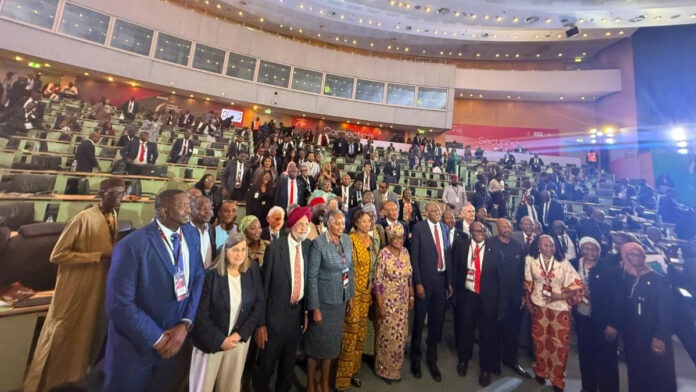
Against this backdrop, the 7th Africa Emerging Markets Forum (AEMF), held in Abuja on July 29–30 under the theme “Building Resilience Amidst Geoeconomic Uncertainties,” carried significance beyond the speeches delivered and the dignitaries it attracted. The gathering of central bank governors, finance ministers, development finance institutions, economists, investors and private-sector leaders reflected a growing recognition that Africa must begin responding differently to a rapidly changing global economic order. Rather than merely insulating itself from global disruptions, the continent is increasingly seeking to position itself to benefit from them.
The timing of the forum was hardly accidental. The global economy is undergoing one of its most significant transitions in decades. Trade relations are becoming more fragmented, supply chains are being reorganised, artificial intelligence is reshaping industries at unprecedented speed, while geopolitical competition is altering investment flows across regions. At the same time, emerging markets are facing tighter access to capital as higher interest rates in developed economies continue to attract global investment away from riskier destinations.

For Africa, these developments present a paradox. They create fresh vulnerabilities for economies that remain dependent on exports of raw materials, yet they also open new opportunities for countries capable of positioning themselves as attractive destinations for manufacturing, digital services and long-term investment. This broader context explains why discussions at the Abuja forum extended well beyond conventional debates on inflation and exchange rates to include regional integration, technological innovation, private capital mobilisation and institutional reform.
Perhaps the most important takeaway from the forum was not any single announcement but the apparent shift in economic thinking among policymakers. Increasingly, discussions about Africa’s development are moving away from dependence on aid and concessional financing towards creating conditions that attract private investment. This marks a subtle but important change in philosophy. While development finance will remain important, it is becoming increasingly clear that the scale of Africa’s infrastructure deficit, industrial ambitions and demographic expansion cannot be financed by governments and multilateral institutions alone.
Instead, the conversation is gradually centring on how African economies can create stable macroeconomic environments capable of attracting both domestic and foreign private capital. Investors ultimately seek predictability, policy consistency, transparent regulation and functioning institutions. Forums such as AEMF therefore matter less because they attract influential participants and more because they provide governments with opportunities to communicate policy direction and demonstrate commitment to reform.
Why Nigeria’s reform agenda matters beyond the conference
For Nigeria, the implications are particularly significant. Hosting an international economic forum does not automatically improve investor confidence or translate into higher investment inflows. Nigeria has organised numerous high-profile conferences over the years without fundamentally changing international perceptions of its investment climate. However, this year’s forum coincides with a period of sweeping macroeconomic reforms intended to restore fiscal discipline, strengthen monetary credibility and improve the country’s attractiveness to investors.
These reforms have generated considerable domestic debate due to their immediate social and economic costs. Yet from the perspective of international investors, consistency of policy often matters as much as the policies themselves. By hosting the forum while implementing difficult reforms, Nigeria was able to project an image of a country attempting to reposition itself within an increasingly competitive global economy. Whether that perception ultimately translates into sustained investment will depend less on conference declarations than on the government’s ability to maintain policy continuity over the coming years.
Another recurring theme throughout the forum was regional economic integration. Although the African Continental Free Trade Area (AfCFTA) was established to create the world’s largest free trade area by number of participating countries, implementation has progressed unevenly. Intra-African trade remains significantly lower than trade within Europe or Asia, reflecting persistent barriers including inadequate transport infrastructure, inefficient border procedures, inconsistent regulations and limited industrial capacity.
Yet the economic logic behind deeper regional integration has become stronger rather than weaker. As global supply chains become more regionalised and protectionist policies gain ground in several advanced economies, expanding trade within Africa could help reduce dependence on external markets while encouraging industrial development across the continent. Nigeria, as Africa’s largest economy and one of its biggest consumer markets, has a particularly important role to play in determining whether AfCFTA evolves into a genuinely transformative economic project or remains largely aspirational.
The increasing prominence of artificial intelligence in discussions at the forum also reflected a broader shift in Africa’s development priorities. Until recently, conversations about AI on the continent largely focused on innovation hubs and technology start-ups. Today, the discussion is increasingly framed in terms of productivity, industrial competitiveness, financial inclusion and public-sector efficiency. This evolution is significant because it recognises that future economic growth will depend not only on roads, ports and power infrastructure but also on digital capabilities, workforce skills and technological adaptation.
Nigeria possesses one of Africa’s largest technology ecosystems, with a growing number of fintech companies and digital entrepreneurs attracting international attention. If supported by appropriate regulatory frameworks, investment in digital infrastructure and improvements in education, emerging technologies could enhance productivity across sectors ranging from agriculture and healthcare to manufacturing and financial services. Conversely, failure to build these capabilities risks widening the technological divide between African economies and more advanced markets.
Forum’s success will ultimately depend on execution
Nevertheless, it would be premature to conclude that the forum itself represents a turning point in Africa’s economic history. The continent has hosted numerous conferences over the past two decades that produced ambitious declarations but yielded limited measurable outcomes. Africa’s challenge has rarely been the absence of policy recommendations. Rather, it has been the persistent gap between policy formulation and implementation.
Many of the priorities highlighted in Abuja—including industrialisation, regional integration, fiscal reforms, stronger institutions and private-sector development—have featured prominently in economic policy discussions for years. What has often been missing is consistent execution across successive administrations. Investors are ultimately influenced less by speeches than by evidence that reforms are being sustained, regulations are being enforced and institutions are becoming more predictable.
This reality places considerable responsibility on governments across the continent. Building resilient economies requires far more than responding effectively to crises. It involves diversifying exports beyond commodities, strengthening domestic capital markets, improving educational outcomes, investing in research and innovation, expanding manufacturing capacity and creating regulatory environments that encourage entrepreneurship and long-term investment. Resilience, in this sense, becomes synonymous with competitiveness rather than simply survival.
The forum’s emphasis on resilience therefore deserves closer attention. Traditionally, resilience implied the ability to withstand economic shocks. Increasingly, policymakers appear to be redefining the concept as the capacity to adapt, innovate and sustain growth despite uncertainty. This represents an important evolution in thinking. Countries that develop more diversified economies, stronger institutions and deeper financial markets are generally better positioned not only to weather global disruptions but also to seize new opportunities as they emerge.
Whether the Abuja forum ultimately marks the beginning of such a transformation remains uncertain. Its long-term significance will not be determined by attendance figures, keynote speeches or the quality of panel discussions. Instead, it will depend on whether the ideas debated translate into tangible policy reforms, stronger regional cooperation and measurable improvements in investment, trade and productivity.
If Nigeria succeeds in maintaining macroeconomic stability while improving the business environment, and if African governments accelerate implementation of AfCFTA, strengthen regional infrastructure and embrace digital transformation, the discussions that took place in Abuja may, in hindsight, be viewed as reflecting a broader shift in Africa’s economic direction. If implementation falters, however, the forum risks becoming another well-intentioned conference whose ambitions exceeded its outcomes.
What cannot be disputed is that the questions raised in Abuja are likely to shape Africa’s economic future for years to come. The continent cannot control geopolitical rivalries, global interest rates or international supply-chain disruptions. It can, however, determine how prepared it is to respond to them. The 7th Africa Emerging Markets Forum suggested that Africa’s policymakers increasingly understand that reality. The real test now lies not in recognising the challenge, but in delivering the reforms that can transform resilience from an aspiration into a lasting competitive advantage.

Segun Adeyemi serves as the Associate Editor of THEWILL Newspaper, leveraging more than ten years of editorial expertise and a proven track record in mainstream journalism.
