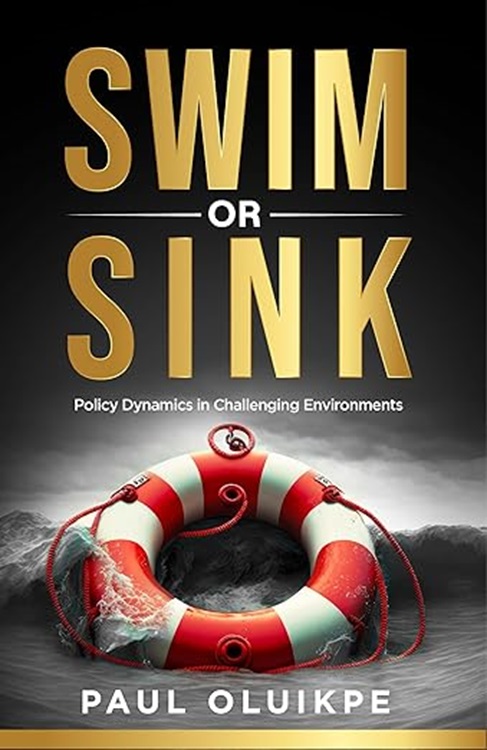
Author: Paul Oluikpe, Central Bank of Nigeria.
Reviewer: Sam Diala
June 15, (THEWILL) – Swim or Sink: Policy Dynamics in Challenging Environments, is a compendium of ideas underlying the knowledge and skill essential for navigating the arduous tasks of policymaking and implementation.

In today’s convoluted environment driven by rapid technological advancement and innovation, with various interests contending for space, policies play a vital role in achieving a social and institutional order.
This is captured in the author’s view that “Of all the known vehicles for bringing about social and economic change, policies have the most potential for controversy.”
Bearing in mind that effective policymaking and implementation is a sine qua non of addressing the fallouts of social and economic change, the author sets out with a clear explanation of essence of the book. He stated in the Introduction that “Swim or Sink” is a treatise on policy dynamics, entirely from his objective assessments of policy situations across the globe.
Based on this, the author posits what he considers the seven forces pivotal to policy outcomes, on which he anchors the seven chapters of the book, namely, The Economy, Politics, Ambiguity, Complexity, Instability, Resources, and Execution. He describes these as the seven fundamental forces that shape policy success or failure, stressing that policy rises or falls on these seven forces.
In a logical sequence, the author takes the reader through the labyrinths of these forces.
Chapter One, ‘The Economy’, opens with the words of renowned Economist and former Chair of the U.S. Federal Reserves, Alan Greenspan: “The economy is governed more by the psychology of investors and consumers than by the logic of economists and investors.”
The chapter emphasises that no matter how imperative a policy might be, the bottom-line is what the author refers to as ‘pocket-book’ issues. In other words, what is the impact on the people?
According to him, whether the leader is dealing with the Arab Springs crisis, the natural disaster of Hurricane Katrina, the abduction of the Chibok girls by the Boko Haram terrorists, or the unending battles in South Sudan, the common denominator is the effect on the ‘pocket-book’.
To illustrate the place of the economy in policy formulation and implementation, the author highlights a vital economic fact – the role of the customer.
He noted that “Customers evolve with needs”; hence the concept of ‘pocket-book’ should be taken more seriously. As a result, policy-makers need to be familiar and come to terms with the clock-speed of issues and transformations occurring in their domains, especially in the market place.
For instance, changes in the economic landscape show the consumer as principally transactional. The consumer is concerned about the pocket-book impact in his choice of goods and services. This is epitomised with the fact that if a business does not find a solution, or sells the right thing, customers will move on to the next business.
External matters are equally important. Using the role of infrastructure in economic development as an example, the author emphasises that substandard road networks make transport and logistics notoriously onerous leading to price increases which sometimes do not reflect the income-driven demand nexus.
The author says, “Low-quality road construction, poor maintenance, lack of interconnectivity of roads, inadequate drainage, traffic congestion, safety concerns and corruption are key features impeding the transport and logistic sector of Nigeria.
“Policy can intervene by fixing the roads to ensure the smooth functioning of the market, and help drive the prices down.”
To achieve this, Politics is involved, which is the topic of the second chapter of the book. Alluding to the role of politics as the authoritative allocation of values in determining who gets what, when and how, according to the theory by Harold Laswell, the chapter treats the subject-matter with numerous examples.
In this chapter also, the reader gets to the heart of the subject-matter concerning the arduous task of policymaking and implementation which results in the swim or sink outlook. He uses many illustrations to substantiate the fact that politics has huge influence on policy, emphasising that policy formulation and implementation rarely exist in isolation from political issues.
“With the complex mix of populations, systems, processes, culture and politics in our modern state, policy-makers are confronted with complex, tricky problems which make straightforward situations not straightforward.”
The author emphasises that “Much of what blunts policy effectiveness is the admixture of political imperatives with economic necessity, with the former clouding and crowding out the latter.” This often results in Ambiguity – the topic of the third chapter.
The author’s treatise on ambiguity is an interesting one, as he leads the reader into what could be seen as the useful paradox of a phenomenon. He refers to ambiguity as a ‘concept’ influential in policy by stressing its dual, yet contradictory purposes in human relations. Interestingly, he sees ambiguity from the prism of its potential to derail policy on one hand, and its capacity to help drive positive outcomes for policy on the other.
Here, the author scopes the theoretical landscape of ambiguity spanning several disciplinary confines to situate the word within its varied contexts. He thereafter dives into the diverse world of knowledge while showcasing his mastery of the subjects.
He touches extensively the unlimited scope of the literary world — from the arts, history, poetry, philosophy, religion, law, linguistics, sciences even to ambiguity itself, quoting a linguist, Christopher Kennedy’s work entitled, ‘Ambiguity and Vagueness’.
This chapter highlights the fact that a policy-maker’s dilemma with ambiguity begins with the very first thought process involved in policy formulation even before implementation is under way. It contains the author’s argument that entities with ambiguous economic policies often oscillate between different strategies which can lead to uncertainties not beneficial to stakeholders.
Despite the challenges emanating from ambiguity, the author argues that policy ambiguity is not entirely detrimental. It can provide flexibility, allowing for adaptive implementation in response to changing circumstances or new information. To minimise the negative impacts, the author advises policy-makers to strike a balance between what he refers to as necessary ambiguity and sufficient clarity.
He emphasises that ambiguity could be a problem to be solved or a tool to be used because of the complexity that results from it. Chapter 4 of the book discusses Complexity – another force that drives policy.
Interestingly, the author sees complexity in every facet of human existence – from the nation state to the activities of a corporate body, a local council, voluntary organisation or family unit, stressing that the causes of these complexities are often not far-fetched.
“Policy-makers, of necessity, should care about the extent of complexity in their policies, the processes involved in formulating policies, and the interactions such policies could have with stakeholders both internal and external.”
He expands the discourse under four sub-headings: Complexity of our origins, Complexity of civilisation, Complexity of institutions and processes, and Policy complexity.
For effective policymaking and implementation, he advises the authorities concerned to see policy complexity as essential for dealing with the instability that emanates from its occurrence. Chapter 5 of the book is about Instability.
According to the author, instability has the potential to profoundly affect policy. He shows that instability and policy are intertwined and both are mutually reinforcing and not exclusive of each other.
“Policymakers are therefore wise to pay attention to risks of instability in policy constructs. Instability has various manifestations. It can be internal, external or combined.”
All this hinges on the need for resources as inevitable in achieving policy objectives. In chapter 6, the author deals on the role of Resources in policy making and implementation.
Quoting Mahatma Gandhi’s philosophy that ‘The earth has enough for everyone’s need, but not enough for everyone’s greed’, the author emphasises that resources play a key role in policy success or failure, as policies are built upon the pedestal of resources, and must, therefore, be judiciously applied. Governments, institutions, societies, families and individuals make plans based on available and prospective resources.
The centre-point of the chapter resides in the author’s argument that resources are the sine qua non of policy formulation and implementation.
“Every policy, big or small, complex or simple, liberal or conservative, idealistic or pragmatic, rests on the existence and availability of resources for achievement.”
From there, the book ends with Execution as the last chapter. Referring to the military philosophy of George S. Patton, a General in the US Army, the author points out that “A good plan, ‘violently executed now’, is better than a perfect plan next week.”
He maintains that the public wants solutions and they want them fast. “You can postpone a policy decision, but it comes with a price.” Putting off an economic decision would be more catastrophic than a badly implemented policy.
Insisting that policies are meant to be executed, because the value of an idea lies in the using of it, the author wonders what value exists in engaging in so much thought, introspection, reflection and ideation, if the products of those processes are not translated into tangible form.
“Execution is where the rubber meets the road in terms of translating policy objectives into tangible outcomes.”
In Swim or Sink, the author generously offers diverse means towards the bumpy route of policymaking and implementation to actualise desired objectives.
Consequently, the author did not leave the reader stranded, confused or gasping for help as to what course of action to take in order not to sink. Hence the work touches virtually on every aspect of life – economics, politics, religion, education, sports, literature, science, philosophy, linguistics, mathematics, engineering, music ….
This shows the author’s profound knowledge and a good grasp of the subject-matter — confirming he is sufficiently knowledgeable in the numerous areas that impact policy.
Swim or Sink engages in what can rightly be described as the anatomy of intellectual exegesis in the herculean task of policy enunciation, policy formulation, policy implementation and policy evaluation.
In all, the book is attractive both in print and in packaging. It is presented in an outlook of serious intellectual discourse with a captivating design that stimulates curiosity, interest and ‘fear’ at the same time, considering the words Swim or Sink. The prints are bold enough to sustain interest and douse lethargy
However, a flipside of the book is the author’s penchant for long sentences. Readers who are used to short-sentence style may find the book cumbersome in a way. There are sentences that span between forty and over sixty words which could have been split to make for a ‘lighter’ reading – without losing the messages.
For instance, the second paragraph on page 76, contains the longest sentence found in the book: “Against this backdrop, policy in Nigeria and in most of Africa has the touch and thankless task of cutting through the maze thrown by the mundane and moribund, the real and imaginary, curious and concrete, fantastic and phantom, delusory and delirious, and cater for all shades and sentiments in a constantly shifting environment challenged by the notion of truth, reality and sentiment (62 words).
Page 3, line 6, has a 54-word sentence: “For five years I served the bank on financial inclusion and at a point became the Head of Financial Inclusion, leading the efforts to accelerate access to finance to Nigeria’s vulnerable demographics, such as women, rural people, youth, people living with disability, internally displaced populations, and people in the most excluded zones, in Nigeria.”
The third sentence in the second paragraph on page 2, begins with a 50-word sentence: “In early 2008 ….”
The author’s use of two conjunctions – “Although” and “but” in the same sentence on page 46, line 13, would be considered out of place in assessing the mechanical accuracy of the work.
Again, the printer’s devil sneaked into the well-edited book to cause havoc on page 188, line 5, thereby corrupting the sentence to read: “At the Battle of Waterloo in 1815, Napoleon was roundly defeated roundly by the Duke of Wellington .…”
On the whole, Swim or Sink showcases the author’s profound knowledge of the subject of policy both in theory and in practice. His versatility in numerous disciplines where he exhibits knowledge and language proficiency is awesome.
With background in Engineering, Strategy and innovation, Policy, Strategy Finance and Development, the author proves a strong grasp of the subject-matter, providing the reader with the intellectual tool to navigate the arena of policy formulation and implementation.
Moving on to something lighter: for a father of seven to write a book of seven chapters from his office near the seventh floor of the multi-story headquarters building of the Central Bank of Nigeria in Abuja, may add to the complexity of the gifts underlying the author’s multi-talented expertise in writing.
The 316-page book has a well-presented table of contents and 34 pages of bibliography to aid referencing.
Swim or Sink: Policy Dynamics in Changing Environments is recommended to policymakers, business leaders, politicians, researchers, business journalists, analysts, advocacy groups, strategists and anyone interested in policy.
The focus of the book can be summed up in a sentence that captures the seven chapters: Policy must support the economy, ensuring that politics is devoid of ambiguity of process to eliminate the complexity and instability which encumber allocation of resources for effective execution.