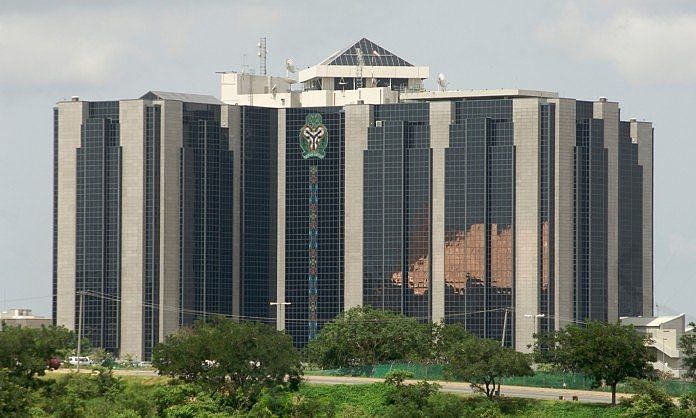
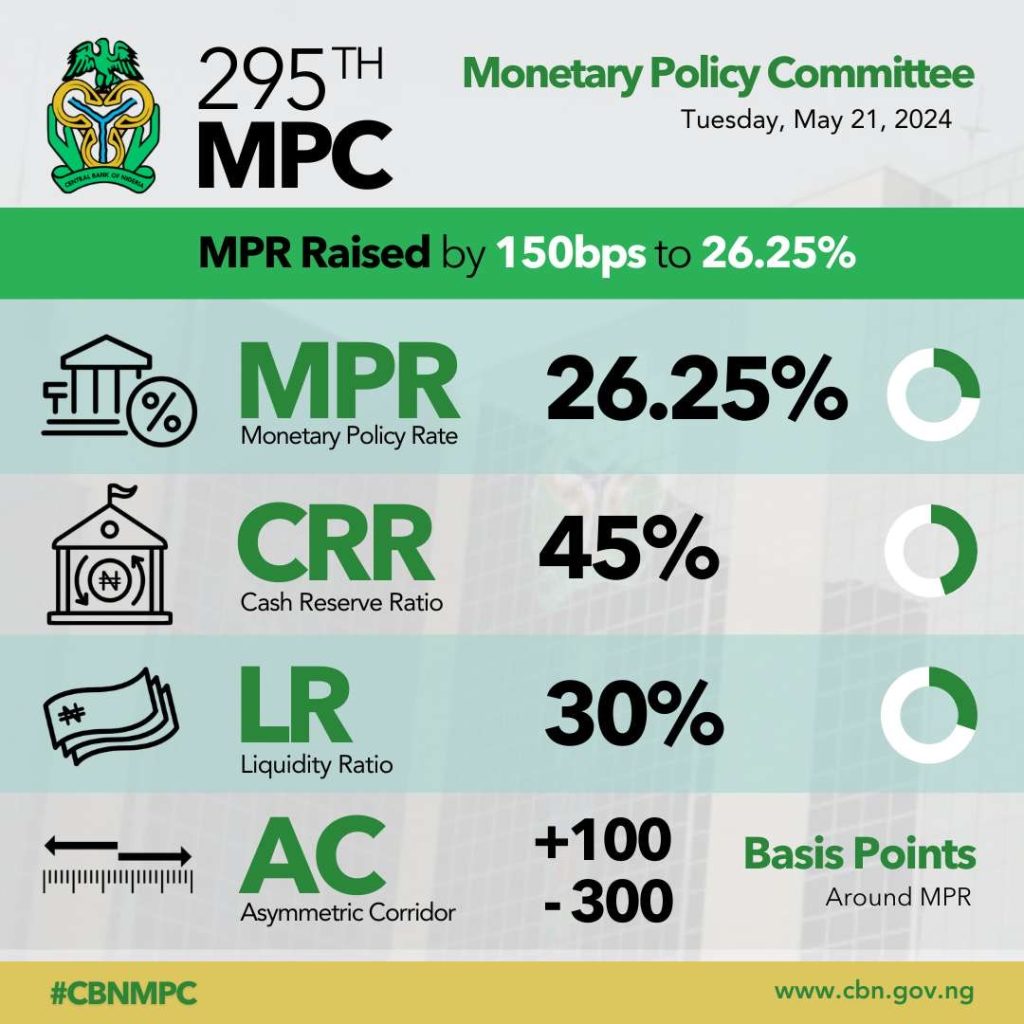
May 21, (THEWILL) – The Central Bank of Nigeria (CBN) has raised the interest rate by 150 basis points, increasing it from 24.75 percent to 26.25 percent to tighten inflation and ensure the stability of the naira.
CBN Governor, Olayemi Cardoso, announced this in Abuja after a two-day meeting of the bank’s Monetary Policy Committee (MPC) on Tuesday.
THEWILL reports that all twelve members of the MPC attended the meeting.

A communique issued at the end of the meeting and signed by the apex bank chief, Cardoso, said the MPC retained the asymmetric corridor at +100 basis points and -300 basis points around the MPR. It also retained the cash reserve ratio (CRR) at 45 percent for deposit money banks (DMBs) and 14 percent for merchant banks while the liquidity ratio (LR) was left unchanged at 30 percent.
Cardoso said the key focus of the MPC at the meeting was to achieve price stability by effectively using tools available to the monetary authority to rein in inflation.
“Following an extensive review of risks and the near-term inflation outlook, the balance of risks suggests further tightening of policy to build on the benefits accrue from previous rate hikes,” he said.
The MPC observed that while year-on-year headline inflation in April 2024 rose moderately, the month-on-month measures of headline, food and core all declined significantly. This follows a decline (month-on-month) of headline and food measures in March 2024, suggesting that the recent tight monetary policy stance of the Bank is beginning to yield the desired outcomes.
The Committee, however, noted that the inflationary pressure continues to be driven largely by food inflation.
It reiterated several challenges confronting the effective moderation of food inflation, including the rising cost of transportation of farm produce; infrastructure-related constraints along the line of distribution network; security challenges in some food-producing areas; and exchange rate pass-through to domestic prices for imported food items.
The MPC urged that more be done to address the security of farming communities to guarantee improved food production in these areas.
Members further observed the recent volatility in the foreign exchange market, attributing this to seasonal demand, a reflection of the interplay between demand and supply in a freely functioning market system.
The Committee also noted the marginal increase in the external reserve balance between March and April 2024 and urged the Bank to sustain its focus on accretion to reserves.
The MPC commended the Bank for the recent approval of licences of fourteen (14) International Money Transfer Operators (IMTOs).
While noting that the decision is expected to improve competition and lower the cost of transactions (attracting more remittances through formal channels), the Committee noted with satisfaction that the banking system remains safe, sound, and stable, despite the headwinds confronting the economy.
It commended the recent recapitalization initiative and urged the management to sustain its regulatory oversight to ensure the continued stability of the banking system.
According to the Communique, “Members focused on the best policy approach to continue to guide the economy towards achieving an overall macroeconomic balance. At this meeting, the Committee was thus faced with the option of either continuing with policy tightening or hold to observe the impact of previous rate hikes.
“Following an extensive review of risks and the near-term inflation outlook, the balance of risks suggests further tightening of policy to build on the benefits accruing from previous rate hikes.
“Key Developments in the Domestic and Global Economies Domestic headline inflation rose further to 33.69 per cent in April 2024, from 33.20 per cent in March, driven by both the food and core components.
“On a month-on-month basis, however, headline inflation declined significantly to 2.29 per cent in April 2024, from 3.02 per cent in March. The food and core components also declined to 2.50 and 2.20 per cent from 3.62 and 2.54 per cent, respectively, in the same period.
“According to the National Bureau of Statistics, real GDP grew by 3.46 per cent in the fourth quarter of 2023, compared with 2.54 per cent in the third quarter, driven by both the oil and non-oil sectors.
“Recent Purchasing Managers’ Index (PMI) suggests that economic activities will continue to expand in 2024. In addition, staff forecasts indicate that the domestic economy will grow by 3.38 per cent in 2024.
“According to the IMF, global growth in 2024 and 2025 is projected at 3.2 per cent apiece, while it revised Nigeria’s growth upwards to 3.3 per cent from 3.0 per cent in 2024. The identified headwinds to this projection are the tight financial conditions and broad disruptions to the global supply chain associated with geopolitical tensions and economic fragmentations.
“While these are feeding directly into a rally in the prices of key commodities such as grains and oil, global inflation is projected to continue to decelerate in 2024 but could remain above the long-run objectives of advanced economy central banks.
“This group of central banks are likely to pause their rate hike cycles in the near term to observe the trend of inflation. Accordingly, the Committee will continue to monitor developments in the global and domestic economies to guide policy and ensure that inflation expectations are adequately anchored.”
The next meeting of the Committee will be held on July 22 and 23, 2024.

Felix Ifijeh is a journalist with years of professional reporting experience. Known for his keen news sense, compelling storytelling and commitment to accurate, impactful reporting, he has built a reputation for turning leads into clear, engaging, and well-structured reports that resonate with readers. His work reflects deep newsroom experience and a commitment to accurate, impactful journalism.