
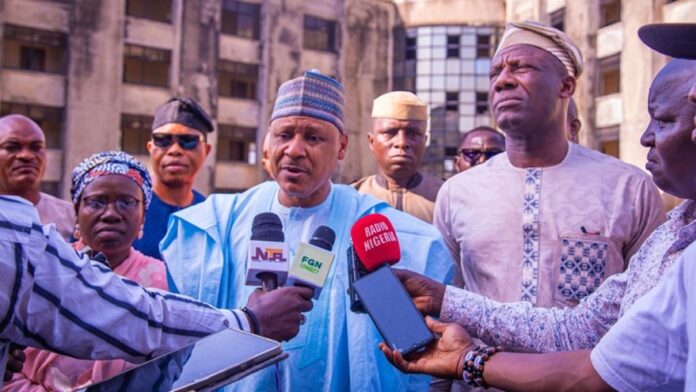
April 02, (THEWILL) — The federal government has cautioned against the careless use of language in security operations, media reporting, and public discourse, warning that inaccurate or insensitive terminology can deepen societal divisions and weaken national unity.
The Minister of Information and National Orientation, Mohammed Idris, made the warning at a high-level conference organised by the Whiteink Institute for Strategy Education and Research Nigeria (WISER), themed “Contextualising Definitions and Terminologies to Address Stereotyping and Ethnic Profiling in Discourses and Security Operations in West Africa.”
The Minister, represented by the Executive Secretary of the Nigerian Press Council, Dili Ezughah, stressed that language is not neutral, noting that the way issues are described can significantly influence public perception, institutional trust, and national cohesion.

“Definitions are not neutral; they influence how communities are perceived and treated. Careless or inaccurate language can reinforce stereotypes, deepen divisions, and erode trust between citizens and institutions”, he stated.
He called for a clear distinction between criminal acts and ethnic or religious identities, warning that conflating both could undermine peacebuilding efforts and fuel mistrust among communities.
Highlighting ongoing government initiatives under President Bola Ahmed Tinubu, Idris referenced the National Values Charter, which he said is designed to promote accountability, inclusion, and shared responsibility among Nigerians.
He further noted that the National Orientation Agency is currently intensifying public enlightenment campaigns to promote responsible citizenship, counter misinformation, and strengthen civic participation.
On security reforms, the Minister reiterated the federal government’s commitment to strengthening Nigeria’s security architecture in response to terrorism, banditry, and organised crime. He disclosed that the government is working on a phased framework for the introduction of state policing over 60 months, with safeguards intended to prevent political misuse.
Idris also urged journalists and media organisations to maintain high professional standards, particularly in the digital era, where misinformation can spread rapidly. He emphasised the need for accuracy, verification, and contextual reporting in order to avoid escalating tensions.
He further called for stronger regional collaboration across West Africa to develop communication strategies that promote unity, social cohesion, and effective security coordination.
“Security is not only about protecting territory; it is about protecting people, their dignity, and their sense of belonging. Trust begins with fairness—in actions, in policies, and in language”, he added.
The conference concluded with renewed calls for ethical communication practices and stronger institutional cooperation to ensure that public discourse contributes positively to peace and national stability across the region.

Felix Ifijeh is a journalist with years of professional reporting experience. Known for his keen news sense, compelling storytelling and commitment to accurate, impactful reporting, he has built a reputation for turning leads into clear, engaging, and well-structured reports that resonate with readers. His work reflects deep newsroom experience and a commitment to accurate, impactful journalism.
