
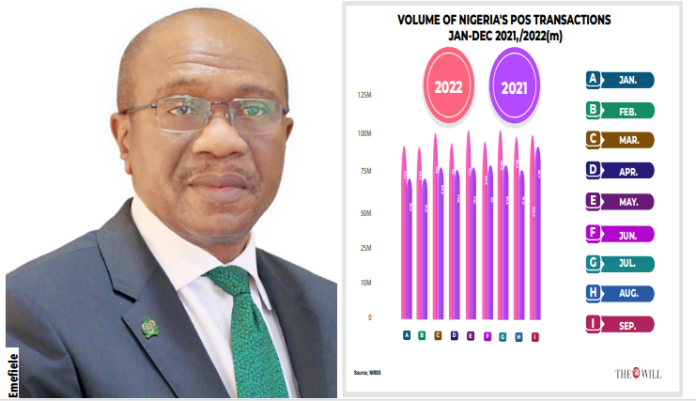
Nigeria’s deposit money banks and other financial institutions, together with the Federation Accounts Allocation Committee (FAAC), raked in N135.56 trillion from electronic payment transactions in the first quarter (Q1) of 2023 as the Central Bank of Nigeria (CBN) intensifies the cashless policy implementation.
According to the Nigeria-Interbank Settlement System (NIBSS), commercial banks and other financial institutions generated N135.52 trillion from electronic payment transactions in Q1 this year.
The NIBSS showed that the value of electronic payment transactions by the financial services institutions grew by 298 per cent year-on-year in the first quarter of 2023, compared to N34.04 trillion the financial service industry generated between January and March 2022.

Also, the financial services institutions recorded a 984 per- cent increase in the volume of e-payment transactions, as they rose to 4.7 billion during the reporting period, up from 433.4 million volume achieved in the first quarter of 2022.
In the same trajectory, the federal, state and local governments pooled N40 billion from Electronic Money Transfer Levy (EMTL) during the period. The EMTL was a component of the monthly FAAC allocations of N750.17 billion, N722,67 billion and N722.67 billion in January, February and March 2023 respectively.
The EMTL which was introduced in 2020, provides for a singular and one-off levy of N50 on the recipient of any electronic receipts or transfers of N10,000 or above. For equivalent receipts or transfers carried out in other currencies, the levy will be charged at the exchange rates determined by the Central Bank of Nigeria (CBN).
The NIBSS stated that N42.42 trillion worth of e-payment transactions were made in January this year while the value dropped in February by 4.3 percent to N40.6 trillion before ascending to N54.5 trillion in March – the highest e-payment transaction value during the three months under review.
Report by the National Bureau of Statistics (NBS) stated that FAAC received N37.91 billion, N11.64 billion and N14.48 billion as EMTL in January, February and March respectively during the year.
The 298 per cent year-on-year increase in the value of electronic payment transactions and 984 per cent increase in volume were significantly driven by the CBN’s Naira redesign policy which sparked preference to alternative payment systems.
THEWILL had reported that the Naira crisis arising from the currency redesign policy of the CBN created a huge boost to financial inclusion as more Nigerians besieged the e-payment channels.
Many Nigerians, including business entities, were increasingly embracing the use of electronic payment platforms amid cash-in-hand challenges in the implementation of the Naira re-design policy of the federal government.
As the banks ran out of cash and their Automated Teller Machines (ATMs) not dispensing the new notes as directed by the authorities, Nigerians had run into severe difficulties with socio-economic activities greatly challenged. This sparked demonstrations and riots in some states as the cash crisis bit harder.
This newspaper reported that in order to meet their daily needs such as feeding, transportation and communication, a large number of Nigerians had moved to digital transactions and alternative payment platforms. The micro, small and medium enterprise (MSME) operators also besieged the electronic payment options in order to remain in business.
Industry stakeholders observed that an unintended (positive) outcome of the ‘bad’ scenario is the boost in the nation’s financial inclusion scheme – National Financial Inclusion Strategy (NIFS) as more people embrace the digital transaction options.
The NIFS, which had experienced sluggish performance despite several measures by the CBN to re-tune its mechanism had, by the Naira crisis, assumed tremendous expansion: The banks were recording increasing number of account opening, digital applications (Apps) enrolment and funds transfer – beyond what they had recorded in the past.
A Professor of Financial Economics at the University of Lagos, Ndubuisi Nwokoma, had observed that the Naira re-design policy would impact significantly on the nation’s cashless policy and change the culture of carrying cash about. He stated that many Nigerians “down the ladder” are now moving towards digital transactions including the commercial vehicle operators, petty traders and pepper sellers in the market.
“This policy has been able to help us to push for having a cashless economy. This is something we have to acknowledge. This policy may not solve all the problems of the CBN, but it has encouraged people to embrace the cashless economy. Those in the lower rung of the society can transact their businesses – use the services of commercial buses, buy pepper, buy yam, buy tomatoes in the market”, said Nwokoma, on a national television programme.
The NIBSS in a recent report stated that the Naira scarcity emanating from the CBN’s redesign and cash withdrawal policy pushed Point of Sales (POS) transactions to N807.16 billion in January 2023.
The NIBSS which monitors cashless transactions through the Nigeria Instant Payment (NIP) System and POS terminals stated that total NIP transactions for January rose by 45.52 per cent year-on-year from N26.65 trillion as of January 2022 to N38.77 trillion as of January 2023.
In order to improve the performance of the e-payment system, the CBN has put measures in place to tackle threats to the payment system in order to advance the cashless policy and deepen financial inclusion.
The Governor, CBN, Mr Godwin Emefiele, disclosed this in his address at the recent seminar for Finance Correspondents and Business Editors in Calabar, Cross River State capital.
Emefiele, who was represented by the CBN Director, Monetary Policy, Dr Mahmoud Hassan, said the Bank was not unaware of the challenges confronting it in implementing the various payment systems.
He identified the challenges to include weak social infrastructure, activities of unlicensed entities, and cyber threats and fraud.
He noted that effective operation of payment platforms is highly reliant on stable telecommunication networks and power infrastructure.
He, however, lamented that “these are currently not optimal in Nigeria, thus, impacting the stability and resilience of the payment system”.
According to him, some entities have continued to exploit access to information technology to engage in regulated activities without the appropriate licences and authorisation.
He noted that the activities of fraudsters continue to threaten the resilience of the payment platforms, adding that the confidence of the public is impacted by the unwholesome activities.
“However, the collaborative effort between the Central Bank of Nigeria and other players in the industry is helping to curtail the nefarious activities of these fraudsters,” he said.
Emefiele enumerated measures adopted by the bank to counter identified challenges to the payments system initiatives.
He said, “In response to the challenges posed by cyber threats, the CBN has put the following initiatives in place: The Nigeria Electronic Fraud Forum (NeFF), which consists of all relevant stakeholders, to proactively address challenges and safeguard the integrity of the e-payment channels.”
Under this measure, he added, the Payment Card Industry Data Security Standard, mandatory for any entity that processes, stores/saves or transmits payment card data has been put in place.
“Also the Financial Industry Cybersecurity Fusion Centre serves as a sectoral Computer Security Incident Response Team (CSIRT) for the Nigerian Financial Services Industry,” he said.
Other Initiatives against cybersecurity and fraud in Nigeria include: Cybercrime Acts’ enacted in 2021 to address National Cybersecurity Policy and Strategy.

Sam Diala is a Bloomberg Certified Financial Journalist with over a decade of experience in reporting Business and Economy. He is Business Editor at THEWILL Newspaper, and believes that work, not wishes, creates wealth.
