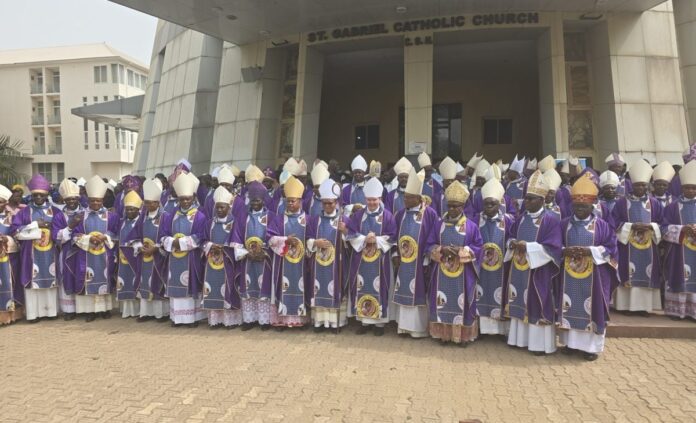
February 26, (THEWILL) — The Catholic Bishops’ Conference of Nigeria (CBCN) has urged the Federal Government to adopt a technology-driven security framework, implement urgent governance reforms and ensure the speedy prosecution of suspected terrorists to address Nigeria’s deepening insecurity.
A communiqué issued at the end of the bishops’ First Plenary Meeting for 2026 in Abuja and read on Wednesday by Peter Chikwe, Bishop of Abakaliki, during the closing Mass of the gathering, the clerics expressed concern over the worsening security situation across the country despite the national security emergency declared by President Bola Tinubu. While acknowledging ongoing efforts by the Federal Government, including plans to recruit more security personnel and intensified military operations, they said many Nigerians continued to live in fear and uncertainty.
Signed by the outgoing President, Lucius Ugorji, and the outgoing Secretary, Donatus Ogun, the Bishops noted that the nation remains burdened by “endless tears and grief”, as attacks persist in several regions, particularly in the North and the Middle Belt, where students, worshippers and rural communities have increasingly become targets of armed groups.

They cited the recent killing of over 200 persons in Woro and Nuku communities of Kwara State, describing the incident as a gruesome massacre, in which both Christians and Muslims were reportedly attacked by Islamist jihadists, for resisting extremist ideologies.
The Bishops also lamented that gunmen continue to operate freely in many parts of the country, forcing farmers away from their lands, worsening food insecurity and displacing thousands of families from their homes.
To curb the trend, the CBCN urged the Federal Government to prioritise the deployment of drones and Artificial Intelligence (AI)-powered surveillance systems to monitor remote and vulnerable areas, especially illegal mining sites. The bishops warned that proceeds from illicit gold and lithium mining were increasingly being used to finance terrorism.
The clerics also raised concerns about delays in prosecuting arrested terrorists, noting that prolonged trials or the reintegration of so-called repentant insurgents into security structures created a dangerous perception of government complicity and undermined public trust.
While welcoming Nigeria’s decision to seek foreign assistance in addressing insecurity, the bishops stressed that the ultimate responsibility for securing the nation rests with Nigerians and their leaders, urging decisive and transparent action.
Beyond security matters, the communiqué, titled “Leadership for the Common Good,” called for comprehensive governance and electoral reforms aimed at strengthening democratic institutions and restoring citizens’ confidence in government.
The bishops warned that Nigeria’s democracy was being weakened by a growing lack of trust in public institutions and rising voter apathy, citing low participation in recent elections as evidence of public disillusionment.
Ahead of the 2027 general elections, they urged the National Assembly to mandate real-time electronic transmission of election results from the Bimodal Voter Accreditation System (BVAS) directly to the Independent National Electoral Commission’s Result Viewing (IReV) portal to enhance transparency and credibility.
The conference also announced a change in leadership, with Matthew Man-Oso Ndagoso, Archbishop of Kaduna, elected as the new President of the CBCN. Other officers elected include Alfred Adewale Martins as Vice President, Peter Odetoyinbo as Secretary, and Peter Chukwu as Assistant Secretary.
The bishops further noted that the 2026 Lenten season coincides with the Muslim Ramadan, describing the period as a “divine invitation” for Christians and Muslims to deepen interfaith harmony and work collectively toward national renewal.
Despite prevailing challenges, the clergy urged Nigerians not to give in to despair, expressing optimism that a better Nigeria is achievable if leadership prioritises service, justice and the common good above sectional interests.
The plenary meeting, which drew Catholic bishops from across the country, began on February 22, and concluded on February 25, with deliberations on the state of the Church and the nation.

Felix Ifijeh is a journalist with years of professional reporting experience. Known for his keen news sense, compelling storytelling and commitment to accurate, impactful reporting, he has built a reputation for turning leads into clear, engaging, and well-structured reports that resonate with readers. His work reflects deep newsroom experience and a commitment to accurate, impactful journalism.