The Central Bank of Nigeria (CBN)’s new policy on over-the-counter cash withdrawal limits as well as withdrawal limits for Automated Teller Machines (ATM) and Point of Sale (POS) terminals has widened the window for tax revenue.
The CBN had on December 6, 2022, announced a new policy that mandates deposit money banks (DMBs) and other financial institutions to ensure that over-the-counter cash withdrawals by individuals and corporate entities do not exceed N100, 000 and N500, 000, respectively, per week.
According to a memo to banks signed by the Director of Banking Supervision, Haruna .B. Mustafa, individuals will only be able to withdraw N100,000 per week (from over the counter, Point of Sale Machines or the Automated Teller Machines), while organisations can access N500,000 per week.

Banks have also been directed to load only N200 and lower denominations into their ATM.
The CBN said the new directive would promote cashless policy and that customers should be encouraged to use alternative channels (internet banking, mobile banking apps, USSD, cards/POS. eNaira, etc.) to conduct their banking transactions.
While the members of public have expressed concern over the transaction inconveniences the new policy would create, not many realise that the increased use of electronic banking facilities has tax implications.
These include the statutory 7.5 percent Value Added Tax (VAT), the N50 Electronic Money Transfer Levy as well as income tax implications for corporate account holders in the small, medium and large enterprises as well as multiple channels such as data, sms, call credits and other electronic media platforms associated with financial transactions.
The government’s lingering revenue challenge which is acerbated by the non-remittance of oil revenue to the Federation Accounts Allocation Committee (FAAC) by the Nigerian National Petroleum Company (NNPC) Limited since January 2022, has led to aggressive tax enforcement by the Federal Inland Revenue Service (FIRS) resulting in improved non-oil revenue in recent times.
Between January and September 2022, FIRS has collected N7.5 trillion which is a significant improvement on the total collection of N6.4 trillion for the entire 2021. Non-oil taxes accounted for N4.3 trillion while petroleum profits tax accounted for N3.1 trillion. It is clear that the reforms undertaken since 2020 have started yielding the desired results as FIRS has been funding FAAC significantly in the last three years, especially in 2022 when oil revenue ‘dried’ up.
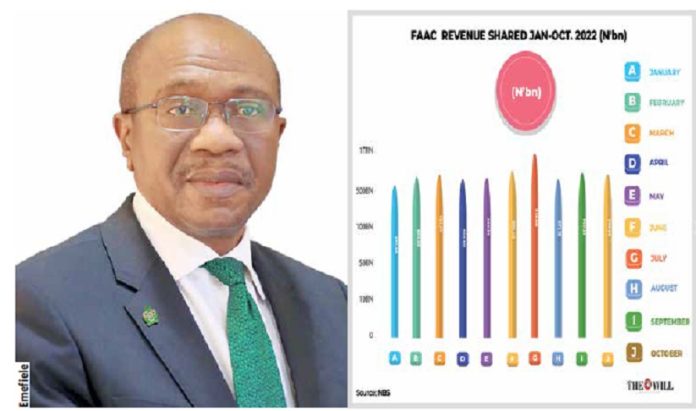
Although ravaging inflation has weakened the value of the Naira, a look at the monthly FAAC performance showed that despite the sharp drop in oil revenue, the amount shared by the three tiers of government from FAAC has grown significantly since the year from N574.66 billion in January to N736.78 in October, 2022.
FAAC recorded the highest receipt of N954.08 billion in July 2022 traced to quantum revenue growth in Oil & Gas Royalties, Statutory Revenues, Exchange Gain, Petroleum Profit Tax, Import Duty, VAT, Company Income Tax, Excise Duty and Augmentations from Non-oil Revenue. Findings showed that a total of N195.43 billion was realised as at November from the Electronic Money Transfer Levy introduced in the 2022 Finance Act.
Manufacturers and service providers are hit by increase in operating expenses, cost of sales, administrative expenses, raw materials, warehousing and finance costs. They have passed the extra costs to the consumers through upward adjustment of prices of their products and services. This has triggers low consumer demand and, by implication, led to poor standard of living. A recent publication by the National Bureau of Statistics (NBS) revealed that 63 percent of the people out of an estimated population of 211 million are multi-dimensionally poor.
“Many Nigerians do not know they pay taxes every day. From phone calls, social media interactions, shopping to purchase of table or sachet water, Nigerians are taxed, sometimes in multiple dimensions”, said Kenny Adiogun, a tax expert. With our government running from pillar to post in search of revenue which they claim was not a challenge, but debt, Nigerians are going to be thoroughly squeezed next year because the country is as good as broke, Adiogun added in a telephone chat.
In his reaction to the CBN’s new cash transaction policy, fiscal policy partner and African tax leader at PricewaterhouseCoopers (PwC), Taiwo Oyedele, explained the tax implications of the CBN’s new policy on over-the-counter cash withdrawal limits as well as withdrawal limits for ATM and POS.
Oyedele revealed that the new cash withdrawal limit will have tax implications, especially for individuals and Micro Small and Medium Enterprises (MSMEs). He noted that the policy will force many people to carry out transactions using electronic payments, with these small businesses that currently operate mostly on cash becoming visible to the tax authorities.
This was made known by Oyedele in a series of tweet posts on his official Twitter account, where he said that the policy will trigger tax obligations including income tax.
“The new cash withdrawal limit will have tax implications, especially for individuals and MSMEs. As many people will be forced to carry out transactions using electronic payments, small businesses that currently operate mostly on cash will become visible to the tax authorities. This will trigger various tax obligations including Income tax.
“If your business is registered as a company you may be liable to Company Income Tax (CIT) depending on your annual turnover (i.e. no CIT if your turnover is below N25 million, 20% if your turnover is between N25 to N100 million, 30% if your turnover is more than N100 million) in addition to Education Tax at 2.5%.
“If your business is not registered as a company then you will be liable to personal income tax based on graduated taxable income bands between 7% and 24%,” Oyedele explained.
Going further, the tax expert said that all businesses are required to register for Value Added Tax (VAT) and charge 7.5 percent on their goods and services except those with annual turnover below N25 million.
As for Pay As You Earn (PAYE), Oyedele noted that all employees earning more than N30,000 per month are liable to PAYE which must be deducted and paid to the tax authority by the employer on a monthly basis. He said that these employees may also be liable to other statutory contributions such as pension depending on the staff strength.
He added that the more transactions that are made by these individuals, the more the tax authorities will get the intelligence to track their income and net worth making it easier to fish out those that are evading tax.
It is obvious that the new cash transaction policy will aggravate the incidence of implicit tax rates common with Nigeria.
At the FIRS Tax Dialogue held virtually in November 2021, the president of the African Development Bank, Akinwunmi Adesina, said Nigerians pay one of the highest implicit tax rates in the world. He acknowledged that conventional tax rates are low in the country, but distinguished those from “implicit tax”, which are “borne but are not seen nor recorded”.
“Truth be told, Nigerians pay one of the highest implicit tax rates in the world — way higher than developed countries.
“Think of it: they provide electricity for themselves via generators; they repair roads to their neighborhoods, if they can afford to; there are no social security systems; they provide security for their own safety; and they provide boreholes for drinking water with their own monies. That is incredulous in itself. Boreholes are not the way to provide water in the 21st century. Every household should have pipe borne water.”
The National President, Association of Mobile Money and Bank Agents in Nigeria (AMMBAN), Victor Ololojo decried the new cash withdrawal limit policy introduced by the CBN saying it would impoverish the members of his association through environmental restrictions and high operating costs inbuilt in the policy. He said the petty traders that patronise AMMBAN facilities will be facing serious difficulty in complying with the cash withdrawal limits.
However, a finance and energy expert, Dr Nnaemeka Obiaraeri, described the cash withdrawal limits as appropriate and timely. He urged Nigerians to appreciate the move which he said would eliminate the involvement of those he described as economic saboteurs in the monetary affairs of the country.
Citing data by the National Deposit Insurance Corporation (NDIC), Obiaraeri, who is Managing Director/CEO, Taurus Oil & Gas Limited, a firm with expertise in finance and global oil and gas, said 99.6 percent of 122 million bank account holders do not have up to N500,000 deposit or savings. He said about 176 million Nigerians do not have or earn N100,000 weekly. He observed that the Naira is gaining against the Dollar even when we are earning little or nothing from oil due to the monetary policy measures adopted by CBN.
To achieve optimum benefits from the new monetary policy initiative, Oyedele listed some of the actions to be carried out by the government and regulatory authorities as well as taxpayers, to ensure the smooth operation of the policy. The steps to be taken include:
Register with the relevant tax authorities (FIRS and the State Internal Revenue Service where you operate).
Open a separate bank account for the business (or dedicate one for that purpose if you already have a business account) and don’t mix business with personal transactions.
The government on its part needs to sensitise the general public, especially small business owners, and the CBN should ensure a proper handshake with the fiscal authorities. For instance, the conditions for excess cash withdrawals could include a Tax Identification Number.

Sam Diala is a Bloomberg Certified Financial Journalist with over a decade of experience in reporting Business and Economy. He is Business Editor at THEWILL Newspaper, and believes that work, not wishes, creates wealth.