
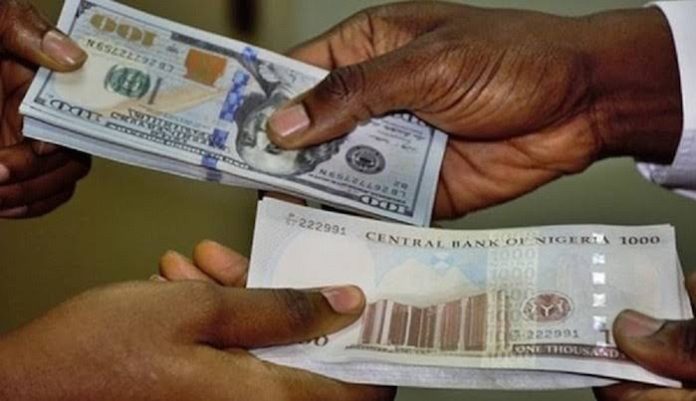
June 17, (THEWILL) – Daily market turnover rose to $311.82 million Friday at the I&E forex window – two days after the Central Bank of Nigeria (CBN) announced the Naira floating policy,
This represents a 444 percent surge from the region of $70 million that was the trend before the apex bank introduced the new forex guideline.
Daily market turnover for Thursday was $70.74 million a day after the new forex regime took effect on June 14.

Exchange rate closed at N663.04/$1 on Friday from N656.23 the previous day which also showed a high of N702.19 during the Thursday trading.
The new forex policy also reflected on the CBN website which changed from N463.38 that had existed at the I&E window to N632.77 on Thursday.
Experts project that the new forex guidelines would boost liquidity and investors’ confidence as the distortions created by the multiple exchange windows would be eliminated.
The Director/CEO of Centre for the Promotion of Private Enterprise (CPPE), Dr Muda Yusuf, had said the new forex policy would spark a surge in turnover as it will boost investors’ confidence in the economy.
In a note extended to THEWILL, Dr Yusuf, immediate past Director-General of the Lagos Chamber of Commerce and Industry (LCCI) also commended the unification of the CBN exchange rates which he said would unlock the huge potentials for investment, jobs and
He however observed that the new forex guideline does not mean amount to devaluation of the currency but a realignment of the pricing mechanism.
“Meanwhile, it should be clarified that this is not a devaluation policy, but a pricing mechanism that reflects the demand and supply fundamentals in the foreign exchange market.
“It is a framework which allows for flexible rate adjustments as and when necessary. It is a model that is predictable, equitable, transparent and sustainable. It is a policy regime that would reduce uncertainty and inspire the confidence of investors. It would minimize discretion and arbitrage in the foreign exchange allocation mechanism”, he said.
The CPPE director further argued that rate unification does not imply that rates will be exactly the same in all segments of the market. “The objective is to ensure that the differentials are very minimal, possibly between 5-10%.”
Nigeria’s inflation rate climbed to 22.41% in May 2023, marking a new 17-year high, the National Bureau of Statistics (NBS) announced Thursday. It said the figure represents an increase of 19 basis points compared to April’s headline inflation rate of 22.22%.
KPMG, a multinational audit, tax and advisory services firm, recently predicted that the current withdrawal of petrol subsidy in Nigeria could see the inflation rate climb to 30 per cent from June.
The depreciation in the value of the Naira is seen creating the space for accelerated rise in inflation rate in the second half of the year.

Sam Diala is a Bloomberg Certified Financial Journalist with over a decade of experience in reporting Business and Economy. He is Business Editor at THEWILL Newspaper, and believes that work, not wishes, creates wealth.
