
-
Okonjo-Iweala urges China to boost domestic consumption and the United States to restore fiscal discipline, warning that deepening global economic imbalances are fuelling geopolitical tensions.
-
WTO chief says the multilateral trading system remains resilient, with 72% of global merchandise trade still conducted under WTO rules despite rising tariffs, protectionism and strategic rivalries.
-
Global trade climbed to a record $34.7 trillion in 2025, defying geopolitical conflicts, policy uncertainty and supply chain disruptions, driven by strong growth in goods and services.
-
Calls on African governments to seize the global supply chain shift by investing in value addition, industrialisation and regional manufacturing, while urging reforms that deliver jobs and higher living standards.
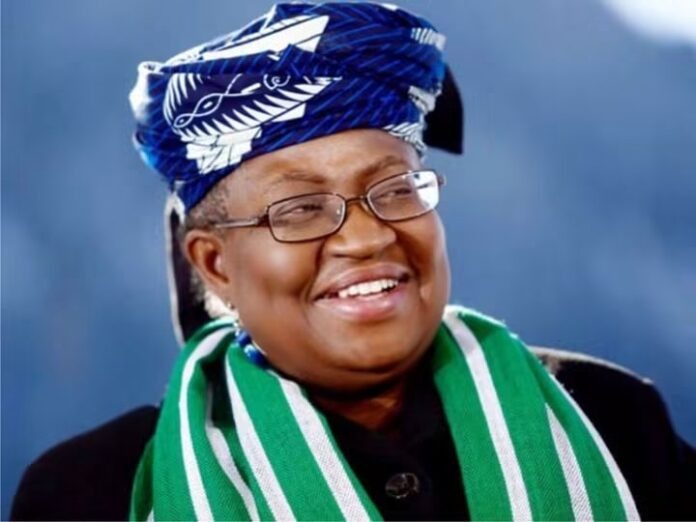
July 30, (THEWILL) — Director-General of the World Trade Organisation (WTO), Ngozi Okonjo-Iweala, has called on the world’s two biggest economies to urgently correct widening structural imbalances that are distorting global trade, warning that China’s dependence on exports and America’s mounting fiscal deficits are deepening economic tensions and reshaping international commerce.
Speaking on Wednesday at the 7th Africa Emerging Markets Forum in Abuja, Okonjo-Iweala said China must expand domestic consumption and rely less on export-led growth, while the United States must increase savings and restore fiscal discipline to strengthen global economic stability.
“The world economy is marked by some troubling over-dependencies. The weaponisation of some of these over-dependencies is swelling resentment, anxiety and political tension. China needs to consume more domestically and rely less on export-led growth, whilst the U.S. has to save more and get its fiscal house in order”, she said during her keynote address.

The WTO Director-General said the global economy is undergoing a profound transformation driven by strategic competition, supply chain diversification and economic security concerns, stressing that these developments should not be mistaken for the collapse of globalisation.
“What we are seeing is not the end of globalisation, but its transformation from cooperative to competitive interdependence”, she said, adding that the changing landscape reinforces, rather than weakens, the importance of a rules-based multilateral trading system.
WTO Still Governs Most Global Trade
Responding to claims that the WTO has become increasingly irrelevant amid rising protectionism and unilateral trade actions, Okonjo-Iweala insisted the organisation remains the legal and institutional foundation of global commerce.
She disclosed that 72 percent of global merchandise trade still takes place under the WTO’s Most Favoured Nation (MFN) framework, while another 16 percent is conducted through bilateral and regional trade agreements built on WTO rules.
“Most global trade still follows WTO rules. Around 72 percent of global goods trade continues to flow on core WTO Most Favoured Nation terms. People take the WTO for granted because we are the plumbing of trade, and they don’t think about it until something goes wrong”, she said.
According to her, while tariffs, export controls and industrial subsidies have become more prevalent, countries continue to rely on predictable multilateral rules because they provide certainty for businesses, investors and governments.
She argued that instead of abandoning globalisation, economies are diversifying production networks to reduce excessive dependence on a handful of countries in critical sectors such as semiconductors, batteries, critical minerals and digital technologies.
Despite heightened geopolitical rivalry, wars, supply chain disruptions and policy uncertainty, Okonjo-Iweala said international trade demonstrated remarkable resilience in 2025.
She revealed that global goods and services trade reached a record $34.65 trillion, representing a 7 percent increase over the previous year. Merchandise trade volumes expanded by 4.6 percent, while services trade grew by 5.3 percent, fuelled largely by the rapid expansion of artificial intelligence-related products and digitally delivered services.
She maintained that the figures contradict predictions that global trade would suffer a prolonged slowdown amid escalating tensions between major economic powers.
“Open and predictable trade can be a powerful force for macroeconomic stability”, she stated, explaining that diversified export markets and investment relationships help countries absorb domestic economic shocks and improve long-term resilience.
Africa Must Not Miss Supply Chain Shift
The former Nigerian Finance Minister said Africa now stands before one of its biggest economic opportunities in decades as multinational companies restructure global supply chains in search of more resilient production bases.
She noted that the continent possesses nearly 30 percent of the world’s critical mineral reserves, making it strategically important to industries driving the global energy transition, including electric vehicles, renewable energy technologies and battery manufacturing.
However, she warned African governments against repeating the historic mistake of exporting raw materials without developing domestic processing and manufacturing capacity.
“Quite frankly, the time to seize this opportunity is now. If we miss this opportunity, I’m afraid we will miss that”, she cautioned.
She urged governments across the continent to accelerate industrialisation by investing in mineral processing, manufacturing and regional value chains under the African Continental Free Trade Area (AfCFTA), arguing that Africa would gain greater bargaining power by negotiating collectively rather than individually.
Okonjo-Iweala cited Morocco’s emergence as a major producer of electric vehicle components, alongside growing industrial investments in Zambia, Angola and Nigeria, as evidence that Africa can successfully move beyond commodity exports into higher-value manufacturing.
- Push For WTO Reform, Nigeria’s Economic Agenda
The WTO chief also renewed calls for comprehensive reforms of the global trading system, saying current rules must evolve to reflect technological advances, industrial policy, digital commerce and artificial intelligence.
She disclosed that ongoing negotiations in Geneva are examining reforms to subsidy disciplines, transparency obligations, consensus-based decision-making and new frameworks for digital trade ahead of the WTO’s next Ministerial Conference scheduled for 2028.
Turning to Nigeria, Okonjo-Iweala commended the Central Bank under Olayemi Cardoso for measures aimed at restoring confidence in monetary policy and stabilising the foreign exchange market.
She, however, stressed that macroeconomic reforms would ultimately be judged by their ability to attract productive investment, stimulate industrial growth, create quality jobs and improve living standards.

Felix Ifijeh is a journalist with years of professional reporting experience. Known for his keen news sense, compelling storytelling and commitment to accurate, impactful reporting, he has built a reputation for turning leads into clear, engaging, and well-structured reports that resonate with readers. His work reflects deep newsroom experience and a commitment to accurate, impactful journalism.
