
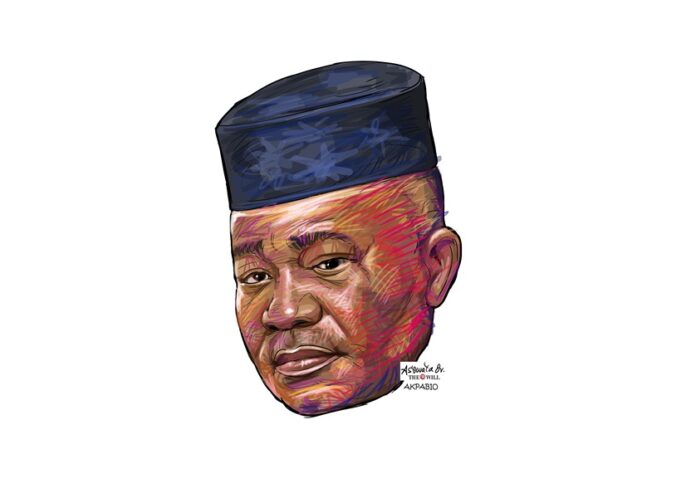
February 16, (THEWILL) — As the Conference Committee of the National Assembly begins seating today, Monday, February 16, 2025, doubts still linger about their readiness to agree on the widespread demand for inclusion of electronic transmission of election results in the Electoral Amendment Act, 2026. Both the lower and upper chambers had made amendment proposals with slight differences.
Explaining the differences, the Senate clarified that the electronic transmission of election results being discussed in the ongoing Electoral Bill review does not amount to e-voting. The Chairman of the Senate Ad hoc Panel to Review the 2026 Electoral Bill, Adeniyi Adegbonmire, made the clarification during a programme in Abuja, stressing that Nigeria has not transitioned to an e-voting system despite widespread public speculation.
Adegbonmire also explained that the INEC Result Viewing Portal (IReV) is not an electronic voting platform but a results publication tool designed to enhance transparency. “IReV is not an e-voting platform. It is a platform where election results that have been manually counted and declared at the polling units are uploaded and publicised”, he stated. The senator drew a clear distinction between electronic transmission of results and electronic voting, noting that real-time transmission can only occur where an e-voting system is fully deployed.

“For now, INEC does not have the capability for e-voting. Maybe in two or three years, we can adopt e-voting. But as of today, INEC has not put an e-voting system in place”, he said. According to him, much of the controversy stems from misinformation and misinterpretation of provisions in the Electoral Bill currently under review by the National Assembly.
THEWILL recalls that the Senate, after much public pressure, constituted the ad hoc committee to review the report of its Committee on Electoral Matters, harmonise divergent views and address grey areas identified during the legislative process.
Explaining further, Adegbonmire explained that under existing arrangements, results are first manually recorded by presiding officers on Form EC8A at polling units before being uploaded to the IReV portal. “The provision you keep emphasising says the presiding officer will first fill the result manually in Form EC8A. It is the Form EC8A that has been filled manually and will be transmitted to IReV”, he added. Adegbonmire argued that changing the wording in the bill from “transmit” to “upload” would not alter the substance of the process. “If we change ‘transmit’ to ‘upload’ in the Electoral Bill, 2026, will it change anything? The answer is no”, he said.
The lawmaker, who also chairs the Senate Committee on Judiciary, Human Rights and Legal Matters, warned that misconceptions surrounding IReV could have serious implications for national stability and peaceful coexistence. “It is important to understand what IReV does because there is a lot of misconception or deliberate misrepresentation of what it stands for”, he said, emphasising that the Senate never opposed the use of IReV in future elections, including the 2027 polls.
“The Senate never said INEC should not use IReV for the 2027 elections. IReV is a software developed by INEC to publicise results already declared at the polling units across the federation”, Adegbonmire stated. Addressing arguments that the House of Representatives’ version of the bill should be adopted, the senator described such positions as based on misunderstanding.
He explained that the House provision merely states that results should be electronically transmitted to the IReV portal in real time after Form EC8A has been signed by the presiding officer and countersigned by party agents. “This is not an emotional argument. It is about understanding the process correctly”, he concluded.Adegbonmire urged the media and the public to avoid spreading misinformation, stressing that accurate understanding of electoral procedures is critical to sustaining public trust and democratic stability in the country.
Unimpressed by his explanation and suspecting that he may have unwittingly revealed the plan of the committee to reject the public demand for the inclusion of e-transmission of results in the amendment, some Senators, civic society organisations and other stakeholders say Adegbonmire is trying to be clever by half. Others maintain they would escalate their earlier protest against the Senate to the President and demand that the latter heed their demand.
Adegbomire’s colleague, Senator Seriake Dickson said at the weekend that he was shocked that in this country and at this age, “we are having arguments, disagreements and expressing fear about the transmission of election results that are conducted manually, counted manually and entered into result sheets manually, yet people have concerns about transmitting such results electronically. That is shocking and speaks to where we are and who we are as a country.”
Speaking at a dialogue on the electoral amendment at a dialogue organised by Action Aid Nigeria at the weekend, Dickson, stated, “ I repeated my call for the House version of the bill to be adopted. However, irrespective of whichever version is adopted, the general rule now accepted by both versions is the electronic transmission of Form EC8A from the polling units. I called on INEC to come out with clear guidelines and regulations that will clearly state the mandatory rule that every election result from the polling unit shall be electronically transmitted, and that only such results should be collated.”
In its response, an umbrella body for political parties, the Conference of Nigeria Political Parties ,CNPP, in a note to THEWILL, said that after it had carefully reviewed the recently released timetable and schedule of activities for the 2027 General Elections by the Independent National Electoral Commission, INEC, it is compelled to raise serious alarm that the current circumstances under which the timetable has been released expose what appears to be a calculated political strategy aimed at frustrating the long-standing and widely supported demand by Nigerians for comprehensive electoral reforms before the 2027 general elections.
“It is becoming increasingly obvious that the persistent delay by the Senate of the Federal Republic of Nigeria in concluding legislative processes on the proposed amendments to the Electoral Act 2022 was not accidental,” Deputy National Publicity Secretary of the CNPP, Comrade James Ezema, said, adding that, “rather, emerging developments strongly suggest that the delay was orchestrated to create a procedural and political environment that would make it easier for President Bola Ahmed Tinubu to lawfully withhold assent to any eventual amendment bill on the grounds that the electoral process has already commenced following the release of the INEC timetable.”
Arguing that credible elections remain the bedrock upon which democratic governance, national unity, and political stability are built, the CNPP urged President Bola Ahmed Tinubu to rise above partisan political considerations and choose the path of democratic statesmanship.
For the International Press Centre, IPS, and the Centre for Media and Society, CEMESO, the senior lawmakers should expeditiously harmonize the process and pass provisions that reinforce transparency and credibility in Nigeria’s electoral system ahead of the 2027 general elections.
According to Dr Akin Akingbulu, Executive Director of CEMESO, and Mr Lanre Arogundade, Executive Director of the IPS, electronic transmission of results should not be discretionary but compulsory, arguing that certainty in the law is essential for credible elections. They specifically recommended that the committee retain the House of Representatives’ provision mandating electronic transmission, while refining the wording to avoid tying the law to a single technology platform.
Referencing specific platforms such as the INEC Result Viewing (IReV) portal could introduce rigidity into the law, given the evolving nature of electoral technology, the groups proposed a technology-neutral approach that mandates electronic transmission as an obligation, while allowing the electoral management body flexibility in implementation.
The civil society groups proposed a modification to Clause 60(3) of the Electoral Bill to state that designated election officials “shall electronically transmit all election results in real time, including the number of accredited voters, directly from the polling units and collation centres to a public portal,” and that such transmitted results should be used to verify results before collation.
They clarified that real-time transmission refers to the electronic uploading of officially announced polling unit results immediately after counting, in the presence of party agents, observers, and voters.

Felix Ifijeh is a journalist with years of professional reporting experience. Known for his keen news sense, compelling storytelling and commitment to accurate, impactful reporting, he has built a reputation for turning leads into clear, engaging, and well-structured reports that resonate with readers. His work reflects deep newsroom experience and a commitment to accurate, impactful journalism.
