
-
Gowon says the controversial £20 post-war payment was a collective Federal Executive Council decision, not Awolowo’s personal policy.
-
Former Head of State insists Igbos and other Nigerians with verified pre-war bank deposits recovered their full savings with accrued interest.
-
He explains that the Federal Government rejected exchanging Biafran currency at par with the Nigerian pound after experts warned the move could trigger economic collapse.
-
Gowon says his administration channelled substantial federal resources into rebuilding the former East Central State under its reconciliation, reconstruction, and rehabilitation programme.
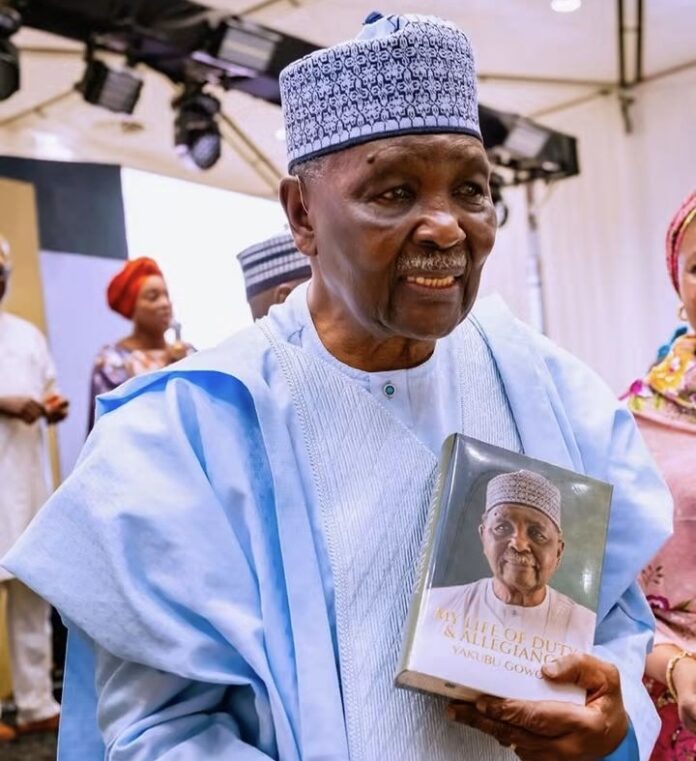
Aug 03, (THEWILL) — Former Military Head of State, Gen. Yakubu Gowon (rtd.), has challenged one of the most enduring narratives of the Nigerian Civil War, declaring that the controversial post-war £20 payment to former Biafrans was not the personal decision of the late Chief Obafemi Awolowo but a collective policy adopted by the Federal Executive Council (FEC), while insisting that Igbos and other Nigerians with verified pre-war deposits in Nigerian banks recovered their savings in full, with accrued interest.
Gowon made the clarification in his memoir, My Life of Duty and Allegiance, where he revisited the economic decisions taken at the end of the 30-month civil war and sought to correct what he described as lingering misconceptions surrounding the Federal Government’s post-war currency control policy.
The Nigerian Civil War, fought between 1967 and 1970 following the secession of Biafra, remains one of the most defining and painful episodes in the nation’s history.

Although Gowon proclaimed a policy of “No Victor, No Vanquished” after the war and launched programmes of reconciliation, reconstruction, and rehabilitation, the decision to pay £20 to many returning Biafrans became one of the most controversial aspects of the post-war settlement, with successive generations accusing Awolowo, then Federal Commissioner for Finance, of orchestrating the policy.
Gowon Defends Awolowo, Explains Basis for £20 Policy
Rejecting that long-standing narrative, Gowon maintained that Awolowo had been unfairly blamed for a policy that was collectively approved by the Federal Executive Council after extensive deliberations and expert economic advice.
He recalled that his administration ordered a nationwide currency change after the war because of the large-scale looting of the Central Bank’s branches in Benin and Enugu during the conflict, a development that left huge quantities of Nigerian currency outside government control.
According to him, the Federal Government was also confronted with the challenge of dealing with the Biafran currency, which, he noted, had no legal status as Nigerian legal tender and could not be exchanged internationally.
“That left the Federal Executive Council with the question of what to do to alleviate the suffering of returnees. Council diligently evaluated all suggestions that were proposed,” Gowon wrote.
He explained that the Central Bank constituted a panel to examine the implications of converting the Biafran pound into Nigerian currency but concluded that the exercise would be extremely difficult because the Biafran currency had never been recognised as legal tender in Nigeria.
“Due to the large number of Biafran pounds in circulation, the Federal Government decided it could not afford to exchange them all at par with the Nigerian currency without risking economic collapse,” he stated.
According to Gowon, economic advisers recommended limiting the payout to approximately £20 for every adult returning from the former Biafran territory.
“We accepted the proposition and adopted it as policy, particularly because we were unable to determine the micro and macro parameters for printing the Biafran notes,” he said.
The former military ruler lamented that despite the passage of more than five decades, “pseudo-historians” had continued to portray Awolowo as the architect of the policy.
“This is far from the truth. The final decision was not Chief Awolowo’s, even though he was the Finance Commissioner. It was done in the overall national interest,” Gowon stated.
He added that ignoring the advice of economic experts after a devastating 30-month war fought without external borrowing could have plunged the country into financial crisis.
“We certainly could not have ignored the recommendations of our economic advisers without collapsing the economy. Thus, the government made a collective and tough decision to save Nigeria’s economy, which struggled to stabilise after a 30-month war fought without external borrowing,” he added.
‘Verified Depositors Recovered Their Savings’
Gowon also dismissed the widespread belief that all Igbos lost their legitimate bank savings after the war, stressing that the controversial £20 payment related to Biafran currency and should not be confused with verified deposits held in Nigerian banks before the conflict.
He maintained that Nigerians who had fled during the war but could provide proof of ownership of bank accounts in Nigerian financial institutions recovered the full value of their deposits together with the interest accrued during the period.
“However, all who fled Nigeria but had proof of having money in Nigerian banks received full value for their money plus the interest that it earned in the Nigerian currency. It would have been unwise to take a different course of action,” he wrote.
Defending his administration’s post-war recovery agenda, Gowon said the Federal Executive Council deliberately allocated a substantial proportion of the national budget to the rehabilitation of the former East Central State and other areas devastated by the war.
He said additional measures were introduced to accelerate reconciliation and economic recovery, including bringing forward the implementation of the Second National Development Plan to ensure the East Central State participated fully in the country’s rebuilding process.
According to Gowon, rather than commence the development plan in April 1970 as originally scheduled, the Federal Government shifted its implementation to October 1970 to facilitate meaningful reconciliation and enable the war-ravaged region to benefit from national reconstruction efforts.
The former Head of State’s account is expected to revive national debate over the enduring legacy of the controversial £20 policy and the Federal Government’s post-civil war economic decisions, while offering a fresh perspective on the role played by Awolowo and the Gowon administration in shaping Nigeria’s recovery after the conflict.

Felix Ifijeh is a journalist with years of professional reporting experience. Known for his keen news sense, compelling storytelling and commitment to accurate, impactful reporting, he has built a reputation for turning leads into clear, engaging, and well-structured reports that resonate with readers. His work reflects deep newsroom experience and a commitment to accurate, impactful journalism.
