September 01, (THEWILL) – In an apparent state of bewilderment stemming from what stakeholders and industry experts ascribed to ineptitude and corruption, the Nigerian National Petroleum Company Limited (NNPC) has made a detour on the endless route towards fixing the nation’s dormant refineries which have consumed over N10 trillion without producing a drop of petroleum products.
The nation’s oil company had in the last 12 years embarked on the turnaround maintenance of the four refineries – in Port Harcourt (two plants), Warri and Kaduna – with countless promises of fixing the facilities to end the notorious practice of importation of petroleum products.
However, in a dramatic turn of events, the NNPCL on Friday, August 30, 2024 announced that it was seeking private Operations and Maintenance (O&M) companies to bid for the Warri and Kaduna refineries (while repairs of the Port Harcourt refinery is in progress).

In a public notice on its official X handle, the national oil company which outlined the qualifications of companies interested in bidding for the O&M contracts stated that the move will help ensure reliability and energy security for the country.
“The Nigerian National Petroleum Company (NNPC) Limited is an integrated Oil and Gas company engaged in petroleum/gas exploration, refining and petrochemicals, transportation, storage, and marketing.
“NNPC Ltd is seeking to engage reputable and credible Operations & Maintenance (O&M) companies to operate and maintain two of its refineries, Warri Refining and Petrochemical Company (WRPC) and Kaduna Refining and Petrochemical Company (KRPC), to ensure reliability and sustainability to meet the nation’s fuel supply and energy security obligations,” the circular said.
The circular further indicates that the tender process for the refineries will be handled as a single tender, conducted in three stages—Expression of Interest (EOI), Technical, and Commercial.
According to the circular, this process will take advantage of all possible cost-saving opportunities related to the procurement of consumables, personnel management and the use of systems, such as Computerised Maintenance Management Software (CMMS) and Warehousing Management System (WMS).
Coming after many assurances by the NNPCL management to fix and deliver the refineries, including the ones located in Warri and Kaduna, and having committed enormous sums of taxpayers’ money in fixing the plants, the announcement was a huge surprise to Nigerians.
Speaking on an Arise Television News programme on Friday evening, an oil and gas expert, Mr Godwin Ibe, noted that though the arrangement was still unclear as to what the role of NNPCL would be when it transfers the operation and maintenance of the refineries to another party, the continued operation of the refineries by NNPC should stop.
Answering a question on the feasibility of achieving the objective of the exercise as explained by NNPCL, Mr Ibe lamented the many years that the plants had laid dormant, and observed that a large portion of the plant would have become obsolete as the manufacturers of those plants would no longer be in existence, adding that the facilities ought to have been sold off.
“The ideal situation would be to sell off the refineries to private investors. If NNPC still wants to be involved, they should have equity because it has been proved that NNPCL cannot operate the refineries. They should not be the operator.
He recalled that at the twilight of former President Olusegun Obasanjo-led government, the refineries were sold to Aliko Dangote, which was reversed by the late President Umaru Yar’adua. He also recalled that many people opposed the move, which he said would have put the refineries in a better shape and saved Nigeria the energy crisis that had plagued it.
“If Dangote had acquired those refineries, we would have gone far in resolving the lingering energy challenges that now confront the nation in terms of producing what we require as a country. These refineries should be sold out,” he emphasised.
Reacting to the development, a financial engineer and oil and gas expert, Dr Nnaemeka Obiaraeri, expressed concern over the many years that NNPC had been on the matter without result.
“Let us stop wasting our time. The NNPC has been on this game of deceit since 2015. They do not want to let go of those refineries. They do not want to fix the downstream sector of our oil industry because NNPC has become a cesspit of corruption.
“If we want those refineries to start working within the next six months, it is very simple. Let the federal government put the refineries in a bucket, Value and equip the bucket. Sell 80 percent of the shareholding of those refineries. Get high net-worth, technically sound private investors who will take over the place, manage it and run it efficiently, just like we have the NLNG today.
“If they want that place to work, value it, sell off 80 percent of shareholding in those refineries to private investors, just like what Obasanjo did in 2007. That is the way the refineries will work,” Dr Obiaraeri told THEWILL in a chat.
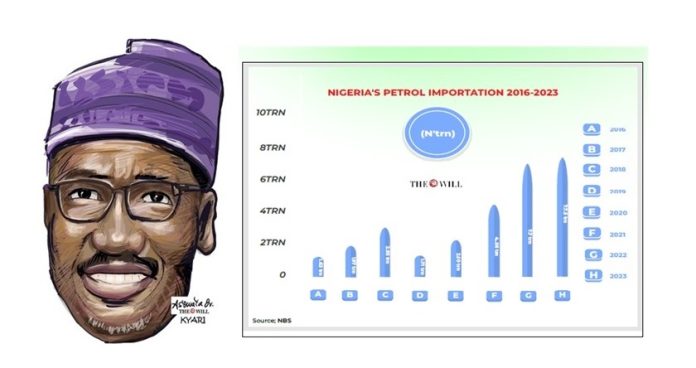
The lack of functional refineries has forced Nigeria to rely heavily on imported refined petroleum products, which has had a significant impact on the country’s economy. But the end does not seem to be in sight.
On August 3, 2022, former Minister of State for Petroleum, Mr Diepreye Sylva, told Journalists that FEC had approved $1.48 billion for the rehabilitation of both Kaduna and Warri refineries. He added that 15 percent of the contract sum had been disbursed to the contractors: Saipem SPA, and Saipem Contracting Ltd.
On October 27, 2022 (barely two months after), then Special Adviser on Media & Publicity to the President, Mr Femi Adesina, in a statement, said the then President Muhammadu Buhari during his visit to Seoul, South Korea, expressed delight as he witnessed the signing of the MoU between NNPC and Daewoo Group on the rehabilitation of Kaduna and Warri refineries and constructing NLNG Train-7 project.
The installed capacities of the Warri and Kaduna refineries, operated by NNPC, are 125,000 bpd and 110,000 bpd. At the time, the project was expected to be completed in three phases of 21, 23, and 33 months.
Nigeria, for years, has stopped producing petroleum products after all its government-owned refineries packed up.
THEWILL recalls that NNPC Ltd had in July 2023 promised that the Port Harcourt Refinery would resume production in December of that year.
While Nigerians awaited the outcome of the promise, the Senate on October 24, 2023 constituted an ad-hoc committee to investigate all contracts estimated at over N11.35 trillion awarded for the rehabilitation of the four moribund refineries in the country.
Ten months after the Senate embarked on the probe of the endless maintenance of Nigeria’s moribund refineries without a report, the upper and lower legislative chambers jointly commenced a similar exercise in August, 2024..
Following fresh controversies trailing the nation’s oil and gas industry, especially in the aspects of sabotage, corruption and oil theft, the Speaker of the House of Representatives, Abbas Tajudeen, named a seven-member committee to probe alleged economic sabotage in the oil and gas sector.
Surprisingly, this came on the heels of the action by the same Speaker who abruptly relieved the joint committee on Petroleum Resources Downstream and Midstream of the responsibility of a forensic probe into the sector amid allegations of massive fraudulent activities.
The panel headed by House Leader, Julius Ihonvbere, was to join the Senate in executing the same task. The House said the new structure aimed to ensure synergy between the two chambers of the National Assembly towards a holistic approach in addressing the issues involved.
On its part, the Senate also raised an Ad Hoc Committee to Investigate the Alleged Economic Sabotage in the Nigerian Petroleum Industry. The upper legislative chamber expressed concerns over the $1.5 billion approved in 2021 for the turn-around maintenance of the Port Harcourt Refinery with little or no result.
Opeyemi Bamidele, chairperson, Senate Ad Hoc Committee, said it was unfair and wrong to treat public companies shabbily while private businesses were flourishing and thriving.

Sam Diala is a Bloomberg Certified Financial Journalist with over a decade of experience in reporting Business and Economy. He is Business Editor at THEWILL Newspaper, and believes that work, not wishes, creates wealth.