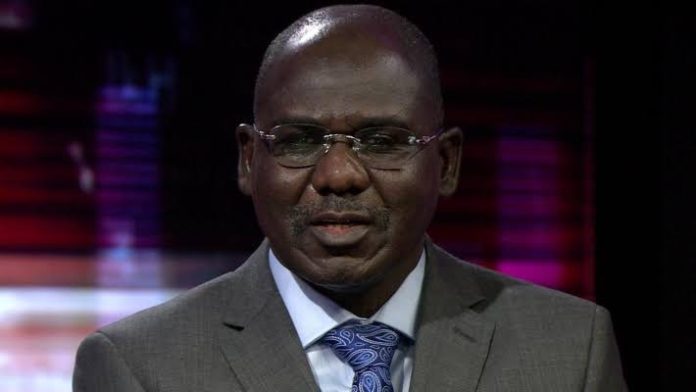
July 19, (THEWILL) – Former Chief of Army Staff, retired Lt.-Gen. Tukur Buratai, has said that a coup should be seen as an organised crime and punished accordingly, to allow democracy to survive in Africa.
Buratai spoke on Tuesday, at a one-day International Conference on Organised Crimes, put together by the Tukur Buratai Centre for Contemporary Security Affairs, Igbenedion University, Okada, in Abuja.
Speaking on the theme, “Organised Crimes Network as an Emergent Threat to National Security”, Buratai said the battle against organised crime requires concerted efforts of experts, policymakers, and stakeholders from diverse sectors.

According to him, contemporary challenges had shown that the military must continue to play its constitutional role without getting involved in governance while democratic governments should govern the citizens well.
He said the military had been at the receiving end because of the rate of attrition, adding that the craving for democracy now required the military to perform its constitutional role rather than get directly involved with governance.
“They can have many ways to influence the government to make sure that security role is played appropriately and also allow the democrats, the civilians, to perform their roles properly.
“The best way is for the military to remain within the constitutional bounds and also encourage the civil administration to do their best to solve the governance challenges or the developmental challenges of our country.
“It is by doing so that everybody plays his role, the democrats doing their own property, the politicians, the military, the populace are performing their own roles properly.
“The politicians and the military should try to avoid being influenced externally to disrupt the democratic process in the country”, he added.
The former army chief said the causes of organised crime in the Sahel, particularly in Nigeria, were multifaceted, adding that porous borders remained a primary contributing factor.
“In Nigeria, organised crime has taken various forms, reflecting the country’s socio-economic challenges and political landscape.
“One notable episode of organised crime was the Maitatsine insurgency in the 1980s, which saw a radical sect advocating for a strict form of Islamic governance, resulting in violence and loss of lives.
“Another infamous case was the Anini saga in the 1980s, where Lawrence Anini led a notorious gang involved in high-profile robberies and assassinations.
“Additionally, the rise of kidnapping syndicates has posed a significant security threat, with criminal groups targeting individuals for ransom.
“Furthermore, banditry has become a major concern, particularly in the northwestern region, where armed groups engage in cattle rustling, armed robbery, and other criminal activities.
“The emergence of drug cartels has also contributed to the expansion of organised crime, leading to increased drug trafficking, money laundering, and corruption”, he said.
Buratai said the scope of organised crime in Nigeria was vast and diverse, requiring a comprehensive and multifaceted approach from law enforcement agencies and government to effectively combat and protect citizens.
According to him, Nigeria has a criminality score of 7.15 out of 1 to 10 and is ranked 5th out of 193 countries.
“It is 2nd of 54 countries in Africa and 1st of 15 countries in West Africa according to the Global Organised Crime Index”, he said, adding that the countries with the highest criminality levels were those experiencing conflict or fragility.
Buratai cautioned that the alarming reality of ongoing criminal activities, ranging from the illicit theft of about 500 barrels of crude oil on a daily basis to the calculated displacement of communities for the purpose of mining minerals could not be ignored.
“These multifaceted crimes undermine the stability and well-being of affected regions and perpetuate a cycle of violence and exploitation.
“These criminal enterprises not only rob our economy of legitimate growth and development but also inflict immeasurable harm on individuals and communities”, he said.
The Vice-Chancellor, Igbenedion University, Prof, Lawrence Ezemonye, said the scale of insecurity in Nigeria was heightened by the growing convergence and proliferation of organised criminal activities such as banditry, terrorism, human and drug trafficking, kidnapping, among others.