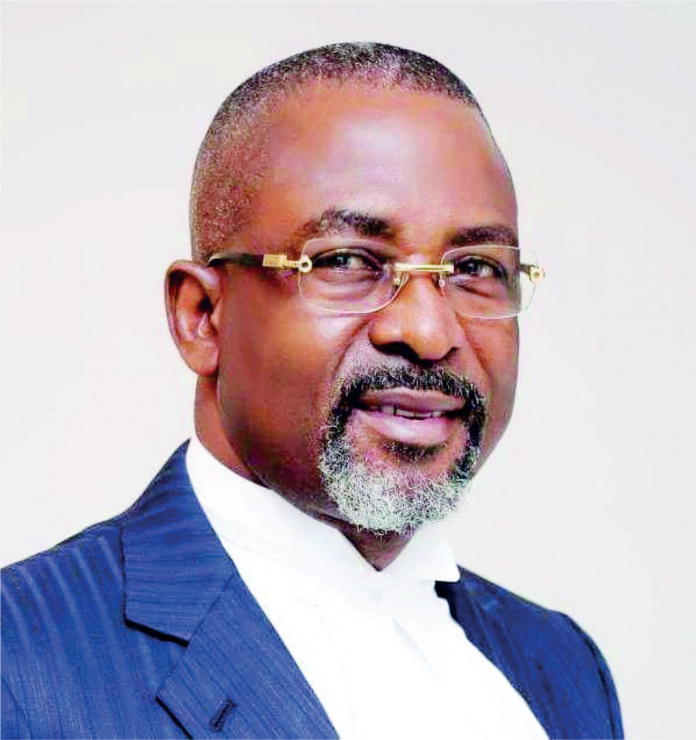
July 04, (THEWILL) – Barrister Emmanuel Enoidem is the National Legal Adviser of the Peoples Democratic Party, (PDP). In this interview with UDEME UTIP in Uyo he identified, injustice, unemployment/joblessness, religious/ethnic crisis as factors responsible for insecurity in Nigeria. He also speaks on other sundry issues as they affect the country. Excerpts:
Do you still think that Nigeria is the sleeping giant of Africa?
Nigeria appears to be hunted by a crisis that has on many occasions defied solutions. Our nation is the only country on earth that is currently plagued with multi-dimensional problems in the forms of terrorism via the Boko Haram insurgency, Fulani herdsmen/farmers crisis and banditry, kidnapping, advance fee fraud, self determination agenda, worsening economy, ritual killings and bad leadership.

Never in the history of our country have we had mutual concerns about what the future holds for us. For the first time after the Nigerian Civil War, which lasted two years, six months, one week, and two days, there are real threats to the corporate existence of Nigeria. The reality of this challenge is established by the fact that more than one ethnic group is insisting on breaking away from the country.
Is there hope for the common man after 22 years of democracy?
Many African countries lack credible, workable, purposeful and result-oriented democratic governance. Nigeria is one of such countries. In advanced countries such as the United States of America and United Kingdom, adherence to democratic principles is the raison d’être of its social, political and economical justification. That is why Amdani in 1999 said, “it is fair to say that Nigeria has little or no experience in sustaining democracy.” This raises serious concern about the survival of Nigeria’s democracy.
What are the characteristics of democracy and how would you rate Nigeria’s democratic experience in the last 22 years?
I will talk about the characteristics of democracy by describing it, in the well-known words of Abraham Lincoln, as ‘the government of the people, by the people and for the people.’ In other words, it is government that is rooted and grounded in the popular will of the people. In a democratic process, the people must be allowed to speak freely and donate their mandate and authority to whoever they choose.
In the last 22 years, Nigerians have experienced unbroken democratic governance, albeit in an imperfect manner, with growing concerns about ethnic and religious crises resulting from poverty amid plenty, revenue sharing formula, insecurity, marginalisation and domination of government positions by a particular ethnic group. Nigerians expected democracy to assist towards closing the widening gulf created by decades of hatred and animosity, especially among the major ethnic groups; ending the culture of violence; and restoring the country on the path of prosperity. The anticipated dividends of democracy are still far-fetched. Instead of closing the gap of ethnic rivalry, Nigeria is fast becoming a country that seems to gauge its political maturity by how many inter-ethnic animosities it frequently generates.
For a change, would you advocate a military takeover of government?
No. Notwithstanding the imperfections, our democratic experience in the last 22 years is by far better than the best and most robust military government. Nigerians have endured for the right reasons. It is on that note, that I join all lovers of democracy to congratulate Nigerians for their faith in the system. There is no gainsay ing the fact that democracy has come to stay in Nigeria. It should and must be seen as a way of liwfe.
In building viable, workable, effective, result-oriented and sustainable democratic structures in Nigeria, the citizens must be alive to their responsibilities and eschew all activities that will mar the progress made in the last few years. They must conform to ideas and attitudes that aid sustainable development. Government at all levels must also own up to its faults and redefine its position on the core values of democracy, which include respect for human rights, adherence to free speech and access to education. That is why I agree with those who say that the nurturing of democracy depends on a revolutionary overhaul of public institutions, the mentality of those saddled with the responsibility of entrenching laws, as well as those who heed the call for restructuring.
What is your assessment of the security situation in the country?
The biggest and the most debilitating challenge facing Nigeria at the moment is insecurity. It is an existential problem worse than what we experienced during the last civil war. The unity of the country is badly threatened. Our national foundation is badly rocked. The country today stands on a cliff. What seems to baffle most Nigerians is the fact that the government of the day appears to be completely helpless. Nigeria’s western allies, such as the United States of America (USA) and the United Kingdom, have described our security challenges as so complex that outsiders find very difficult to intervene.
What, in your own opinion, are the factors responsible for such high level of insecurity?
I have identified the various factors responsible for insecurity in the country. Injustice is one of them. Injustice means a lot of things to many people. It could be lack of fairness and justice or an unjust act or occurrence. It could also refer to a kind of behaviour that lacks what is morally right and fair. It is definitely the opposite of fairness, equity, and justice.
Injustice inflicts undeserved pain, violates a person’s fundamental human rights and deprives him of his lawful entitlements. It smacks of discrimination, exclusion, and a brazen infliction of emotional, physical and social agonies. It is often said that injustice anywhere is injustice everywhere. It cannot be doubted that what is happening in the South-East today, which is gradually snowballing and spreading to other parts of the country, is a function of a built-up perennial systemic injustice.
The Nigerian state specifically from 1999 till date has continued to show disdain for the Igbo, an attitude that proves the civil war has not ended. My opinion is that until and unless the managers and leaders of the Nigerian state take deliberate and sincere steps to accommodate the Igbo by allowing them to occupy the highest office in the land, the civil war has not ended.
This is not to justify any form of violence resulting in the death of people and destruction of property. I completely condemn violence. However, the Nigerian leadership must be alive to its responsibility by assuaging all the stakeholders, dialoguing with them and building a productive relationship based on trust.
Another potent source of insecurity in Nigeria is unemployment, which has risen by 33 per cent. About 66 million people, in a population of 200 million, are reportedly unemployed in the country. I do not agree with the figure. I believe that it is higher than that figure. Now, most of these 66 million people are graduates of tertiary institutions who have been without jobs for more than 10 years. There are others who are employed, but their salaries cannot feed their families for up to seven days in a month.
These unemployed youths get involved in anti-social behavior, which is responsible for insecurity in the country. A perfect example of what happens when the majority of a country’s youths are unemployed was observed during the #endSARS protests, in which millions of Nigerian youths occupied the streets in most parts of the country. Many of those youths who occupied the streets and shook the foundation of the country were unemployed.
Some Nigerians have called for the balkanisation of the country along ethnic cleavages. While members of the Indigenous People of Biafra and another separatist group in the South-West are agitating for the ‘Republics of Biafra and Oduduwa, Boko Haram and ISWAP terrorists are pushing an Islamist agenda. Also, Fulani herdsmen, who are believed to be non-natives of Nigeria, are claiming that the country belongs to their ancestors and as such, they must continue open grazing in the 21st century, irrespective of the negative consequences for farmers who are authentic Nigerian citizens. Unfortunately, the present Federal Government openly supports this by trying to re-establish what it sadly calls traditional grazing routes.
Until all the above issues are roundly addressed and sincerely resolved, the government will continue to pay lip service to insecurity. As long as the causes of insecurity are not addressed squarely then we will continue to play the ostrich.
Do you envisage a united Nigeria?
I need to state here emphatically that from the amalgamation in 1914 till today, Nigeria has not experienced real unity. Indeed, the creators of Nigeria – the British never really wanted the country to be united. The amalgamation was not made in the interest of Nigeria. It was made to bring the vast region of the Niger areas comprising different nationalistic compositions for the benefit of the colonial masters, for economic gain and their administrative convenience. It was a very artificial arrangement devoid of any sense of integration or justice.
This has remained largely so through independence, with the inherent injustice, dislocation and divisions that eventually culminated in the devastating civil war that lasted between 1967 and 1970. One expected that some lessons would have been learned from the war, which claimed 1 million lives, at least and some strategies would have been adopted to ensure that the wounds incurred are massaged in a veil attempt to cure or at worst, mitigate them. Unfortunately, today the situation is fed and sustained by blind partisanship on the part of the current political leaders of the country and their followers.
What is the way forward for Nigeria?
There are several strategies that the Federal Government can adopt to make the country work again. They include an amendment of the current constitution of the country to reflect the practice of true federalism. The government can also dialogue with the ethnic groups that are agitating for secession and democratise education.
Nigeria is on the brink of collapse because its leaders lack the required skills to govern, as well as the vision to train and educate the citizenry. The Federal Government should also fund and encourage studies that will quicken the pace of unity, in addition to strengthening laws of the country to enable the full practice of the rule of law. It should liaise with a western power to train Nigeria’s military personnel on how to combat terrorism. It must pursue the fight against corruption with vigour, sincerity and holistically. Finally, we need to encourage ethno-religious tolerance and give prizes and national recognition to boost efforts made at enhancing national unity.
What advice do you have for Nigerians and the country’s leaders?
To sustain democracy in Nigeria and find a solution to her numerous problems, there is a need for the various ethnic groups and other stakeholders to come together and understand the dynamics of democracy and the need to incorporate the spirit of tolerance. Nigeria has come of age, the country belongs to all of us. No ethnic or religious group has any right to impose itself on the others. Our democracy must be strengthened and made to work.
At this juncture, I must commend Nigerians for their resilience, doggedness, and unwavering commitment to the Nigerian project. We believe that despite the deficiencies and shortcomings in the practice of democracy in our country, it remains the best option. Our belief is anchored on the hope that our leaders will learn to be sincere to all and treat every tribe as a core component of the country. Just as we hope that the secularity of the nation will de-emphasise tribal sentiments. It is only then that democracy will yield its ultimate benefits, enhance security in our country and promote unity.