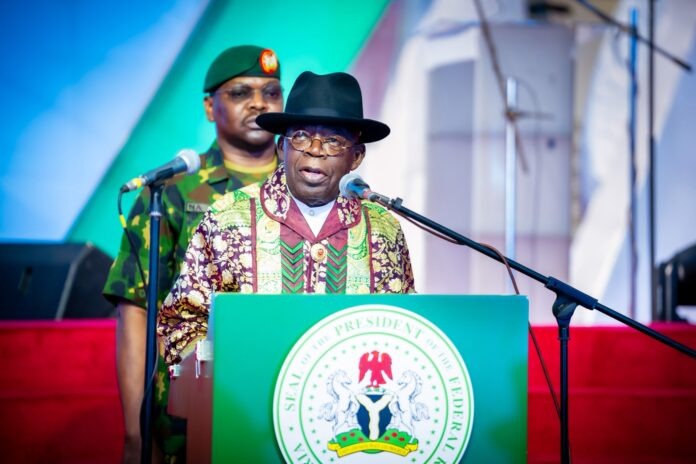
June 12 (THEWILL) — President Bola Tinubu on Friday used his 2026 Democracy Day address to defend his administration’s economic reforms, present what he described as major achievements recorded since assuming office in 2023, and call on Nigerians to unite behind efforts to build a more secure, prosperous, and stable nation.
Speaking in a nationwide broadcast to mark 27 years of uninterrupted democratic governance in Nigeria, Tinubu declared that democracy must move beyond political freedoms and begin delivering tangible economic prosperity capable of improving the daily lives of ordinary Nigerians.
The President said that while the historic June 12 struggle secured political freedom and democratic governance, the responsibility of the present generation is to achieve economic freedom through sustainable growth, job creation, improved infrastructure, stable governance, and expanded opportunities for citizens.

“June 12, 1993, revealed the possibility of a true Nigerian nation. The heroes of June 12 secured political freedom. Our challenge now is to secure economic freedom. Democracy must be felt in the quality of people’s lives — in opportunities for youth, prosperous farmers, successful entrepreneurs, and the dignity of our workers,” Tinubu said.
Responding to widespread criticism over the economic hardship that has followed key reforms introduced since his administration came into office, Tinubu insisted that difficult decisions taken by the government were necessary to rescue Nigeria’s struggling economy and restore fiscal stability.
According to him, Nigeria’s public finances were under severe strain before his administration took office in 2023, while economic uncertainty and declining investor confidence threatened long-term national development.
“The reforms we are undertaking were not chosen for ease, but for necessity. Three years ago, our public finances were under severe strain, investment was discouraged and economic uncertainty threatened our future. We chose to act, embracing reforms to advance Nigeria’s economic freedom,” the President stated.
He argued that those reforms have since restored credibility to economic management and strengthened public financial accountability across the federation.
Highlighting what he described as measurable gains, Tinubu said federation revenues have risen significantly under his administration, enabling state governments and local councils to access greater resources for infrastructure, healthcare, education, and security interventions.
The President said fiscal leakages that previously weakened government finances have been reduced considerably while transparency in public finance management has improved.
“Since 2023, our reforms have restored stability and credibility to economic management. Federation revenues have risen, providing states and local governments with more resources for infrastructure, education, healthcare, and security.
“Fiscal transparency has improved, leakage has been reduced and public funds are now better directed to national priorities,” he said.
Tinubu further disclosed that investor confidence is gradually returning, with increased investments being recorded across agriculture, mining, manufacturing, transportation, energy, technology and Nigeria’s expanding creative sector.
The President also pointed to improvements in Nigeria’s energy sector, particularly domestic petroleum refining, saying the country is steadily reducing dependence on imported petroleum products. According to him, increased domestic refining capacity is strengthening national energy security while supporting broader economic stability.
“Domestic refining capacity has increased, strengthening energy security and reducing our reliance on imported petroleum products,” Tinubu said.
Addressing Nigeria’s long-standing electricity crisis, Tinubu said his administration inherited a power sector burdened by weak generation capacity, fragile transmission infrastructure, unreliable gas supply, and billions of naira in legacy debt.
The President noted that despite an installed electricity generation capacity estimated at 13,500 megawatts, poor infrastructure had prevented efficient transmission and distribution across the country. He said the sector was also weighed down by a metering deficit affecting more than four million consumers nationwide.
To tackle the crisis, Tinubu said he signed the Electricity Act 2023, a major reform law allowing state governments to independently generate, transmit, and distribute electricity.
He added that the Presidential Power Sector Task Force has now been authorised to raise a N4 trillion bond to settle long-standing verified debts in the electricity sector.
The Rural Electrification Agency, working with the World Bank and African Development Bank, is also expanding off-grid and mini-grid electricity solutions to underserved communities, universities, hospitals, and major markets nationwide.
“Electricity is a democratic dividend we owe every Nigerian. We intend to deliver it,” he declared.
On agriculture and industrial development, Tinubu revealed that the newly created National Agricultural Development Fund is implementing plans to deploy 10,000 tractors over the next five years to boost mechanised farming and improve food production.
He also disclosed that more than 1,000 small and medium enterprises (SMEs) have already been certified for export, while Nigeria’s non-oil exports grew by 21 percent over the past year, reflecting progress in economic diversification efforts.
Despite defending his administration’s economic reforms, the President admitted that millions of Nigerians continue to face serious economic hardship driven by inflationary pressures and high living costs.
He assured citizens that the government remains committed to reducing inflation, increasing food production, expanding employment opportunities, and improving overall living standards.
“Many Nigerians still face economic hardship. We remain focused on reducing inflation, expanding food production, creating jobs, improving living standards, rebuilding confidence in our economy, and creating conditions for sustainable prosperity,” he said.
Tinubu added that Nigeria is gradually transitioning from economic uncertainty toward stability, with the next phase of governance focused on accelerating growth while ensuring citizens directly benefit from government reforms.
“We are moving from uncertainty to stability. The next phase is about accelerating growth and ensuring the benefits are felt in every home, every community, and every region. Democracy must be felt in the pocket.”
Beyond the economy, Tinubu called on Nigerians to remain united despite ongoing security challenges facing parts of the country, warning against ethnic profiling and political blame games.
The President said criminality should never be interpreted through ethnic or regional lenses, stressing that terrorism, banditry, and kidnapping remain common enemies of the Nigerian state.
“At a time like this, let us not assign blame or point fingers. Crime has no ethnicity. We must stand united and be assured that the enemies of our nation shall soon be history,” he declared.
He urged Nigerians to reject division, cynicism, and despair, while embracing hope, national unity, and collective responsibility in building a stronger country.
“Let us move forward together — rejecting division, cynicism and despair; embracing unity, hope and confidence. Let us build a Nigeria united by a common purpose, strengthened by diversity, where justice is accessible, liberty is secure and opportunity is abundant.”
Tinubu reflected on Nigeria’s historical journey, saying every generation has been confronted with a defining national responsibility.
According to him, Nigeria’s founding fathers secured independence, the June 12 generation fought for democracy, while the responsibility of the current generation is to secure prosperity and economic transformation.
“Every generation has a defining responsibility. The generation of our founding fathers secured independence. The generation of June 12 secured democracy. Our generation must secure prosperity.”
Tinubu expressed confidence that despite current economic and security difficulties, Nigeria remains capable of achieving long-term stability and prosperity if citizens remain united.
“The road ahead is steep. But June 12 reminds us that Nigerians do not break. We bend, we bleed, but we do not break.”
Tinubu reaffirmed his government’s commitment to ensuring democracy delivers real benefits to citizens while preserving national unity and strengthening democratic institutions.
Felix Ifijeh is a journalist with years of professional reporting experience. Known for his keen news sense, compelling storytelling and commitment to accurate, impactful reporting, he has built a reputation for turning leads into clear, engaging, and well-structured reports that resonate with readers. His work reflects deep newsroom experience and a commitment to accurate, impactful journalism.