November 04, (THEWILL) – Nigeria’s five south-east states of Abia, Anambra, Ebonyi, Enugu and Imo, recorded a total internally generated revenue (IGR) of N152.94 billion in 2023. This constitutes a 33.5% growth compared to N114.55 billion achieved in 2022, according to the National Bureau of Statistics (NBS).
The NBS in its recent states’ IGR report showed that the IGR was made up of taxes and other revenues. Taxes include Pay As You Earn (PAYE) which constitutes over 60% while road and property-related taxes made up the rest of the tax revenue.
Analysis of the report revealed that Enugu recorded the highest IGR among the states with a total of N33.86 billion in 2023, followed closely by Abia which pooled N33.73 billion IGR.

Anambra recorded N33.43 billion while Ebonyi garnered N30.84 billion. The least is Imo with N21.05 billion.
Disaggregated by percentage, Ebonyi recorded the highest with 89.8% compared with N12.46 billion it received in 2022. It was followed by Abia which earned 67.8% IGR growth in 2023 compared to N20.10 billion in 2022.
Enugu grew its IGR by 18% against N28.69 billion it earned in 2022, while Imo recorded the lowest percentage growth with 8.8% compared to N19.33 billion in the previous year. Anambra recorded a negative 1.58% growth with N33.97 billion earned in the previous year.
The five states recorded a total tax revenue of N98.82 billion in 2023 compared to N72.1 billion in the previous year, which translates to a growth of 37.0%.
Anambra recorded total tax of N23.33 billion in 2023, which constitutes a 27.5% growth compared to N18.29 billion in the previous year.
It is followed by neighbouring Enugu with N22.9 billion – an increase of 32.9%; before Ebonyi’s 229.5% growth to N21.65 billion from relatively meagre N6.57 billion prior.
Imo and Abia grew their tax revenue from N15.26 billion to N15.61 billion, and N14.77 billion to N15.53 billion, translating to 2.29% and 3.79% respectively.
Infesting insecurity
The states could do better given their legacy of industrious and innovative people in various fields of entrepreneurship. But their growth is hampered by insecurity.
The south-east region has been engrossed in multi-dimensional insecurity in the last nine years when Nigeria became the hotbed of terrorism, banditry, kidnapping and gun-running. While Enugu and Ebonyi have suffered many attacks by suspected Fulani herdsmen who invade their communities to kill, burn houses and destroy farmlands, Anambra and Imo are held hostage by various criminal groups.
These include the ones parading in the name of unknown gun men and supporters of the separatist Indigenous People of Biafra (IPOB) group. The same groups also infiltrate Abia but not at the rate they operate in Imo and Anambra.
The worst hit is Imo which has become notorious for frequent killing and kidnapping, resulting in significant economic setback for the state known for its booming hotel and hospitality industry.
THEWILL in an earlier report visited over twenty hotels in Owerri and its environs .Findings revealed that proprietors of the once booming hotels and entertainment centres, were counting their losses. What used to be “where it is happening” had become where little is happening.
The then chairman of Imo State Hoteliers Association, Mr Chima Chukwunyere, expressed concern that the serene nature of the town which favoured hotel and hospitality business had been destroyed by insecurity.
“Many people are afraid; no one would like to lose his life in search of entertainment and pleasure”, he said.
He added, “There are many checkpoints where security agents harass people, order them out of their vehicles with raised hands like captives. They have their belongings searched or seized. No one would want to come to Owerri under such a terrible situation.”
Troubled economy
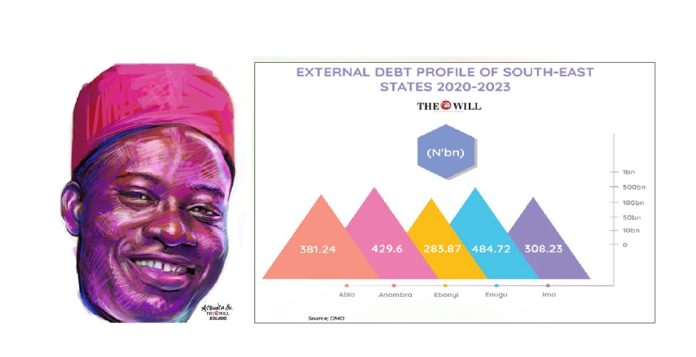
THEWILL also reports that Nigeria’s five south-east states accumulated a total of $1.89 billion external debt in four years, between 2020 and 2023; but recorded a paltry $261.6 million foreign investment during the period.
Data from the Debt Management Office (DMO) and National Bureau of Statistics (NBS) showed that the states’ combined external debt jumped by 14.1 percent from $428.3 million in 2022 to $489 million as of December 31, 2023.
Enugu state has the highest external debt stock of $494.72 million and recorded zero foreign investment during the period.
The reports showed Anambra in the second position of the zone’s external debt portfolio with $429.6 million during the review period. However, the state recorded a foreign investment of $51.48 million during the reference period.
Abia’s external debt amounts to $381.24 million, however, it recorded the highest foreign investment of $210.12 million among the south-east states during the four-year period.
The DMO data showed that Imo’s external debt position was $308.22 million but the state recorded zero investment inflow during the period. Similarly, Ebonyi which recorded the least external debt of $283.7 million had no capital inflow to the economy during the period.
A further study of the reports showed that Abia attracted its highest foreign investment within four months of Dr Alex Otti’s tenure as governor from May 29, 2023.
Although Abia is among the few Nigerian states that attract foreign investment to their economies on a fairly regular basis, the state never attracted capital inflow to the tune of $150.09 million within three months, as was the case in Q3 2023 under Otti.
By that outstanding feat, Abia came third after Lagos and the Federal Capital Territory (FTC) Abuja in capital importation destinations during Q3 2023.
The report further revealed that Abia and Anambra remained investment destinations among the south-east states, while investors shunned the other three – Imo, Enugu and Ebonyi.
That of Imo was most disappointing. Despite housing the largest natural gas reserves in West Africa, and significant crude oil deposits, Imo attracted zero foreign investment in four years, between 2020 and 2023.
The NBS reports showed that, after recording $3 million in 2019, Imo had no dime to its name by way of investment inflow to the state during the four years. Imo was also the only oil-producing state that attracted no foreign investment for the period. The situation did not change in the Q1 2024 report by the NBS.
Among the five south-east states, Anambra and Abia achieved a total of $51.48 million and $210.12 million, respectively in four years (Abia had received a cumulative of $60.03 million from 2020 to 2022.)

Sam Diala is a Bloomberg Certified Financial Journalist with over a decade of experience in reporting Business and Economy. He is Business Editor at THEWILL Newspaper, and believes that work, not wishes, creates wealth.