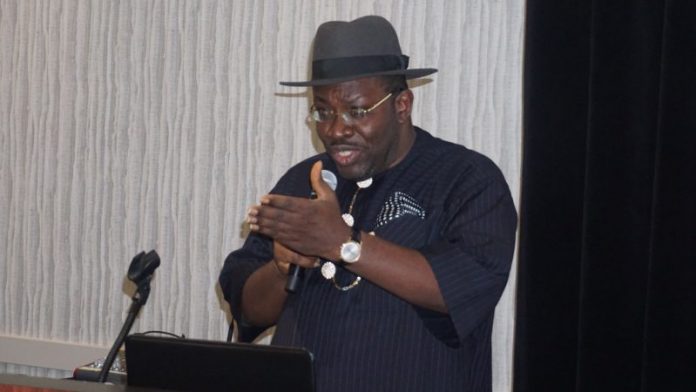
January 24, (THEWILL) – The former Governor of Bayelsa State and Senator of the Federal Republic of Nigeria, Henry Seriake Dickson, has proffered solutions for the economic development of the country, as he identifies a tripartite plank of social, economic, and environmental sustainability to anchor renewable alternatives and initiatives for economic rejuvenation.
In a convocation lecture themed, “The impact of government policies on economic development in Nigeria: challenges and sustainability”, presented at the Nigerian College of Accountancy, Kwall, near Jos, Dickson pointed out that policy per se “refers to the actions taken or not taken by the government in addressing societal issues, influenced by ideas, institutions, and interests within the political arena.”
He also identified and categorised government policies as fiscal, monetary, and trade in an open economy, with the sole objective of such policies being to provide benchmarks and direction for the attainment of macroeconomic objectives.

He said every government’s drive for economic development is geared towards the particular goals of increasing the level of national income, increasing investment, providing employment opportunities, countering or removing poverty, and stimulating a self-reliant economy.
However, over the years, he noted, the government’s economic development initiatives and drive are often belied or threatened by challenges that are as varied in nature and dimension as they vary in origin.
According to Senator Dickson, the factors “Militating against effective policy making and implementation in Nigeria” are wide-ranging, but include political rascality, ethnicity, lack of needs assessment, corruption, religion, multiple government set goals or agenda, lack of clarity of policy definition, weak democratic values and institutions, lack of good governance, lack of popular commitment, paucity of data, and policy instability.
With the guide or planks of social, economic, and environmental sustainability properly defined and put in place, Dickson recommends fiscal discipline and tight maintenance of monetary policy, a unified exchange rate regime that reflects market realities, expanding the foreign exchange market, reduction of debt risks and increasing poverty-focused spending, and protection of vulnerable groups and expansion of cash transfer programmes and strengthening of social safety nets as the panacea for meaningful economic development.