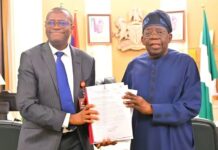
President Bola Tinubu on June 9, suspended Mr Godwin Emefiele from office as Governor, Central Bank of Nigeria (CBN). This is coming one year ahead of the end of Emefiele’s second term in June 2024.
A release from the Office of the Government of the Federation on Friday, June 9, 2023, stated that “President Bola Ahmed Tinubu has suspended the Central Bank Governor, Mr Godwin Emefiele, CFR, from office with immediate effect”.
The release signed by Willie Bassey, Director of Information, for Secretary to the Government of the Federation, said the suspension “is sequel to the ongoing investigation of his office and the planned reforms in the financial sector of the economy.”

It added that “Mr Emefiele has been directed to immediately hand over the affairs of his office to the Deputy Governor (Operations Directorate), who will act as the Central Bank Governor pending the conclusion of investigation and the reforms.”
President Tinubu had hinted about the action in his inauguration speech on May 29, 2023:
“Monetary policy needs thorough housecleaning. The Central Bank must work towards a unified exchange rate. This will direct funds away from arbitrage into meaningful investment in the plant, equipment and jobs that power the real economy.
“Interest rates need to be reduced to increase investment and consumer purchasing in ways that sustain the economy at a higher level.
“Whatever merits it had in concept, the currency swap was too harshly applied by the CBN given the number of unbanked Nigerians. The policy shall be reviewed. In the meantime, my administration will treat both currencies as legal tender”, Tinubu said.
Emefiele has been on the spotlight in recent times over the monetary policy and other actions of the CBN to grow and manage the nation’s economy more effectively. These include foreign exchange, inflation, interest rates and, on several occasions, fiscal policies matters that the CBN had to take on the economy.
The most controversial is the Naira redesign policy initiated by the former President Muhammadu Buhari-led government which fell under the purview of the CBN for implementation. The outcome of the exercise was a bitter experience for Nigerians who were caught in the web of the policy initiative of the Federal Government.
While investigation of Emefiele and the monetary policy regime under his tenure is going on, Nigerians expect a fair and transparent process that would expose the flaws in the system and yield concrete measures to build a strong, productive economy.
Emefiele was a government appointee and a public servant. His appointment was governed by the CBN Act which also derived its legality from the constitution. Only the Senate can remove the governor of the CBN from office through a vote. This explains why President Tinubu opted to suspend him instead.
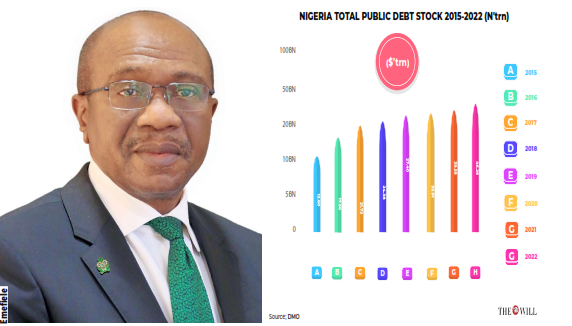
Emefiele has his strengths and weaknesses. That cannot be disputed. In the course of his duties, the policies he promoted were received with mixed feelings by the public. He also may have made mistakes. Whatever may be his areas of weakness, we believe that Emefiele did his best to build the economy encumbered by low productivity, infrastructure decay and uncontrollable appetite for imported goods. Nigeria’s penchant for borrowing, which exacerbated under the Buhari administration, was a major challenge for anyone occupying the seat of the CBN governor.
Since he first assumed office on June 4, 2014, Emefiele, Nigeria’s tenth indigenous Central Bank Governor, has been in the eye of the storm over the apex bank’s monetary policies, as already noted. The reason is simple. There is an organic relationship between the central bank and the economy of a nation; the bank’s policies have far-reaching implications on the people’s wealth-creating abilities and standard of living.
At one time, he was applauded by proponents of the bank’s policy initiatives. At the other, he was lambasted by critics for what they perceived as deliberate moves to worsen an already bad situation.
Unarguably, Emefiele’s coming on board as CBN Governor first in June 2014, and reappointed in June 2019, brought hope and calm to an economy that witnessed two recessions and suffered the scourge of COVID-19 pandemic under his watch. This may not be understood and appreciated by those the policies touched in different ways.
Upon his first appointment in June 2014, Emefiele unveiled his ten-point agenda, which spelt out, unambiguously, his plan to make the CBN more people-focused.
He left no one in doubt as to the priority of his policy thrust – development finance, to create jobs and attain financial stability. He said he was committed to create “a central bank that is professional, a central bank that is apolitical, and people-focused. A central bank that spends its energies on building a resilient financial system that can serve the growth and development needs of our beloved country.”
He did not fail to deliver as he did not relent in efforts at ensuring economic growth and financial stability through strategic policies that impact meaningfully on the economy.
Data from the bank’s Corporate Communications Department showed that the bank’s development finance interventions have created over seven million jobs. Intervention programmes introduced under the leadership of Emefiele were born out of market failure and other critical issues within the nation’s economic space.
As some experts have pointed out, such policies helped the CBN to navigate the Nigerian economy through challenges occasioned by recession and COVID-19 pandemic. By extension, interest rate issues, external reserves, foreign exchange rates, price stability, financial inclusion, gap in the agricultural and manufacturing value chains as well as sound financial system, dominate public discourse over policy actions of the central bank. At every point, Emefiele showed he was prepared for the challenge that his calling demanded.
The CBN strategic policy initiatives during the COVID-19, saved the economy from collapse and created an environment that enabled the capital market to function effectively. The result was that Nigeria emerged the best performing stock exchange in the world in 2020.
Amid fierce criticism, Emefiele and his team remained committed to the patriotic goal of ensuring economic stability through the bank’s several intervention programmes. Currently, the CBN has 37 intervention funds targeted at stimulating the economy and addressing the issue of unemployment.
Among the interventions is the famed Anchor Borrowers’ Programme (ABP) which brought unusual reform to Nigeria’s agricultural sector. The Emefiele-led CBN also created the Agribusiness/Small and Medium Enterprise Investment Scheme (AGSMEIS), and the Targeted Credit Facility (TCF).
There was the National Youth Investment Fund (NYIF), the Creative Industry Financing Initiative (CIFI), the N100 billion Healthcare Sector Intervention Facility (HSIF), the CBN Healthcare Sector Research and the Development Intervention (Grant) Scheme (HSRDIS) for the development of testing kits and devices for COVID-19 and Lassa Fever. Recipients of these facilities have contributed meaningfully to the growth of the GDP.
To solve the lingering electricity challenge, the bank under Emefiele created the National Mass Metering Programme (NMMP); N36.04 billion was disbursed to 17 Meter Asset Providers and 9 DisCos for the procurement and installation of about 700,000 electricity meters.
On the Nigerian Electricity Market Stabilization Facility – 2 (NEMSF-2), the CBN released funds to 11 DisCos, to provide liquidity support and stimulate critical infrastructure investment needed to improve service delivery and collection efficiency.
Through the N1.0 trillion Real Sector Facility, the apex bank released significant facilities to the Cotton, Textile and Garment (CTG) businesses which led to the creation of over 620,000 direct and indirect jobs in two years.
The Presidential Fertiliser Initiative, and the Shared Agent Network Expansion Facility (SANEF) were created by the Emefiele-led CBN to offer the needed support to enterprises with huge potential for job creation, conservation of foreign exchange, backward integration as well as financial inclusion.
The CBN in collaboration with key financial institutions deployed several measures towards improving access to finance for the MSMEs which are the engine of the economy. The creation of the National Collateral Registry (NCR) helped the small businesses to leverage on the opportunities to access credit for their operations.
According to experts, this has encouraged MSMEs to develop a good credit rating culture at relatively lower cost from the financial institutions.
The Emefiele-led CBN has taken the gauntlet to restore the lost glory of the classic National Arts Theatre. The Federal Executive Council (FEC) in February 2021 approved a Memorandum of Understanding (MoU) between the Ministry of Information and Culture and the Central Bank of Nigeria (CBN) Bankers Committee for the renovation of the National Theatre, Iganmu, Lagos.
Under the arrangement, the CBN and banker’s committee will invest N21.894 billion to renovate and run the Theatre profitably for a period of 21 years.
The government explained that the development is a landmark approval because it has paved the way for investment in the creative industry as part of the resolve to create at least 1 million jobs in the next three years in the creative industry.
The CBN robust payment system has continued to evolve towards meeting the needs of households and businesses in Nigeria. The high level of confidence in the payment system, between 2015 and 2020, attracted the investment of about $500m in firms run by Nigerian founders, the apex bank said.
The peak of the bank’s payment system revolution is the introduction of the central bank digital currency, the eNaira. Emefiele said the eNaira would help in attaining the goals of fostering greater inclusion using digital channels, supporting cross border payments for businesses and firms as well as providing a reliable channel for remittances inflows into the country.
The recently introduced RT200 scheme, which was aimed to revolutionise non-oil export, stimulate domestic production and expand the frontier of diversification has recorded over $6 billion proceeds of non-oil exports repatriated under the programme as at the first quarter of 2023.
President Tinubu has appointed Mr Folashodun Adebisi Shonubi as acting Governor, following the suspension of Godwin Emefiele as Central Bank of Nigeria (CBN) governor,
In effect, Shonubi, a former commercial bank executive, Engineer and Technology expert, will lead the CBN as governor and complete Emefiele’s tenure which was due to end in May 2024.
Shonubi, who was appointed Deputy Governor (Operations Directorate) in 2018, has had a fruitful career in banking, marketing, business and technology that has spanned over three decades.

Sam Diala is a Bloomberg Certified Financial Journalist with over a decade of experience in reporting Business and Economy. He is Business Editor at THEWILL Newspaper, and believes that work, not wishes, creates wealth.