
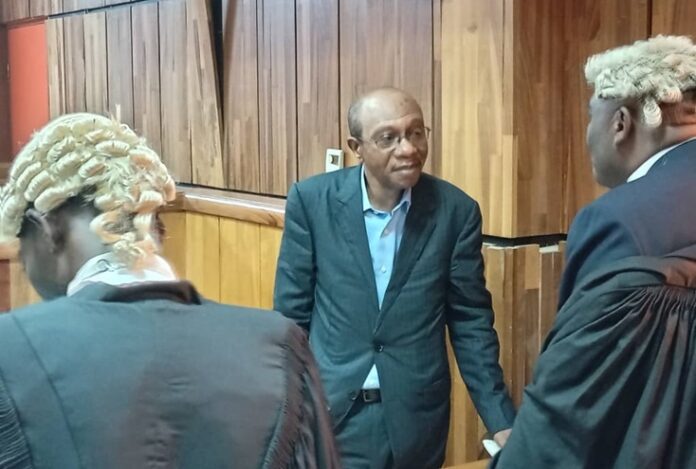
April 01, (THEWILL) — An Abuja High Court was told on Wednesday that the late former President, Muhammadu Buhari, approved the local production of the redesigned Naira notes, as a prosecution witness gave fresh details in the ongoing trial of former Central Bank of Nigeria (CBN) Governor, Godwin Emefiele.
The Economic and Financial Crimes Commission (EFCC) witness, Chinedu Eneanya, made the assertion while testifying in the case, which centres on allegations of disobedience to lawful directives and other alleged acts said to have caused injury to the public.
The EFCC, on May 15, 2024, arraigned Emefiele on a four-count charge before Justice Maryanne Anenih of the High Court of the Federal Capital Territory (FCT), sitting in Maitama, Abuja. In the four-count charge, the anti-graft agency claimed that Emefiele embarked on the naira redesign without the approval of President Buhari and the CBN Board.

Emefiele had, in his plea, denied the charge and was admitted to bail in the sum of ₦300 million.
An EFCC witness, a former Director of Currency Operations at the CBN, Ahmed Umar, had told the court that former President Buhari actually gave his approval for the printing of the redesigned naira notes.
At the resumption of trial on Wednesday, Eneanya told the court that the redesign process followed a presidential memorandum, in which three samples of the new notes were attached and submitted for approval. According to him, the President approved the design and specifically directed that the currency be produced locally.
“The defendant in his 11-page memo to the President attached three samples or sketches of the notes to be changed, and the President approved the design and said it should be produced locally”, the witness stated.
He added that his investigation showed that the Nigerian Security Printing and Minting Company (NSPMC) carried out the local production of the redesigned currency, with the Central Bank of Nigeria responsible for payment.
During cross-examination by defence counsel, Olalekan Ojo, SAN, the witness confirmed that Exhibit N1—an extra-judicial statement attributed to Ahmed Halilu, the Managing Director of NSPMC, was part of the evidence before the court. He said Halilu was invited to provide clarification on the subject matter of the charge.
Eneanya further testified that Halilu’s account indicated that NSPMC commenced and completed the production of the redesigned Naira notes locally, and that he did not encounter any contradictory evidence during the course of his investigation.
On the question of compliance with legal procedures, the witness stated that the investigation pointed to a breach of the Central Bank of Nigeria Act, 2007, particularly Section 19, which requires that currency redesign recommendations originate from the CBN Board and be forwarded to the President for approval.
He also confirmed that the original design of Nigeria’s currency notes was handled by De La Rue of the United Kingdom before the redesign exercise, adding that NSPMC was not responsible for the initial design of the currency.
Eneanya told the court that he obtained statements from members of the CBN Committee of Governors and the Board of Directors, but said he was not aware of any petition from members of the public relating to the matter, noting that his investigation was limited to directives from the EFCC.
Under re-examination by prosecution counsel, A.O. Mohammed, the witness maintained that the redesigned notes were produced based on documents attached to the presidential memo, which he said carried approval for local production.
Following his testimony, the witness was discharged by the court.
Justice Anenih subsequently adjourned the matter until May 11 for continuation of the hearing.

Felix Ifijeh is a journalist with years of professional reporting experience. Known for his keen news sense, compelling storytelling and commitment to accurate, impactful reporting, he has built a reputation for turning leads into clear, engaging, and well-structured reports that resonate with readers. His work reflects deep newsroom experience and a commitment to accurate, impactful journalism.
