
-
ECOWAS Parliament calls on member states to remove border bottlenecks by harmonising customs procedures, import regulations, taxation policies, and business registration requirements to ease cross-border trade.
-
Lawmakers demand full implementation of ECOWAS trade protocols, elimination of non-tariff barriers, and greater investment in trade infrastructure to create a seamless regional market.
-
Parliament urges expanded financing for MSMEs, stronger support for women- and youth-led enterprises, and accelerated implementation of export support, digital skills, and business development programmes.
-
Nigerian lawmakers pledge to engage the National Assembly on implementation, while ECOWAS Parliament vows sustained oversight to ensure compliance with regional trade and industrialisation commitments.
Aug 03, (THEWILL) — The ECOWAS Parliament has mounted fresh pressure on governments across West Africa to dismantle entrenched border bottlenecks blamed for slowing regional trade.
It urged member states to urgently harmonise customs procedures, taxation policies, import regulations, and business registration requirements to unlock investment, boost cross-border commerce, and accelerate economic integration.
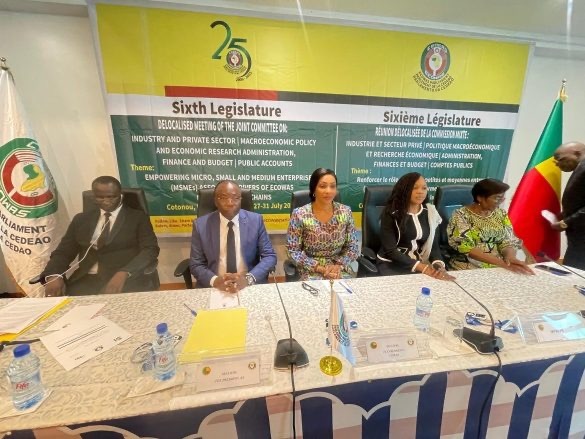
THEWILL reports that the call, forms part of far-reaching resolutions adopted at the close of a delocalised joint meeting of the Parliament’s Committees on Industry and Private Sector, Macroeconomic Policy and Economic Research, Administration, Finance and Budget, and Public Accounts, held in Cotonou, Benin Republic.

The resolutions are aimed at addressing long-standing regulatory and administrative barriers that continue to undermine the ECOWAS vision of a common regional market, despite years of trade liberalisation policies designed to facilitate the free movement of goods, services, and investments across member states.
Presenting the communiqué on Friday, Co-Chairman of the Joint Committee, Alhagie Darbo, said the Parliament was convinced that creating a predictable, transparent, and business-friendly regulatory environment had become imperative to improving the competitiveness of Micro, Small, and Medium Enterprises (MSMEs) and strengthening regional economic integration.
Darbo said the Parliament urged member states to fully implement ECOWAS trade and investment protocols by removing non-tariff barriers, investing in trade-supporting infrastructure, and strengthening national monitoring mechanisms to improve the ease of doing business across the sub-region.
He explained that governments should also harmonise customs procedures, import regulations, taxation policies, and business registration requirements to reduce the cost of cross-border trade and eliminate policy inconsistencies that discourage investment and slow the movement of goods.
The Parliament further recommended the adoption of legal, regulatory, and fiscal frameworks that promote entrepreneurship, encourage local value addition, facilitate the transition of informal enterprises into the formal economy, and enhance the competitiveness of MSMEs operating within the Community.
In addition, the lawmakers called for improved governance of markets through transparent allocation and management of trading facilities, accessible tenancy agreements, a review of restrictive trading practices, and decisive action against the unlawful harassment of traders.
The Parliament equally advocated accelerated harmonisation of ECOWAS product standards, certification systems, and quality assurance mechanisms to ensure uniform requirements for goods traded across member states and improve access to regional and continental markets.
Lawmakers also pressed for stronger implementation of the ECOWAS Trade Liberalisation Scheme (ETLS), recommending simplified procedures, improved awareness among businesses, greater transparency, and the elimination of administrative obstacles that continue to frustrate cross-border commerce.
MSMEs, Financing and Industrial Development
Recognising that access to finance remains one of the biggest challenges facing small businesses, the Parliament urged governments and regional institutions to expand financial inclusion initiatives and provide affordable financing, particularly for women-owned and youth-led MSMEs.
It also tasked the ECOWAS Commission with strengthening the implementation of the ECOWAS MSME Development Policy (2021–2030) through enterprise support centres, entrepreneurship development initiatives, business support programmes, and digital skills training aimed at improving enterprise productivity and competitiveness.
To further ease cross-border trade, the Parliament recommended the establishment of export support and assistance centres along major trade corridors and strategic border posts to guide exporters, facilitate compliance with trade regulations, and reduce administrative delays affecting intra-regional commerce.
Seeking to deepen industrial integration, the lawmakers encouraged industries to source semi-processed raw materials and intermediate inputs from within the ECOWAS region to reduce dependence on extra-regional imports while strengthening regional value chains.
The Parliament also advocated increased investment in inclusive industrial and agricultural clusters, producer networks, and value-chain platforms capable of attracting investment, improving productivity, expanding access to finance, and enhancing the competitiveness of businesses across West Africa.
Recognising the strategic role of development finance, the lawmakers assigned a broader responsibility to the ECOWAS Bank for Investment and Development (EBID), urging it to expand access to affordable and tailored financing for MSMEs through innovative funding instruments, including credit guarantee schemes, concessional financing windows, and risk-sharing mechanisms targeting women- and youth-led enterprises.
EBID was further encouraged to support investment in regional industrial and agricultural clusters by developing financing instruments capable of enabling producers and other value-chain actors to expand production capacity and integrate more effectively into regional markets.
Implementation and Political Commitment
Beyond the policy recommendations, the Parliament pledged to intensify oversight of the implementation of ECOWAS trade, investment, industrialisation, and MSME development frameworks by monitoring member states’ compliance with Community protocols and legal instruments.
It also resolved to strengthen advocacy for greater political commitment among member states towards implementing policies aimed at improving market access, industrial development, and regional economic integration.
As part of its follow-up strategy, the Parliament said the recommendations adopted in Cotonou would be transmitted to relevant ECOWAS institutions while advocacy would continue at the national level to encourage effective implementation.
Speaking on the sidelines of the meeting, Chairman of the Nigerian House of Representatives Committee on Small and Medium Enterprises, Pascal Agbodike, said Nigerian members of the ECOWAS Parliament would engage the National Assembly to facilitate the implementation of the resolutions.
He added that concerns raised over operational challenges at Nigeria’s borders would be comprehensively addressed as part of broader efforts to improve border management and strengthen regional trade.
The latest intervention by the ECOWAS Parliament comes amid growing concerns that cumbersome customs procedures, multiple taxation regimes, inconsistent import regulations, weak border infrastructure, and persistent non-tariff barriers continue to erode the competitiveness of businesses across West Africa.
Although the ECOWAS Trade Liberalisation Scheme (ETLS) and other regional frameworks were established to facilitate the free movement of goods and services, implementation has remained inconsistent across member states.
Businesses and manufacturers have repeatedly complained of prolonged border delays, multiple checkpoints, arbitrary levies, and cumbersome documentation requirements that increase production costs and weaken intra-regional trade.

Felix Ifijeh is a journalist with years of professional reporting experience. Known for his keen news sense, compelling storytelling and commitment to accurate, impactful reporting, he has built a reputation for turning leads into clear, engaging, and well-structured reports that resonate with readers. His work reflects deep newsroom experience and a commitment to accurate, impactful journalism.
