
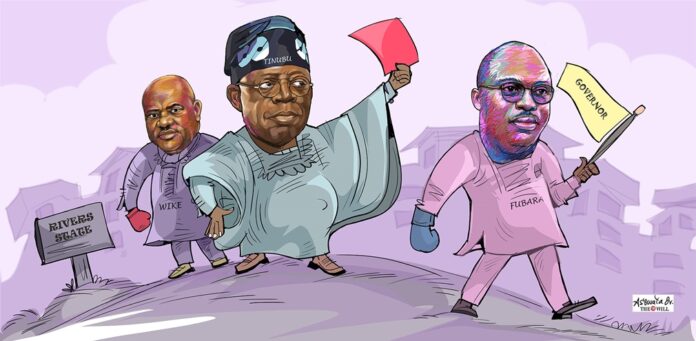
March 23, (THEWILL) –Former President Goodluck Jonathan has joined other concerned Nigerians in speaking out against the removal of Governor of Rivers State, Siminalayi Fubara, and other elected officials, as well as the appointment of a Sole Administrator to take charge of the state, following the proclamation of emergency rule by President Bola Tinubu and the controversial approval by the National Assembly.
Speaking at the Haske Satumari Foundation Colloquium in Abuja on Saturday, Jonathan warned that the suspension of the governor could taint Nigeria’s image image and seriously affect its attractiveness to foreign investors.
While explaining that he had resisted calls to speak out on the development so as not to heat up the polity, the former President said, “These actions by key actors in the executive and legislative arms of government paint the country in a negative light. The situation where an individual can dictate to the judiciary makes it difficult for anyone to have faith in the judiciary.”

“The situation in Rivers State reminds me of an Indian proverb: If somebody is truly asleep, you can wake them up easily. But if they are only pretending to sleep, waking them up becomes impossible. The key actors in Nigeria—the executive, the legislature, and the judiciary—know the right thing to do, but they are refusing to do it. They are pretending to sleep. Waking such people is extremely difficult, but they know the right thing.
“There is a clear abuse of office, power, and privileges across the three arms of government—the executive, the parliament, and the judiciary. And I always plead with our people to understand that whatever we do affects everybody. Sometimes, we make decisions thinking they do not impact us directly,” former President said.
Details are emerging of how citizens of Rivers State are adjusting to the reality of the emergency rule shortly after the Sole Administrator, Vice Admiral Ibok-Ette Ekwe Ibas (retd), met with traditional rulers in the state on Friday and pledged to harness their wisdom and influence in de-escalating tension, while fostering unity and building trust among the people. As part of his fence-mending measures, retired Admiral Ibas plans to meet with the Secretary to the State Government and Commissioners tomorrow, Monday.
THEWILL checks show that while most residents of the state are taking the new development in their stride, the majority of the Ijaw ethnic group are adjusting in a peculiar manner, no thanks to the sectarian and ethnic conflicts that often occur when the elite struggle for control of the state and access to power, unequal allocation of resources and economic survival amid insecurity and hardship in the country. They are miffed, like most other Nigerians, by the sheer illegality of a proclamation that sacked democratically elected government officials rather than deploying more security personnel to prevent breakdown of law and order.
Investigations show that two major strands of dissenters have emerged among the Ijaw over the matter. The first is driven by a sense of loss because Governor Siminalayi Fubara, a ‘son of the soil’ has temporarily been ‘intimidated’ out of office, while the other thinks that the whole affair offers vital lessons that must be leveraged for their betterment, going forward.
Uniting both groups is a common feature: Their perception that a major party in the dispute which later escalated to induce the declaration of emergency by President Bola Tinubu, was left unpunished. That party, in their consideration, is the Minister of the Federal Capital Territory, Nyeson Wike.
For both groups, leaving Wike, who openly maligned the Ijaw ethnic group at a press conference held in Port Harcourt recently, unpunished, is a sad reminder of their insignificance in the Nigerian polity.
Census data from the Nigeria Population Commission recorded the Ijaw population at 5.3 million in 1991, making up 5.9 percent of the country’s 88.9 million people at the time. By 2006, their population had grown to 8.42 million, representing around 6 percent of Nigeria’s 140.4 million people. As of 2024, Nigeria’s Ijaw population is estimated at approximately 14.39 million, accounting for 6.1 percent of Nigeria’s 233.9 million people, placing them as the fourth largest ethnic group in Nigeria. They are the largest ethnic group in Nigeria’s Niger Delta region.
“The proclamation of emergency rule by President Bola Tinubu is a well-rehearsed plot to provoke the Ijaws as there is no provision in the 1999 Constitution as amended that provides for the President to suspend an elected governor and members of the State House of Assembly,” Central Zone Chairman of the Movement for the Survival of Ijaw Ethnic Nationalities in the Niger Delta, Comrade Patrick Zidougha said in an interview with THEWILL on Friday in Yenagoa, capital of Bayelsa State.
He advised the Ijaw to react to the situation with caution as he thinks there is a grand plot to arrest and detain Ijaw leaders on trumped up charges.
Zidougha claims that the emergency rule imposed on Rivers State is nothing but oppression, by other means, of the Ijaw and a way of testing the waters before probably extending the same treatment to Bayelsa State just to silence the opposition-controlled states for 2027.
Asked for his reaction to Wike’s comments on the Ijaw, he said, “It is very demeaning and unbecoming of Wike to call the Ijaw the minority of the minorities in the Niger Delta and that they cannot produce a governor in Delta, Edo, Rivers and Akwa Ibom States, but only in Bayelsa State which is an Ijaw homogeneous state.
“I wish to remind Wike, if his memory has failed him, to search the archives and realize the frontal role the Ijaw played in championing the creation of Rivers State which brought to the limelight, His Royal Highness, Alfred Pappapreye Diete Spiff, who is the first military Administrator of Rivers State, followed by Chief Melford Okilo as first civilian governor, then Chief Ada George, all of them Ijaw sons that ruled old Rivers State.”
Wike had said in that press conference, “The Ijaw do not constitute the majority in the Niger Delta. People must speak out the truth. Heaven will not fall. What nonsense. Everyday people will just wake up and say Ijaw this and that. In Akwa Ibom, Ijaw can’t be governor. In Delta State, Ijaw is the minority of the minorities.
“The only place where an Ijaw man can become governor is Bayelsa State, not in Edo or Rivers states.”
Media Adviser to the FCT Minister, Mr Lere Olayinka, however, said the minister’s statement was twisted to serve a purpose, in addition to being wrongly seen as a party to issues that warranted the proclamation of emergency rule in Rivers State.
Speaking to THEWILL on Friday, he said that when it became clear that Wike was misunderstood, he provided further clarification of his statement on the Ijaw at a recent reception in Rivers State.
He said, “Was it FCT Minister Nyesom Wike that demolished the House of Assembly Complex.? Was it Wike that set fire on the House of Assembly complex? Was it Wike that was using three members of the Assembly to pass a budget? Was it him that refused to pass a budget in accordance with the Constitution of Nigeria? When the President intervened and everybody agreed to the terms, was it Wike that left the meeting and started calling the President a meddlesome interloper? Was it Wike that addressed the youth and said he would tell them what to do at the appropriate time? And when he told them what to do, they started bombing pipelines.”
Reminded that the report on the bombing of pipelines may have been incorrect as the Nigeria National Petroleum Company Limited, NNPC, disclosed the so-called bombing of its facility was just a flare that was immediately corrected, while the bombed pipeline in Ogoniland has been running full stream, he disagreed, saying, “No, no, no, a major pipeline was bombed and it was fixed.”
On the statement that allegedly maligned the Ijaw, Olayinka said that Wike clarified the statement at a reception held in his honour last Saturday. “He said the Ijaw on their own cannot produce governors in any state they are present except through a synergy with other ethnic groups, everybody working together. That is why he said it was only possible because they were in a majority. He also said the Ijaws should rise up against those giving them bad names and stop claiming an identity that what they are only good at is militancy. There are professors of Ijaw descent, just as they are in the armed forces.”
Olayinka refuted claims that his boss snubbed traditional rulers and stakeholders who contacted him for peaceful resolution of the leadership crisis in the state and declared, “If they came to see him, to do what? After all, when the President intervened and everybody signed an agreement to a peaceful resolution, who were those that said the President was a meddlesome interloper? Look, if you go to war and you lose, you have lost every right to sit at the negotiation table. That is the reality the governor should have faced. After the Supreme Court judgement, he should have gone low and done the needful. He had no option.”
Furthermore, he debunked a viral social media picture of the FCT Minister with the Sole Administrator of Rivers State, Vice Admiral Ibok Ibas, saying the notion that the former influenced the latter’s appointment is ridiculous. “Haven’t you also seen the Admiral’s pictures with former governor Rotimi Amaechi, with former Lagos Governor Akinwunmi Ambode and many others? When he was in the military, the Admiral paid visits to state governors. That was when Wike was a governor,” he said.
Reacting to the claims that the Governor Fubara’s negligence warranted the proclamation of emergency rule, Nelson Chukwudi, Chief Press Secretary to Governor Fubara, absolved his principal of any dereliction of duty.
He said, “It is clearly untrue that somebody who has all the while preached peace and non-violence even in the face of extreme provocations, would be ‘telegraphing attacks on oil pipelines’ and would be breaching the peace he has worked so hard to promote and sustain for the good of the people of the state.
“There was also another claim that after demolishing the Hallowed Chambers of the State House of Assembly on Moscow Road in Port Harcourt, the governor did nothing to rebuild the facility, whereas the project is 80 percent completed.”
While maintaining that the presidency was not properly briefed about developments in the state to guide decision making, he blamed Wike for triggering the reaction of stakeholders in the Niger Delta, especially elders, chiefs, women, Ijaw National Congress, its youth wing, IYC, as well as militants, among others, by remarks in a live media chat, during which he dismissed the Ijaw as a “minority of the minorities’ and powerless in the Nigerian polity.
Nonetheless, THEWILL checks show that there are two divides among the Ijaw that share different views on the development.
Irritated by what it deems to be a deliberate insult to the Ijaw like the invasion of Odi in Bayelsa State in 1999 by the armed forces on the orders of the Federal Government, one side reasons the Ijaws should prepare for the worst.
Odi is an Ijaw enclave that was invaded and destroyed by armed forces after the community failed to heed a Federal Government directive to stakeholders to fish out the killers of 12 policemen during a protest over rights to oil and gas resources by militants operating in the area. Over 900 persons were killed in the attack and almost all houses were razed by the rampaging soldiers who claimed they were ambushed by militants on their way to the town.
When reminded that both events are dissimilar, an influential Ijaw leader who asked to be anonymous argued that in a situation where there are unevenly matched parties in a dispute, the stronger can go to any length to exert its price.
“There is no smoke without fire. For the FCT Minister to talk down on our people in such a disparaging manner without being called to order and then the president goes ahead to illegally and unconstitutionally sack elected officials, is enough warning,” the leader said.
More alarming to this side of the divide is what they perceive as the silence of prominent Ijaw leaders in the face of Wike’s “provocative verbal attack.”
Prominent Ijaw political leaders, like ex-President Goodluck Jonathan, Governor Douye Diri, Senator Seriake Dickson, Minister of State for Petroleum, Heineken Lokpobiri, his predecessor, Timipre Sylva and militant ‘Generals’ should have responded to Wike’s comments, the person said.
He commended the President of INC, Prof Benjamin Okaba for providing leadership to guide the Ijaw. Last Thursday Okaba disclosed that the proclamation was tantamount to a slap on the face of the Ijaw.
“There are clear facts all over the place and I believed President Tinubu ought to have had a look at them all. I stated that it’s unfair. So, why are you going to fire Sim Fubara and abandon Wike? Eliminating all those involved is the best course of action. Wike must be fired, along with all other federal appointees from the state, because if they are not fired, they will use their positions to provoke further problems and carve out more favourable roles for themselves,” Okaba said.
In a sharp contrast, the other side of the divide views the unfolding events as a hard lesson for the Ijaw ethnic group. “There should be a paradigm shift in defending the strategic interests of the Ijaw nation, going forward. According to this group, the era of ‘Barasin Tamaran Preye Yahaa’ (Leave everything to God) is gone.
This group is coordinated by the Ijaw in the Diaspora with sufficient experience of the political dynamics back home, having schooled and worked in Nigeria.
A lawyer among this group, who once worked in a leading law practice in the country before relocating to the United States, and preferred anonymity, canvassed for unity amongst all Ijaws and harmonisation of aspirations. Though the fourth largest ethnic group in Nigeria, Ijaws are currently scattered along many coastal states in the country, such as Edo, Akwa Ibom, Delta, Ondo and Cross River and Rivers, apart from Bayelsa which they populate by 95 per cent. They also have a sizeable presence in fishing communities of Benue and Kogi States.
BACKGROUND
Speaking in a nationwide broadcast on Tuesday evening, President Tinubu invoked Sections 305 of the 1999 Constitution (as amended) to suspend the Rivers State Executive and the legislature for an initial period of six months. The president appointed Vice Admiral Ibok-Ette Ibas (Retd) as Sole Administrator of the state. The controversial proclamation has drawn nationwide condemnation for its illegality and unconstitutionality with the Nigerian Bar Association and several constitutional lawyers urging the president to rescind his action.
Justifying his proclamation, the President said, among others that, “It is public knowledge that the Governor of Rivers State for unjustifiable reasons, demolished the House of Assembly of the state as far back as 13th December 2023 and has, up until now, fourteen (14) months after, not rebuilt same. I have made personal interventions between the contending parties for a peaceful resolution of the crisis, but my efforts have been largely ignored by the parties to the crisis. I am also aware that many well-meaning Nigerians, leaders of thought and patriotic groups have also intervened at various times with the best of intentions to resolve the matter, but all their efforts were also to no avail.”
The National Assembly has since ratified the proclamation in a controversial voice vote that lacked transparency nor met the requirement of the constitution.
AGGRIEVED PARTIES HEAD TO COURT
Meanwhile, three parties have gone to court to challenge the removal of the governor, deputy and state legislature. The first is by a lawyer, Daniel Wariboko, who as a sole plaintiff, filed a suit marked FHC/CS/550/2025, at the Federal High Court in Abuja on March 20, 2025. The suit, commenced through an originating summons, was filed on behalf of the electorate. Wariboko is suing for himself and other registered voters in Rivers State.
The President, President of the Senate, the Speaker of the House of Representatives, the National Assembly and the Attorney-General of the Federation (AGF) are listed as the 1st to 5th defendants in the case. Wariboko wants the court to determine whether, under Section 305 of the Constitution of the Federal Republic of Nigeria (1999, as amended), a dispute between a governor and a state House of Assembly constitutes grounds for declaring a state of emergency; whether provisions of Section 305 of the Constitution, the 1st defendant has power to suspend a democratically elected executive and legislative arm of government and appoint a sole administrator to run the affairs of state where there is an elected governor, deputy and members of the assembly.
A second lawsuit is on the way and this time, from the main opposition party, the Peoples Democratic Party, PDP, Fubara’s party. The Governor of Oyo State, Seyi Makinde, made this disclosure at the weekend.
The governor said, “I am glad that our great party, the PDP, is demonstrating the needed strength and leadership. The PDP Governors’ Forum arose from an emergency meeting where we unanimously decided to challenge the actions of President Tinubu in a court of competent jurisdiction. We cannot fold our hands and watch the democracy we built for almost three decades be trampled upon.”
The third group is led by leaders of the Ijaw Youth Council (IYC), Eastern Zone. They have filed a lawsuit against the Federal Government of Nigeria at the Community Court of Justice of the Economic Community of West African States (ECOWAS Court) in Abuja, challenging the declaration of a state of emergency in Rivers State.
In a suit dated March 20, 2025, and marked ECW/CCJ/APP/18/25, the applicants are seeking an order from the regional court to nullify the suspension of elected officials and reinstate democratic governance in the state.
The plaintiffs, Comrade Harry Ibiso and even others, acting on behalf of the Eastern Zone of the IYC, also want the court to set aside all actions, policies, and directives issued by the sole administrator appointed by President Tinubu on March 18.
Citing Articles III and IV of the ECOWAS Court’s supplementary protocol, Article II of the Court’s Protocol, and Article 33 of its rules, the applicants argued that President Tinubu, as an elected leader, lacks the constitutional authority to remove or suspend an elected governor.
Notice: Function wpdb::prepare was called incorrectly. Unsupported value type (object). Please see Debugging in WordPress for more information. (This message was added in version 4.8.2.) in /home/thewilln/public_html/staging.thewillnews.com/wp-includes/functions.php on line 6170
Notice: Function wpdb::prepare was called incorrectly. Unsupported value type (object). Please see Debugging in WordPress for more information. (This message was added in version 4.8.2.) in /home/thewilln/public_html/staging.thewillnews.com/wp-includes/functions.php on line 6170
Warning: Undefined variable $show_related in /home/thewilln/public_html/staging.thewillnews.com/wp-content/plugins/molongui-authorship/views/author-box/parts/html-tabs.php on line 30
Amos Esele is the Editor of THEWILL Newspaper. He has over two decades of experience on the job.
Amos Okioma is a Correspondent at THEWILL
