November 25, (THEWILL) – Total disbursements from the Federal Account Allocation Committee (FAAC) to the federal, state and local governments rose by 60 percent to N19.7 trillion (year-on-Year) as of October 2024, from N12.31 trillion in the corresponding period — according to data from the National Bureau of Statistics (NBS)
Further analysis of the reports revealed that the highest allocation in 2024 was recorded in February when the three tiers of government shared N2.33 trillion, while the least amount of N1.20 trillion was shared in August.
In the case of 2023, the highest amount was recorded in June when the FAAC allocation for the three tiers of government was N1.89 trillion, while the least — N860.04 billion, was shared in February of that year.

On the face value, the federal, state and local government councils are harvesting an incredible volume of FAAC revenue which is largely attributed to the removal of fuel subsidy by the federal government in May 2023.
However, a closer look at the state of the nation’s affairs would reveal that the source of the ‘voluminous’ naira is the significant depreciation of the local currency.
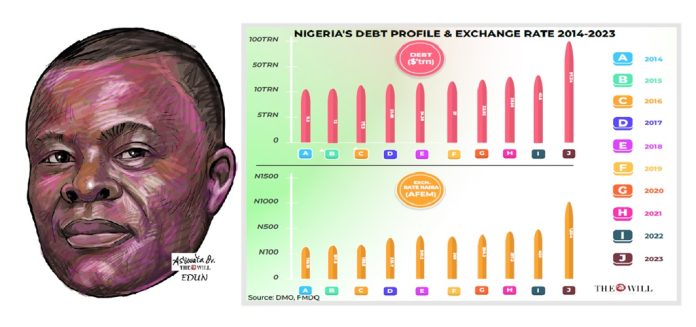
Data from FMDQ platform that publishes the Nigerian Foreign Exchange Market (NAFEM) daily rate showed that the naira has lost over 150 percent of its value since June 14, 2023 when the currency was floated under the foreign exchange reform policy of the Bola Tinubu-led government.
On the abolition of the multiple exchange rate windows, which signified the devaluation of the naira, on June 14, 2023, the local currency slumped to N665/$1 on the same day, from N472/$1 the previous day, representing a depreciation of 40.8 percent in one swoop.
This triggered a roller-coaster trend for the naira which suffered intense volatility that the monetary policy authorities have struggled to control.
As of Friday, November 21, 2024, the naira exchanged N1,569/$1 at NAFEM indicating a value loss of N1,185.
Pangs of inflation
In real terms, the federal, state and local government councils are receiving a relatively ‘worth-less’ volume of the naira which has lost a significant chunk of its value – in a stagflation environment.
With inflation rate climbing to a four-month high of 33.9 percent in October, from 32.7 percent in September, according to recent report by the NBS, it becomes obvious that the three tiers of government are carrying huge volume of naira with lesser value compared to the pre-devaluation period, thus triggering price pressure.
Price pressures have left millions of Nigerians grappling with the worst cost of living crisis in decades as they struggle to meet their basic needs. To ease the pressure on workers, the federal government has approved a new minimum wage ofN70,000.
“With insecurity continuing unabated and farmers abandoning their farms to live in the IDP camps, trucks conveying food items spend two weeks from the North to Lagos, for instance, while most of the items become damaged before arrival, it is doubtful what the government can do under the circumstance without addressing the major causes of the abnormally high inflation – fuel subsidy removal, high exchange rate and insecurity”, said Joseph Akor, a Lagos-based merchant.
Besides, many state governments embark on white elephant projects such as fly-overs and airports which do not have immediate and direct impacts on the lives of the people battling with high rate of unemployment.
Shrinking EMTL
Further analysis of the NBS reports showed that the revenue accruing to FAAC via the Electronic Money Transfer Levy (EMTL) dropped by 43.6 percent from N302 billion in the first ten months 2023 to N170.2 billion as of October 2024.
The boom recorded in 2023 could be attributed to the high volume of e-transactions following the intensified naira scarcity which forced many bank users to patronise alternative payment channels in the midst of severe cash crunch.
Typically, EMTL is levied on transactions conducted via platforms such as mobile money, internet banking, and other electronic payment methods. The Finance Act, 2020 which gave birth to it, further specified the particular rates and circumstances of the Levy, which ensured transparency and consistency in its application.
It applies to all electronic transfers of funds placed in a Nigerian-licensed bank or financial institution. The Levy is imposed as a singular and one-off charge of ₦50 on electronic transfers or electronic receipts of money in the sum of ₦10,000 or more. Transfers under ₦10,000 and between accounts within the same financial institution are outside of the scope of EMTL.
The process of collecting and remitting the Levy involves financial institutions collecting the Levy on each qualifying electronic transfer and remission is expected to be made to the Federal Inland Revenue Service (FIRS) within the timeframe stipulated.
The Finance Act, 2023 stipulates that revenue accruing by the operation of EMTL shall be distributed to the three tiers of government on the basis of derivation with the federal government receiving 15 percent, states 50 percent and the local governments 35 percent of the EMTL realised.
THEBILL reports that the system has pushed the banks into stiff completion as their e-revenue continues to surge with the Tier-1 banks topping the game.
The e-banking income includes revenue from electronic platforms, such as mobile applications, USSD channels, Internet banking, ATM, PoS as well as other debit and credit card transactions.
Recently, the banks have embarked on systems upgrade to expand their e-banking channels for maximum performance and enhanced revenue generation, which have created a stiff competition among them.
The remarkable increase in e-banking revenue of the banks shows the high level of interest in alternative payment systems by bank customers as the CBN pushes for expansion in financial inclusion across the country.
According to Nigeria Inter-Bank Settlement System (NIBSS), e-banking activities through the electronic payment transactions in Nigeria hit an all-time high in 2023 as it rose by 55 per cent to N600 trillion, compared to N387 trillion in 2022.
Also, the total value of point of sale (PoS) transactions for 2023 was N10.73 trillion compared to N8.39 trillion recorded in 2022 indicating a 27.85 per cent increase.
These feed the EMTL that the three tiers of government share every month.

Sam Diala is a Bloomberg Certified Financial Journalist with over a decade of experience in reporting Business and Economy. He is Business Editor at THEWILL Newspaper, and believes that work, not wishes, creates wealth.