
February 22, (THEWILL) — With over 60 per cent of results from the six Federal Capital Territory Area Councils uploaded on the Independent National Electoral Commission’s result-viewing portal, IReV, by the early hours of Sunday, February 22, 2025, the All Progressives Congress (APC) has taken the lead, with the Peoples Democratic Party (PDP) and the African Democratic Congress (ADC) trailing the governing party.
While the APC has maintained an overall lead across the six councils, namely Abuja Municipal Area Council (AMAC), Bwari, Gwagwalada, Kuje, Abaji, and Kwali, the PDP and the ADC also showed significant strength in some areas. In AMAC, which hosts the Presidential Villa, the National Assembly, and the Judiciary, the ADC matched the APC in many polling units in the Chairmanship election. The PDP candidate, Zadna Dantami Maikalangu, had stepped down in favour of the APC candidate, Christopher Maikalangu.
Except in Bwari, where the PDP candidate Julius Adamu also stepped down for his APC counterpart, Joshua Musa, resulting in unchallenged APC dominance, the PDP and the Young Progressives Party (YPP) gave the ruling party a competitive run in several other councils.

In Kwali, where 75 per cent of results had been uploaded as at press time, the APC led, followed by the PDP, the Action Democratic Party (ADP), and the ADC. It was a neck-and-neck fight between the PDP and the APC in Kuje Council, where 65 per cent of results had been uploaded by early Sunday morning. In Abaji, with 82 per cent of votes counted, the APC, YPP, and PDP were locked in a tight race. Gwagwalada presented a straight contest between the APC and the PDP.
VOTING PROCESS
Apart from the 2:30 p.m. deadline set for the end of voting and the commencement of sorting and collation, the generally peaceful conduct of the FCT Area Council poll was nearly marred by the familiar malpractices that have bedevilled Nigerian elections over the past 26 years of democratic governance.
Vote-buying, snatching of ballot papers, over-centralisation of polling units, midnight notifications of polling unit changes, and the late relocation of polling units by the Independent National Electoral Commission (INEC) all threatened to undermine an otherwise orderly election for six Chairmanship and 62 Councillorship positions, contested by 1,680,315 registered voters across 2,822 polling units in 62 electoral wards.
Some voters disclosed that they received notifications of new polling unit locations only on Saturday morning, minutes before voting began.
Sharing his experience, Mr Polycarp Opara told journalists that he received no notification from INEC whatsoever. Having voted at the same polling unit in Abaji Council since 2019, he was at a loss when he could not find his name in any unit in the area after an extensive search. In frustration, he returned home without casting his vote.
Another voter, who gave her name simply as Gloria, said she received an early Saturday morning notification that her polling unit had changed to Kurudu Primary School in Abaji Council, where she was subsequently able to vote without difficulty.
Emmanuel Ugbechie, a former Chairman of the Nigeria Union of Journalists (NUJ) in the FCT, said he received a message about his new polling unit on Friday night. According to him, INEC cited congestion as the reason for the change.
A significant security lapse was recorded at a polling unit in the Kuje Area Council after a Department of State Services (DSS) operative was assaulted by a mob of youths during the elections. The incident occurred at the Junior Secondary School, Kayada polling station, where over 50 youths reportedly attacked the operative, accusing him of filming and photographing alleged vote-buying activities.
Eyewitnesses said the youths became hostile after suspecting the operative was documenting how voters were allegedly being induced to sell their votes. He was manhandled for more than five minutes, during which his mobile phone and wallet were forcibly taken. He was left visibly shaken as he pleaded with the youths to spare his life. Despite the prolonged assault, no other security personnel were present at the polling unit to intervene, allowing the situation to escalate unchecked.
The operative reportedly held off the mob until some of the youths relented and released him. Speaking briefly to THEWILL before fleeing the scene on a motorcycle, he lamented the absence of other security agents at the polling station. He said that although his accreditation card was seized, he was fortunate to recover his damaged handset and wallet before escaping.
The incident heightened concerns over the adequacy of security arrangements at polling units across the FCT, as reports of vote-buying and voter intimidation continued to emerge throughout the day.
INTERIM REPORT BY SITUATION ROOM
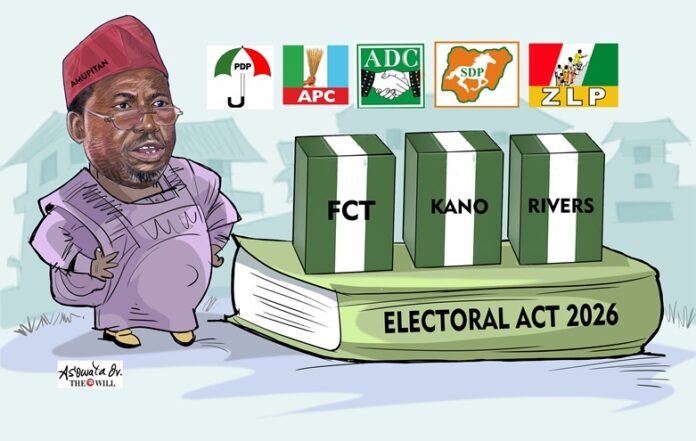
Coming on the heels of the new Electoral Act 2026, the poll was widely seen as a litmus test for INEC and a dress rehearsal for political parties ahead of the 2027 general election.
The Nigeria Civil Society Situation Room, comprising over 70 groups, said reports from its network of observers across the FCT revealed sloppiness in many areas. In an interim report co-signed by conveners Mma Odi and Celestine Odo, the Room stated that there was evidence suggesting that what occurred in many instances was a reflection of past patterns likely to repeat in future electoral cycles.
The report noted relatively late opening of polls, with an average start time of 9:15 a.m. across many observed polling units.
On vote-buying, the report stated: “In a few places, it was done openly at polling units such as PU008, 056, 057, and 058 in Gidan Mangoro Ward of AMAC, where votes were traded for as much as N10,000 each. In some other places, vote-buying was discreet but still observed.”
While commending Kwali Area Council, where INEC personnel and materials arrived on time and voting began early, the report flagged late openings in many other councils due to the late arrival of INEC staff and materials. It noted that citizen turnout was slow initially, with queues forming gradually in polling units across Kuje, Kwali, Gwagwalada, and Abaji Area Councils.
“Although some voters acknowledged receiving text messages from INEC on the eve of the election, they were unable to verify the locations due to the short notice. The Bimodal Voter Accreditation System (BVAS) performed efficiently, with a one-minute average turnaround time for voter accreditation in the majority of polling units. However, two reports of BVAS malfunctions came from Gwako Town/Primary School II and IV in Gwagwalada, and PU143 (Open Space opposite Okada Park by Gate Post, Navy Town, City Centre, Abuja),” the report said.
The Situation Room praised the professionalism displayed by security personnel, comprising the Nigeria Police, Civil Defence Corps, Immigration Service, and Fire Service, at polling units.
“Although there were a few reports of intimidation and harassment in locations such as Grade 1 Area Court, Rubochi, Kuje; Naharati Sabo School II, Rimba/Ebagi; PU3, Ungwar Liman 1, Abaji Central; and Kpasele JSS, Giri II, Gwagwalada, where a voter arrived with a cutlass and youths charged at him, the situation was swiftly handled by security agents who removed him,” the report noted.
The report also raised concern over the unavailability of materials such as braille ballot guides and magnifying glasses for Persons with Disabilities (PWDs). It commended the presence of party agents in many visited polling units and praised the INEC FCT Help Desk for its prompt response to issues raised by the Situation Room.
The FCT Minister, Nyesom Wike, who monitored the poll, acknowledged low voter turnout. “Yes, there is low voter turnout. It is unfortunate. In off-cycle elections, this is always the case,” he told journalists on Saturday afternoon.
INEC Chairman Prof. Josiah Amupitan expressed measured optimism in his assessment. “As far as the efficiency of the BVAS is concerned, I am very satisfied; they have worked efficiently. It took seconds for voters to be accredited. The only place we had problems was in Abaji Council, and we informed the security agents, who acted promptly and tamed the situation,” he said.
INEC COMPLYING WITH NEW ELECTORAL ACT PROVISIONS
Dr Olalekan Omokeinde, the Resident Electoral Commissioner (REC) for Ekiti State, who served as the supervising REC for the FCT poll, explained that the provisions of the new Electoral Act regarding electronic transmission of results would be followed. He said Presiding Officers were expected to complete the EC8A form, have it stamped, and then upload the results to the IReV portal, with manual collation serving as a back-up. He said BVAS performance was near 100 per cent.
In practice, however, compliance with the method appeared discretionary in some polling units.
A Presiding Officer in a unit in Kwali Council, who gave his name simply as Abraham, confirmed that during training they were instructed to scan the EC8A form after party agents had appended their signatures, and then immediately transmit the result to the IReV portal, an instruction he carried out diligently. In another unit in the same council, a Presiding Officer did the opposite. When confronted by journalists as he packed up election materials and mounted a motorcycle heading to the collation centre, he disclosed that he was travelling there because he had been unable to upload the results remotely.
‘OBIDIENT’ MOVEMENT RAISES ALARM
In light of the observed lapses in the handling of results, The Obidient Movement on Saturday evening raised the alarm that results uploaded from several polling units were not reflecting on the IReV server.
Yunusa Tanko, who issued a statement on behalf of the movement, said: “Information reaching us indicates that the IReV server is active but not displaying results that were reportedly uploaded successfully from various polling units.”
“All Obidients and Nigerians are therefore encouraged to remain alert and vigilant. If necessary, we urge everyone to proceed peacefully to the Area 10 INEC office and Karu for the collation process and observe developments closely. Ensure that you have the accurate results from your respective polling units for proper verification. Let us remain calm, law-abiding, and committed to protecting the integrity of the electoral process through peaceful and lawful means,” he added.
Political analysts observed that INEC’s inability to release results from a single local government election on the same day it was conducted raises questions about its preparedness for future elections.
“On the deployment of logistics, I score INEC average. Accreditation in some polling units went well, but the voting process, marred by voter apathy, leaves much to be desired,” said Mr Jake Epelle, Chief Executive Officer of The Albino Foundation, which monitored the poll across the FCT.
RIVERS AND KANO BY-ELECTIONS
Unlike the FCT, the by-elections held in the Ahoada East and Khana II constituencies in Rivers State, and in the Kano Municipal and Ungogo constituencies in Kano, were largely peaceful affairs.
The Resident Electoral Commissioner in Rivers State, Gabriel Yomere, expressed concern over voter apathy but commended the efforts made by INEC and civil society organisations in sensitising voters ahead of the election. “We took it upon ourselves to go from local council to local council, pleading with traditional rulers, politicians, and CSOs to encourage voters,” he said.
Governor Siminalayi Fubara of Rivers State described the exercise as “actually a family affair, and so there was no need for rancour and acrimony.”
Predictably, the APC won both by-elections in Rivers State. Napoleon Ukalikpe of the APC was elected in Ahoada East after polling 3,980 votes in a contest from which two major opposition parties, the PDP and the ADC, abstained. A breakdown of the results shows: Action Alliance (AA), 33 votes; APC, 3,980 votes; Allied Peoples’ Movement (APM), 38 votes; Boot Party (BP), 11 votes; NNPP, 7 votes; YPP, 7 votes; and Zenith Labour Party (ZLP), 6 votes.
In Khana Constituency II, INEC declared Bulabari Henrietta Loolo of the APC the winner after she polled 7,647 votes. The remaining results were: Action Alliance (AA), 46 votes; New Nigeria Peoples Party (NNPP), 37 votes; Young Progressives Party (YPP), 23 votes; and Zenith Labour Party (ZLP), 47 votes.
In Kano, voters in the affected constituencies discovered that the NNPP, the PDP, and the ADC had been omitted from the official ballot papers, leaving only nine parties in contention. THEWILL recalls that these elections were triggered by the deaths of two legislators who represented their constituencies until their passing late last year. Both deceased lawmakers were prominent members of the NNPP.
In many polling units across the Kano Municipal Local Government Area, INEC officials arrived early and were fully prepared, yet spent much of the morning waiting for voters who never came in significant numbers. Mid-morning observations showed only a handful of constituents trickling in, while electoral materials remained largely untouched in many areas. The day was marked by a palpable sense of voter apathy, even as a strong contingent of security operatives patrolled the area.
The Kano REC, Ambassador Abdul Zango, suggested that the PDP, ADC, and NNPP may have stayed away because it was a small election. Governor Abba Yusuf praised the Commission for conducting a free and fair poll. “For the first time in recent history, we witnessed an election free of crisis, use of weapons, and any form of manipulation in Kano. This development aligns with our Kano First Agenda. The era of killing, maiming, and disenfranchising voters is over,” he said.
The parties that participated in the Kano by-elections, according to INEC, were: Accord (A), Action Democratic Party (ADP), Action Peoples Party (APP), African Action Congress (AAC), All Progressives Congress (APC), Allied Peoples Movement (APM), Peoples Redemption Party (PRP), Young Progressives Party (YPP), and Zenith Labour Party (ZLP). With the major opposition parties absent, the APC was widely expected to win.
Officials of the NNPP and PDP accused INEC of disqualifying their candidates for partisan reasons. Speaking on behalf of the NNPP, Senator Mushed El-Doguwa vowed to institute legal action against the Commission. PDP State Chairman Alhaji Yusuf Kibiya disclosed that while the party was prepared to participate, INEC had given them only four days to conduct primaries and submit candidate names, a timeframe he described as insufficient.
Notice: Function wpdb::prepare was called incorrectly. Unsupported value type (object). Please see Debugging in WordPress for more information. (This message was added in version 4.8.2.) in /home/thewilln/public_html/staging.thewillnews.com/wp-includes/functions.php on line 6170
Notice: Function wpdb::prepare was called incorrectly. Unsupported value type (object). Please see Debugging in WordPress for more information. (This message was added in version 4.8.2.) in /home/thewilln/public_html/staging.thewillnews.com/wp-includes/functions.php on line 6170
Warning: Undefined variable $show_related in /home/thewilln/public_html/staging.thewillnews.com/wp-content/plugins/molongui-authorship/views/author-box/parts/html-tabs.php on line 30

Amos Esele is the Editor of THEWILL Newspaper. He has over two decades of experience on the job.

Felix Ifijeh is a journalist with years of professional reporting experience. Known for his keen news sense, compelling storytelling and commitment to accurate, impactful reporting, he has built a reputation for turning leads into clear, engaging, and well-structured reports that resonate with readers. His work reflects deep newsroom experience and a commitment to accurate, impactful journalism.
