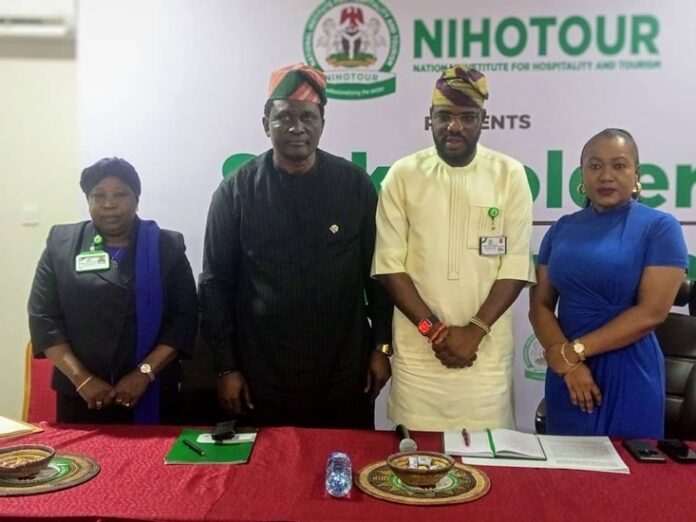
February 21, (THEWILL) – The Federal Government has restated its resolve to enhance Nigeria’s tourism industry through strong partnerships with the private sector and local communities.
Speaking at the National Institute for Hospitality and Tourism (NIHOTOUR) Stakeholders Engagement in Abuja, the Minister of Art, Culture, Tourism, and Creative Economy, Mrs. Hannatu Musawa, emphasised the importance of joint efforts in advancing sustainable tourism.
Represented by the Director of International Tourism, Mrs. Dorothy Duruaku, the Minister described the forum as a crucial avenue for shaping the future of the industry.

Commending NIHOTOUR for organizing the engagement, she stressed the need for stakeholder-driven policies that align with evolving trends.
According to her, tourism and hospitality intersect with multiple sectors such as transportation, cultural heritage, and environmental conservation, making collaboration essential for addressing challenges and unlocking new opportunities.
She highlighted that stakeholder participation is key to fostering responsible tourism, enhancing service quality, and driving innovation.
A structured approach, she noted, ensures alignment between industry operators and regulators in creating policies that support long-term growth.
Addressing the NIHOTOUR Act 2022, the Minister underscored its role in providing a structured legal foundation for industry operations.
The Act empowers NIHOTOUR to set industry standards, develop training programs, and support capacity building to enhance competitiveness in both regional and global markets.
She further noted that the Act strengthens the institute’s ability to attract investment and shape policies that drive sectoral advancement.
Reflecting on the impact of the global pandemic, she called for a renewed focus on recovery and sustainability.
She expressed optimism about the industry’s future, emphasizing that stronger partnerships and collective resilience will position Nigeria as a preferred destination for local and international travelers.
She urged stakeholders to work closely with government and local communities to create an enabling environment for tourism growth. NIHOTOUR, she added, remains pivotal in equipping professionals with the skills and knowledge required to drive innovation and policy development.
The Director General of NIHOTOUR, Dr. Abisoye Fagade, described the engagement as a turning point for the tourism, hospitality, and travel industries.
He stressed the need for renewed commitment from all stakeholders, acknowledging that discussions around tourism had been less encouraging in recent times.
He reaffirmed NIHOTOUR’s dedication to strengthening private-sector partnerships and upholding industry standards.
He also announced plans for further engagements in Lagos to deepen consultations and collaboration with operators.
In his remarks, Mr. Nkereuwem Onung, President of the Federation of Tourism Associations of Nigeria (FTAN),urged industry players to work closely with NIHOTOUR, particularly in addressing concerns surrounding the NIHOTOUR Act.
While acknowledging reservations about its broad scope, which designates NIHOTOUR as both a training institute and a regulatory body, he encouraged stakeholders to view the framework as an opportunity for progress rather than a limitation.
He also noted NIHOTOUR’s willingness to engage in further discussions to refine the Act’s implementation for the collective benefit of the industry.
The engagement ended with a renewed commitment from government representatives, tourism operators, and private-sector stakeholders to foster collaboration and drive sustainable growth in Nigeria’s tourism sector. The gathering marked a significant step toward a more structured and resilient industry.

Janefrances Ebere Chibuzor is a Tourism Writer at THEWILL